
Who owns the Product Vision in your organization, and how clearly is it defined? How does your team align on strategy, and is execution a challenge? Perhaps you’ve solved for all these elements, or maybe the relentless pace of shipping leaves little room for reflection.
In a culture dominated by the relentless mantra of “Ship-It,” there is a seductive appeal in equating velocity with progress. Speed to market can become an obsession, driven by agile rituals and iterative dogma, often causing strategy, and more crucially Vision, to be sidelined. This phenomenon isn’t merely problematic; it’s existential. Without Vision anchoring execution, organizations risk accelerating down paths that lead nowhere meaningful, sacrificing long-term competitive advantage for the transient comfort of motion.
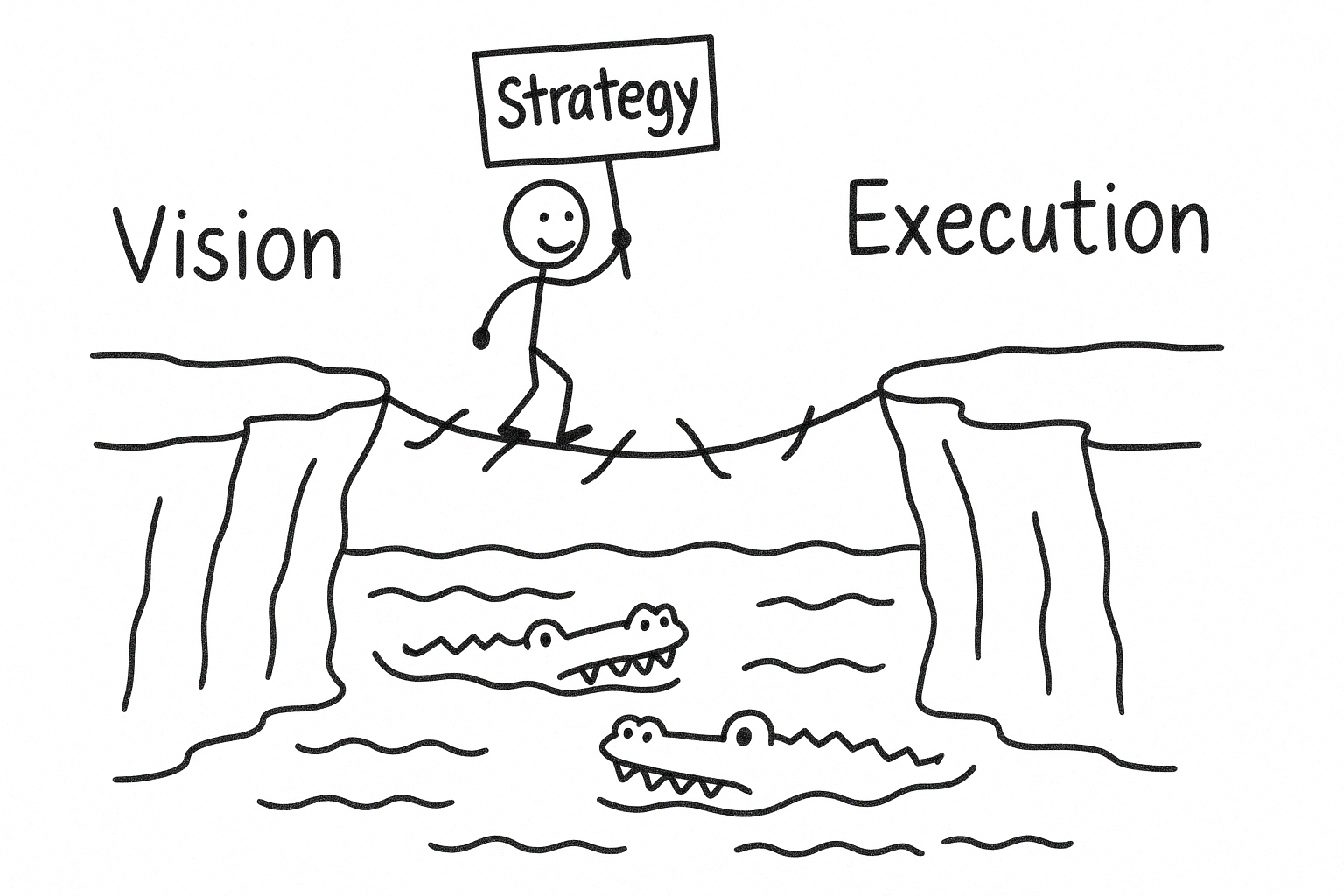
Strategy, far from being the bureaucratic nuisance it is often painted as, serves as the essential bridge between Vision and execution. It acts as the scaffolding that ensures each incremental effort compounds into sustainable differentiation rather than dissipating into disconnected efforts. Yet in the rush to deliver, strategy frequently becomes an inconvenient step, a luxury dismissed by leaders who prioritize pace over purpose. The true role of strategy is not to slow down innovation but to amplify impact by aligning each shipment with the organization’s broader goals.
Vision suffers the greatest neglect in this culture of immediacy. True Vision provides not only a north star but also an enduring framework for strategic coherence. When Vision is overlooked or undervalued, companies inevitably fragment into tactical chaos, mistaking activity for achievement. The paradox is clear: the very speed sought by a “Ship-It” culture is best achieved by clarifying Vision first, strategically aligning efforts second, and then relentlessly shipping toward meaningful outcomes.
No matter where your organization finds itself on the strategy journey, maintaining a balance between thoughtful planning and decisive action is critical. The most successful teams aren’t those who avoid missteps entirely but those who remain committed to progress, excited by the opportunity to continuously learn and refine their approach along the way.
 bencoding