
One of the most frequent yet overlooked mistakes in product management and business strategy is failing to clearly distinguish between “core” and “context.” This is not merely a theoretical issue but a fundamental cause of diluted focus, inefficient resource allocation, and weakened competitive positioning.
Defining Core vs. Context
Let’s start by clearly defining these terms:
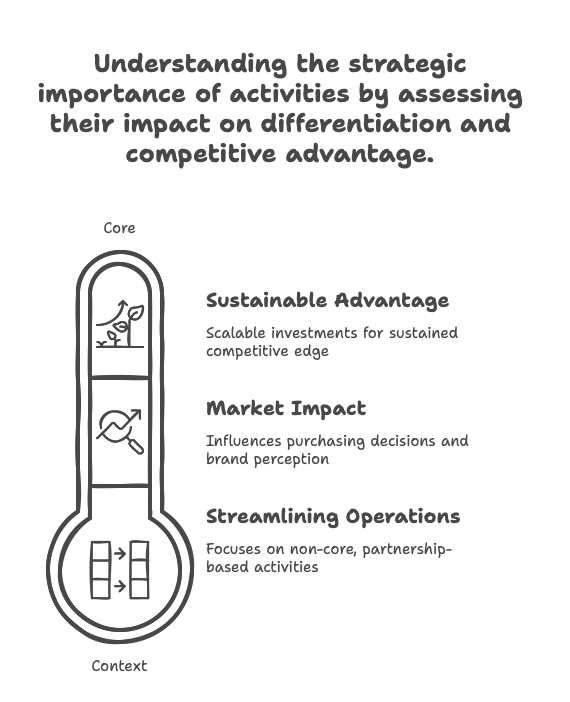
- Core refers to the elements of your products, services, or operations that directly differentiate your company in the marketplace. These are areas where you have, or can build, unique expertise that competitors find difficult to replicate. Essentially, core is the heartbeat of your competitive advantage.
- Context, by contrast, comprises the necessary but non-differentiating activities and technologies that support your business. These activities are essential to operate but offer little strategic advantage because competitors can easily replicate or purchase these capabilities from the open market.
The Risks of Confusing Context for Core
A common pitfall is treating context activities as core activities. Misallocating resources and attention to context often leads to diluted strategic focus, inefficient spending, and reduced capacity for innovation in genuinely differentiating areas. Over time, this misalignment erodes competitive positioning, leading to stagnation or even decline.
Consider a hypothetical example: Company A, a promising SaaS startup, decides to build and maintain its own internal customer support tooling because it perceives support as crucial to user experience. While customer support is undoubtedly important, proprietary tooling does not differentiate Company A from competitors. Instead, the heavy investment into maintaining these internal tools diverts resources away from product innovation, inadvertently giving an edge to competitors focused correctly on their core.
Real-world examples underscore this risk clearly. Netflix recognized early that its “core” was content personalization and delivery technology, not owning servers or data centers, and thus smartly leveraged cloud providers like AWS for infrastructure, a classic “context” component. Conversely, traditional retailers who treated IT infrastructure as core and heavily invested in data centers found themselves struggling against competitors who correctly leveraged cloud platforms.
Actionable Guidelines for Identifying Your Core
Here are practical steps for identifying your organization’s core:
- Strategic Differentiation Test: Regularly ask, “Does this directly differentiate us from competitors in ways customers value and competitors struggle to replicate?”
- Market Impact Analysis: Evaluate if an activity or product capability strongly influences purchasing decisions or brand perception.
- Scalability and Sustainability Check: Determine whether investments in an area sustainably scale your competitive advantage over time.
- Regular Portfolio Reviews: Conduct periodic audits of your product and operational investments to realign resources toward core activities and streamline context ones via partnerships or third-party solutions.
Role of the Business Leaders
Business leaders play a crucial role in clearly defining and consistently communicating strategic priorities. They are responsible for establishing the vision and direction that distinguishes core activities from context. Effective leaders maintain a disciplined approach to resource allocation, focusing resources primarily on strategic differentiators and ensuring context elements are efficiently managed or outsourced.
Role of the Product Team
The Product team, including the Chief Product Officer (CPO), Chief Technology Officer (CTO), and product leaders, operationalize the distinction between core and context. They execute the business vision through technical decisions, product roadmaps, and feature prioritization. The product team ensures day-to-day actions remain aligned with strategic goals, avoiding the temptation to invest disproportionately in non-differentiating context areas.
Contrasting Roles: Business vs. Product Team
While business leaders set the strategic boundaries and priorities, the product team focuses on execution within these boundaries. Business leaders must consistently reinforce the importance of core differentiation at the strategic level, while product teams translate this strategic clarity into practical, focused, and efficient product development efforts.
A Three-Step Framework to Avoid the Core vs. Context Problem
To maintain strategic clarity and competitive advantage, organizations should consistently apply the following three-step framework:
- Identify: Clearly define and communicate what constitutes core and context within your organization.
- Align: Ensure alignment of resources, processes, and investments around core activities, with disciplined outsourcing or efficient management of context activities.
- Review: Regularly revisit and reassess your definitions and strategic alignment to adapt to market changes and maintain competitive advantage.

Ultimately, mastering the core versus context distinction is an ongoing strategic discipline. Organizations that embed this clarity deeply into their culture and decision-making processes will not only enhance their agility and responsiveness but also sustain long-term competitive differentiation. Embracing this framework can empower your teams, clarify strategic direction, and ensure that your organization’s most critical resources, such as time, talent, and capital, are consistently invested where they deliver the greatest impact.
 bencoding