

Artificial Intelligence (AI) agents, are transforming industries and reshaping market dynamics. When evaluating AI’s strategic implications, understanding whether these agents expand or contract your Total Addressable Market (TAM) is crucial.
AI Agents: Catalysts of Market Expansion
AI agents are notably expanding markets by enabling businesses to reach previously underserved customer segments or create entirely new use cases. Consider Shopify’s “Sidekick,” an AI assistant empowering small businesses to launch sophisticated e-commerce stores with minimal expertise. Similarly, GitHub Copilot drastically enhances developer productivity and even empowers non-developers to participate in software creation. Klarna’s AI-driven customer support bot performs the work equivalent to hundreds of support staff, allowing even smaller enterprises to offer around-the-clock customer service.
These examples underline a significant trend: AI agents democratize advanced capabilities, significantly broadening markets by making sophisticated solutions accessible to broader audiences.
Where AI Agents Contract TAM
However, the integration of AI agents also means contraction in specific traditional markets, primarily those heavily reliant on human labor. TurboTax’s AI tools are reducing the need for professional tax preparation services, while Microsoft’s Copilot for Excel threatens niche data analytics tools by embedding powerful AI directly into mainstream products. Likewise, legal firms face revenue contraction from AI-driven contract reviews and document analysis tools automating what previously required extensive manual labor.
Thus, markets reliant on routine human-intensive services face significant disruption and potential TAM contraction unless they strategically adapt.
Products vs. Services: Divergent Impact
AI’s impact diverges between products and services:
- Products: Enhanced by AI integrations, digital products like Microsoft’s Office suite become vastly more appealing and broadly applicable, increasing their market reach. However, niche or standalone products risk commoditization and obsolescence if they don’t integrate competitive AI capabilities.
- Services: AI automation opens scalable delivery opportunities, expanding service reach. Financial advisory bots or healthcare symptom-checkers exemplify how traditionally premium services now scale affordably. Yet, human-intensive services without AI augmentation may find themselves losing customers who switch to lower-cost, AI-driven alternatives.
Industry-Level Implications
Industries experiencing significant TAM expansion include:
- Education: AI tutors (e.g., Khan Academy’s Khanmigo) democratizing personalized learning globally.
- Healthcare: AI symptom-checkers (Babylon Health) extending care access to remote populations.
- Retail & E-Commerce: AI-powered shopping assistants and merchant tools driving customer engagement and business growth.
- Software & Technology: AI expanding software capabilities into roles previously requiring human labor, drastically enlarging software’s market.
Conversely, industries facing contraction pressures include:
- Legal Services: Automation of routine legal work reducing traditional billable services.
- Customer Support BPOs: AI-driven support bots displacing entry-level customer support roles.
- Basic Financial Advisory: Robo-advisors capturing lower-tier investment advisory markets previously served by human advisors.
Overall Industry Outlook: Industries centered on information, analysis, and routine communication are seeing parts of their TAM shrink for traditional players but expand for tech-enabled ones. Meanwhile, industries that can harness AI to reach underserved populations or create new offerings see TAM expansion. Importantly, the total economic opportunity doesn’t vanish – it shifts. As one venture study put it, AI agents let software and automated services compete for a “10-20x larger opportunity” by doing work that used to be outside software’s scope lsvp.com. Companies need to recognize whether AI agents enlarge their particular market or threaten it, and adapt accordingly.
Recommendations
If you are aiming to harness AI agents for market expansion you should:
- Embed AI in Products to Access New Users: Companies should integrate AI agents or assistants directly into their products to enhance functionality and usability. By offering AI-driven features (such as natural language queries, smart recommendations, or autonomous task completion), products become accessible to a wider audience. This can unlock new user segments who lack expertise or resources – for example, a software platform with an AI helper can attract non-specialist users and expand the product’s TAM. Strategic tip: Identify core user pain points and implement an AI agent to solve them (e.g. an AI design assistant in a web builder). This not only differentiates the product but also positions the company to capture customers who were previously underserved. Successful cases like Adobe adding AI generative tools into its suite or CRM systems adding AI sales assistants show that built-in AI features drive adoption and usage lsvp.com.
- Reframe Service Offerings as “Agent-Augmented”: Service organizations (consultancies, agencies, support providers, etc.) should redesign their offerings around AI + human collaboration. Instead of viewing AI as a pure substitute, present it as a value-add that makes services faster, more affordable, and scalable. For instance, a marketing agency might offer an “AI-augmented content creation” service where AI drafts content and humans refine strategy – delivering faster turnaround at lower cost. This reframing helps retain clients who might otherwise try a DIY AI tool, by giving them the best of both worlds. It also attracts new clients who were priced out of the fully human service. The key is to train staff to work alongside AI agents and emphasize the enhanced outcomes (better insights, quicker service) in marketing the service. Organizations that position themselves as AI-empowered advisors or providers can expand their TAM by capturing clients who demand efficiency and still value human judgment.
- Use Tiered Models to Avoid Cannibalization: When introducing AI agents that could undercut your existing offerings, use tiered product/service models to segment the market. Offer a basic, AI-driven tier targeting cost-sensitive or new customers, and a premium tier that includes high-touch human expertise. This prevents the AI solution from simply cannibalizing your top-end revenue – instead, it lets you capture a new low-end market while preserving an upscale segment for those willing to pay more. For example, a software company might offer a free or low-cost AI tool to appeal to a broad audience (expanding TAM), while reserving advanced features and support for a paid enterprise version. In services, a law firm could provide an AI-powered contract review service for simple cases (low fee, high volume) and a specialized attorney review for complex cases (high fee). By tiering, organizations can widen their market reach with AI without eroding the value of premium offerings. Over time, some customers may even upgrade as their needs grow. The goal is a balanced portfolio where the AI-based tier brings in new business and the premium tier continues to generate high-margin revenue – together growing the total addressable market served by the firm.
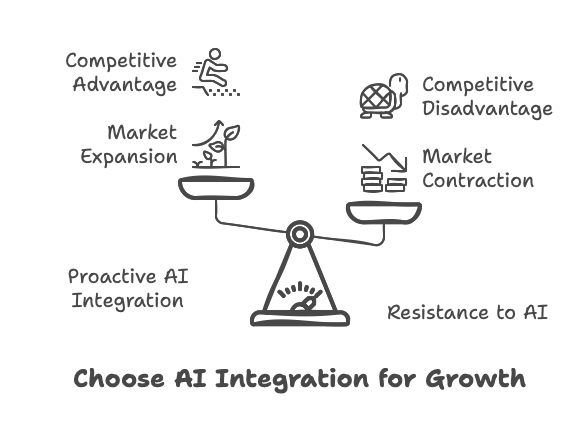
In conclusion, the mandate is clear, embrace AI agents proactively to drive growth, but do so strategically. AI agents are reshaping markets: expanding them in aggregate, but shifting where value flows. Organizations that thoughtfully integrate AI into their products and services, adjust their business models, and target emerging opportunities can ride this wave to capture a larger TAM. Those that resist or neglect the trend risk seeing their addressable market captured by more agile, AI-powered competitors. In summary, AI agents should be viewed as a catalyst for expansion, and with prudent strategy, businesses can ensure that they are on the expanding side of the TAM equation rather than the contracting side, leveraging AI to unlock new horizons of growth.
 bencoding