
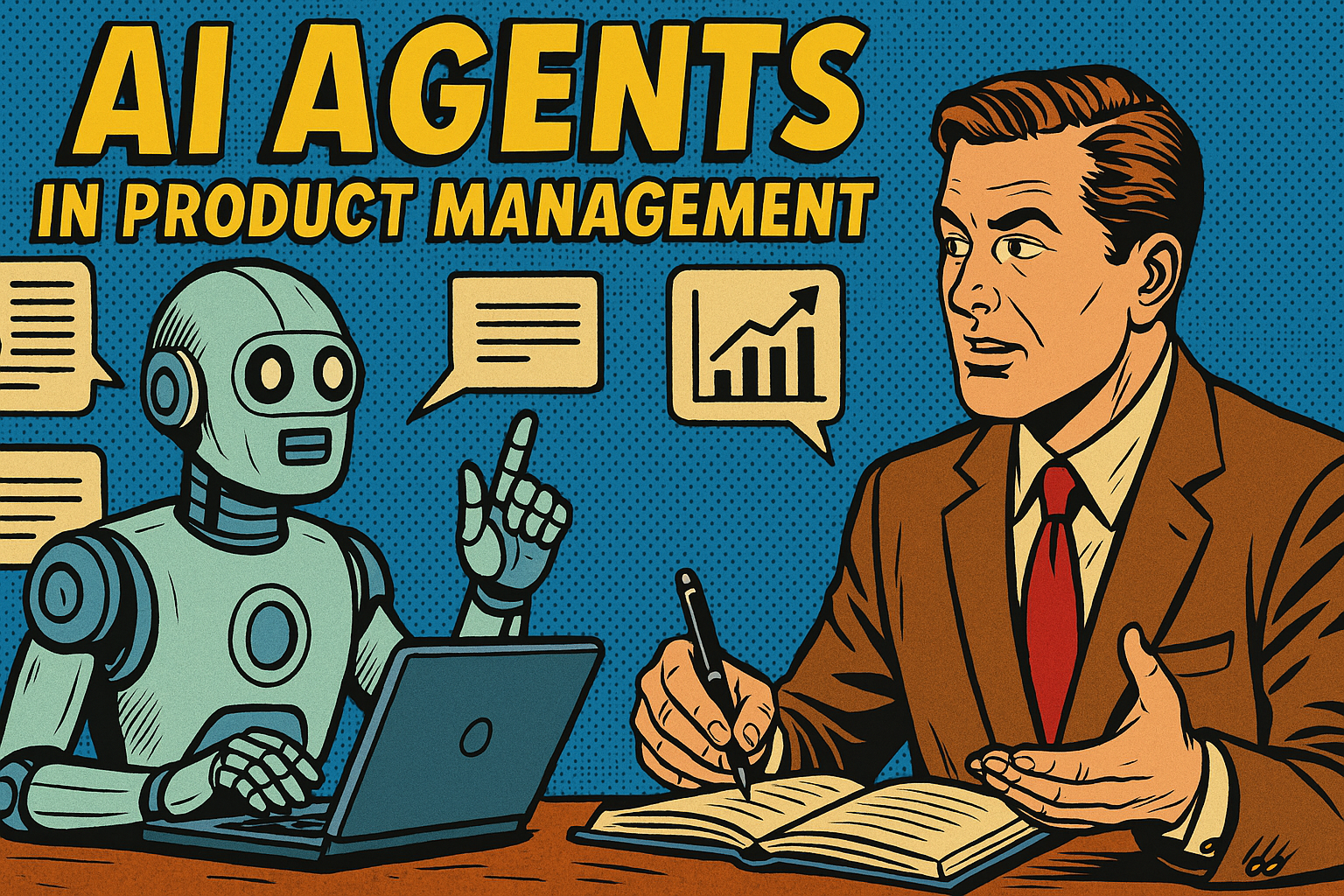
AI is rapidly reshaping every discipline, but its impact on Product Management may be one of the most profound and underestimated shifts happening today. The rise of autonomous AI Agents is not just a tool change. It represents a fundamental evolution in how products are envisioned, built, and scaled.
The Current State: AI Agents as Accelerators
Today, AI Agents are already augmenting Product Managers (PMs) in several key ways:
- Market & User Research: Tools like ChatGPT and Claude can quickly synthesize user feedback, summarize competitive research, and even generate personas from large datasets.
- Roadmapping & Prioritization: AI-driven solutions such as Productboard’s AI Assist analyze customer requests, trend data, and engineering capacity to recommend feature prioritization.
- Experimentation & Analysis: PMs are using AI Agents to automate A/B test design and result interpretation. For example, Amplitude’s AI tools surface actionable insights from product usage data that would take human analysts days to uncover.
- Documentation & Communication: Agents are writing release notes, synthesizing meeting transcripts, and even drafting stakeholder emails. This reduces busywork and gives PMs back valuable time.
Example in Practice:
At Microsoft, PM teams are using Copilot to automate status reporting, aggregate feedback from Azure DevOps, and provide intelligent next-step suggestions all within the workflow. This allows PMs to spend more time with users and less time on repetitive updates.
Historical Parallels: From Waterfall Product Management to Agile, and Now AI
To fully appreciate where we are headed, it is important to look back at how product management has evolved. Traditionally, the product management process mirrored the Waterfall methodology of software development. It was linear, rigid, and heavily reliant on upfront planning and documentation. Product managers would spend months gathering requirements, building detailed roadmaps, and defining release cycles, with limited ability to adapt quickly to market feedback or changing user needs. Progress was measured in milestone documents and phased handoffs, rather than in real-time impact.
The shift to Agile changed everything. Agile methodologies empowered PMs and teams to embrace iteration, rapid prototyping, and close feedback loops. The focus moved from static plans to continuous delivery, learning, and adaptation. This evolution unlocked greater speed, innovation, and customer alignment.
Now, with the arrival of AI Agents, we are on the brink of another revolution. Just as Agile replaced Waterfall, AI is poised to move product management beyond even Agile’s rapid cycles. We are entering an environment where autonomous agents learn, iterate, and act in real time, allowing PMs to focus on the highest-value strategic decisions.
What’s Changing: From Assistant to Autonomous Product Agent
We are at an inflection point where AI Agents will move from being helpers to actual doers. The next wave of agents will be able to:
- Proactively Identify Opportunities: Instead of waiting for PMs to define problems, agents will monitor usage, NPS, and market shifts to surface new product bets.
- Draft and Validate Solutions: Agents will suggest wireframes, create PRDs, and even run early prototype tests with real users using digital twins and simulation.
- Own Tactical Execution: Routine backlog grooming, user story mapping, and sprint planning will become automated. This will allow PMs to focus on vision and business outcomes.
- Close the Loop with Engineering & Design: With multi-agent collaboration (see OpenAI’s GPTs and Google’s Gemini), AI agents will interact directly with design and engineering tools. They will push changes, create tickets, and track dependencies with minimal human intervention.
Emerging Example:
Startups like Adept and LlamaIndex are building agent frameworks that enable AI to take action across tools. This includes pulling analytics, updating Jira, and even creating Figma prototypes autonomously. Motional uses AI product agents to run simulations for autonomous vehicle feature testing, shortening cycles from weeks to hours.
The Next Frontier: AI-Powered Market Research
As product management embraces AI, one of the most promising developments is the use of AI agents for market research and user insights. According to a recent a16z analysis, AI tools are beginning to automate and transform the market research process. This shift enables PMs to understand customer needs at a scale and speed previously impossible.
Traditionally, market research involved time-consuming interviews, surveys, and manual data analysis. AI is now disrupting this model in several key ways:
- Automated, Large-Scale Qualitative Research: AI can conduct thousands of simultaneous interviews, analyze sentiment, and summarize key themes across vast datasets in hours instead of weeks.
- Deeper, Real-Time Consumer Insights: AI agents can tap into social media, review sites, and support channels, continuously surfacing new patterns and unmet needs as they emerge. This means PMs get early signals and can iterate faster.
- Rapid Prototyping and Testing: The blog highlights how product teams can use generative AI to test product concepts, messaging, or UI designs with virtual users or real consumers at scale, getting statistically significant feedback almost instantly.
AI-powered market research, as highlighted by a16z, gives product managers faster, deeper insights for feature prioritization, user segmentation, and go-to-market decisions. PMs who leverage AI for continuous, automated market understanding will build more relevant products and outperform those using traditional methods.
The Future: Product Management as Orchestration
By 2030, product management will look very different:
- The PM as an Orchestrator: The PM’s role will evolve into orchestrating swarms of specialized AI agents. Each will focus on a specific domain, such as research, delivery, or customer insights.
- Faster, Smarter, More Iterative: Prototyping cycles will shrink from months to days. Products will launch with AI-managed experiments running in the wild, learning and adapting at a scale no human team could match.
- New Skills Required: Success will depend on mastering AI orchestration, agent prompt engineering, and understanding the ethical and strategic implications of AI-driven product cycles.
- Radical Collaboration: With autonomous agents handling the “what” and “how,” PMs will double down on the “why.” Their focus will shift to customer empathy, market positioning, and strategic bets.
Quote from Marty Cagan, SVPG:
“The next era of product creation will be led by those who can harness AI to not just accelerate, but fundamentally reimagine the product development process.”
(SVPG: The Era of the Product Creator)
References & Further Reading
- The Era of the Product Creator, SVPG
- OpenAI: The Age of AI Agents
- Adept AI: Agent Action Framework
- Productboard: AI Assist
- Amplitude: Introducing Amplitude AI
- Microsoft Copilot for Product Teams
- LlamaIndex: Agents for Knowledge Work
- Google Gemini: The Next Generation of AI
Final Thoughts
AI agents are here, and they are quickly moving from simply augmenting product management to fundamentally transforming it. The best PMs will embrace this shift, not as a threat, but as a once in a generation opportunity to build better products, faster, and with more impact than ever before.
How are you preparing for the era of AI-augmented product management?
 bencoding