
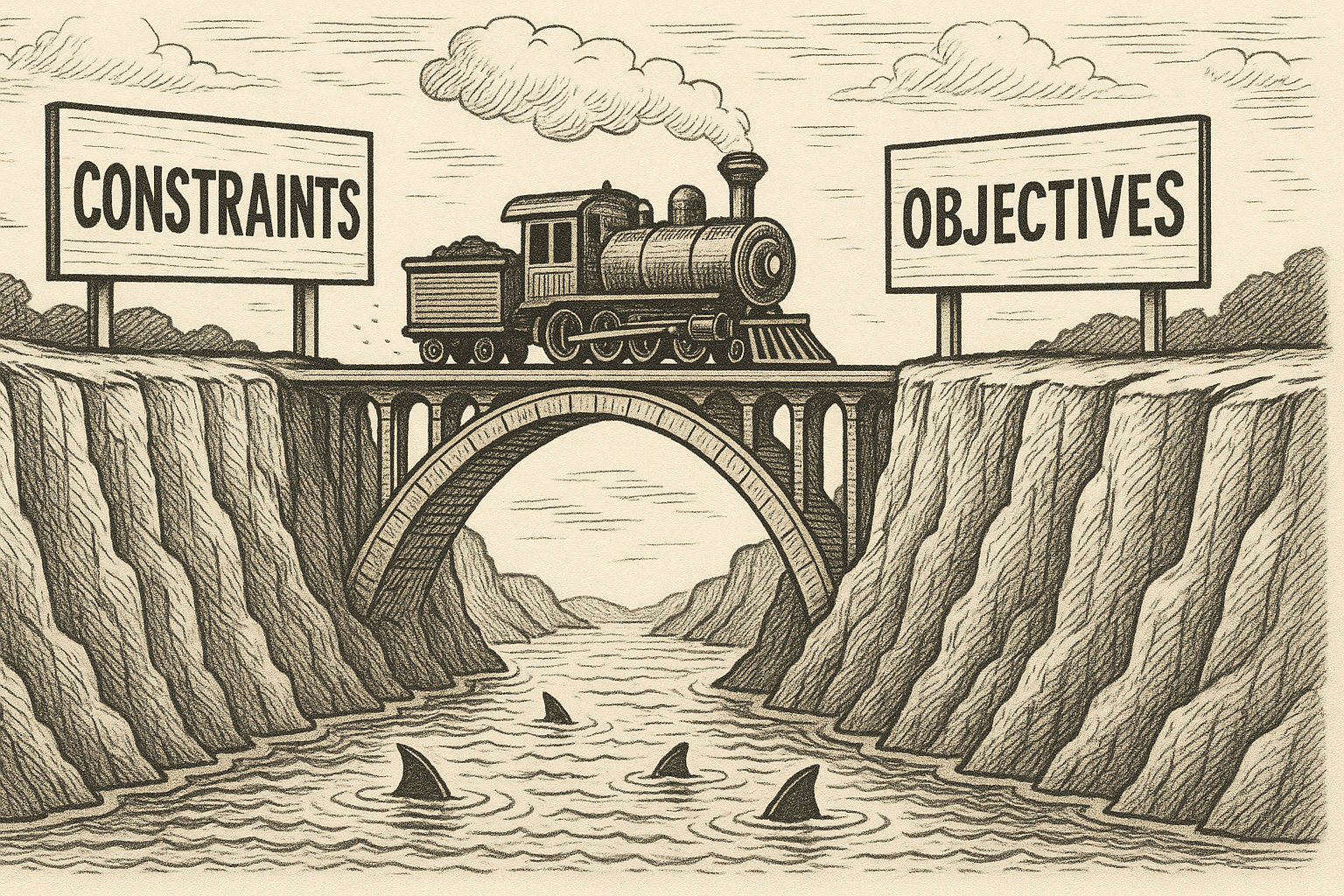
Launching a new product means navigating tension: bold objectives on one side, and real-world constraints on the other. You want to move fast, deliver value, and stand out in the market, but you’re held back by resource limits, compliance requirements, and fixed deadlines. The difference between vision and execution? It’s often how well you use data to connect the two.
Why Data is the Bridge
Data enables product leaders to:
- Quantify what’s possible within given limits
- Align stakeholders on the tradeoffs that matter
- Validate market assumptions before committing to scale
- Convert ambiguity into informed action
Used well, data doesn’t just guide, you de-risk your decisions with it.
1. Use Data to Define the Real Constraints
Most teams understand their high-level constraints: budget, time, people. But data can help you go deeper and quantify the impact of those constraints.
- Burn rate models estimate how far your current budget takes you.
- Headcount capacity planning identifies delivery bottlenecks.
- Compliance risk scoring can uncover which features require the most red tape.
Then, tie constraints to revenue impact:
- Revenue impact modeling shows what features or launches are delayed and how that delay affects potential earnings.
- For example, if a delayed feature defers onboarding 1,000 users per month at a $50 average revenue/user, you can quantify that tradeoff: $50,000/month in deferred revenue.
Action tip: Frame constraint discussions around their revenue implications to drive smarter tradeoffs.
2. Translate Objectives into Measurable Signals
Ambitious goals like “win the mid-market” or “increase retention” need clear, data-backed definitions:
- Use market sizing data to break down total addressable market (TAM), serviceable obtainable market (SOM), and key buyer personas.
- Map strategic goals (e.g., “expand to EMEA”) to product KPIs (e.g., time-to-localization, conversion rates by region).
- Use customer segmentation data to align objectives with where the most revenue or growth potential exists.
Action tip: Create a “data-to-objective map” that connects strategic goals to specific, quantifiable signals in your product analytics.
3. Use Data to Understand Market Fit Early
Product success hinges on whether it meets a real market need, and whether that market is worth entering.
- Search trends, competitor pricing, and customer spend data can help validate demand before investing.
- Use tools like Google Trends, LinkedIn job postings, or firmographic data to identify which markets are growing or underserved.
- Analyze customer willingness-to-pay surveys and early funnel data (e.g., demo conversion rates) to refine positioning.
Action tip: Layer third-party data with internal early signals to triangulate real market opportunity before full launch.
4. Apply Data to Prioritize Tradeoffs Transparently
Every product decision requires a tradeoff. But data helps you make those tradeoffs visible, quantifiable, and less political.
- Run feature impact simulations to model revenue uplift vs development time.
- Use churn data to highlight which constraints (e.g., lack of functionality, latency, onboarding friction) are losing you customers.
- Score roadmap options by business value per unit of effort to prioritize efficiently.
Action tip: Build a tradeoff matrix that pairs data with decision velocity, so leadership can move with confidence, not caution.
5. Align Stakeholders with Shared Data Visibility
Cross-functional stakeholders often have competing priorities. Data helps unify focus around outcomes, not opinions.
- Build shared dashboards that track both constraint metrics (e.g., spend, velocity) and objective metrics (e.g., adoption, revenue).
- Use visual storytelling to show the downstream effects of decisions, such as how one-month delays reduce first-year revenue projections by X%.
Action tip: Establish a shared “north star” metric that links product, revenue, and operational perspectives.
6. Use Feedback Loops to Navigate Uncertainty
Post-launch, data is your compass. Assumptions will shift, and your ability to adapt fast will determine your success.
- Monitor early adoption and feature usage data to refine roadmap priorities.
- Use voice of customer data to catch friction points before churn accelerates.
- Track changes in market or competitor data to stay ahead of disruption.
Action tip: Treat every launch like an ongoing experiment, use data to validate, not just to report.
Thoughts
Taking a product to market is a balancing act. The most successful leaders aren’t just bold, they’re informed. They use data to quantify the real constraints, validate the market opportunity, and continuously weigh tradeoffs against business value.
If you want to move faster, align better, and launch smarter, ask yourself: Where can data help me bridge the gap between what I want to do and what I actually can do?
#ProductStrategy #CTO #CPO #CIO
 bencoding