
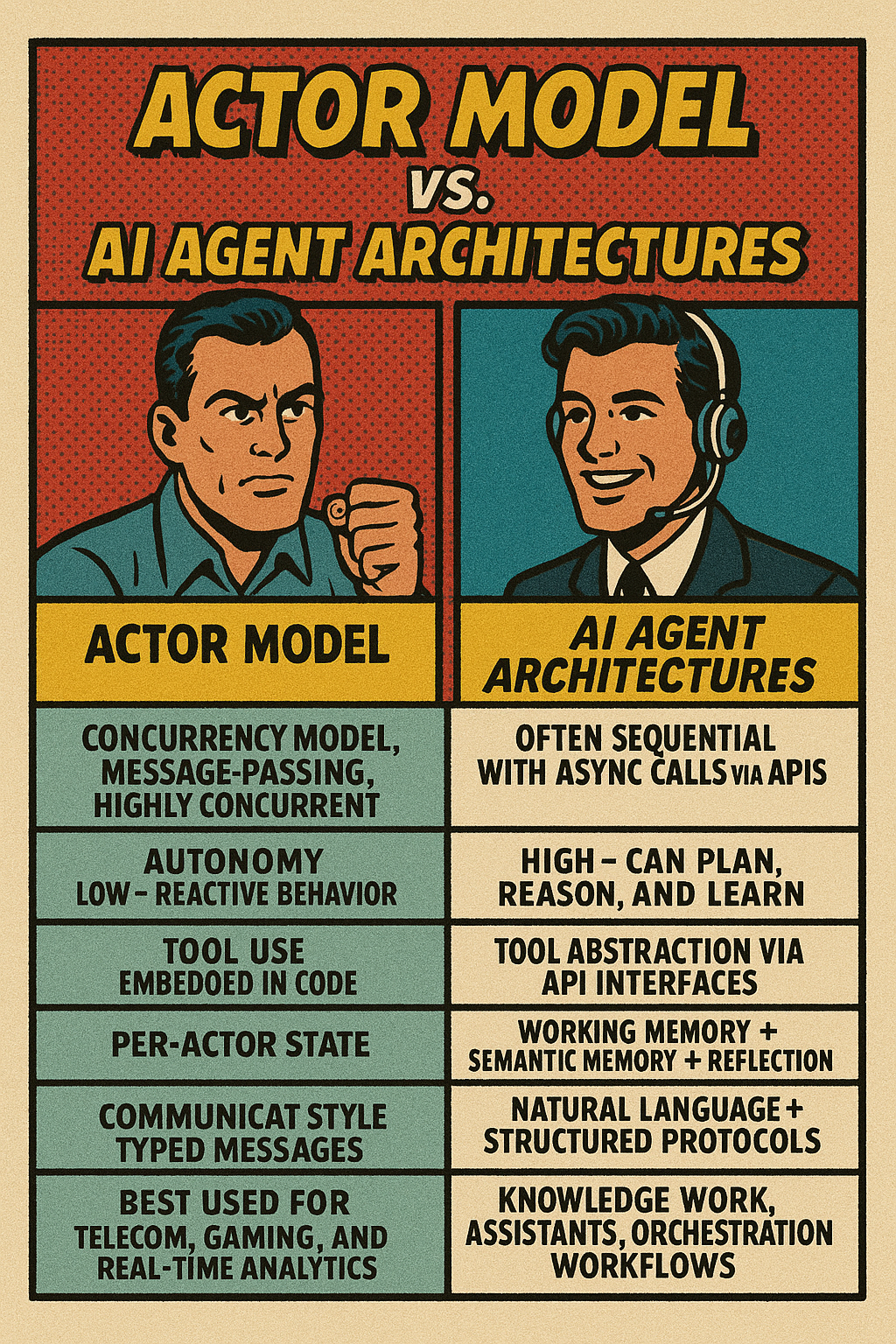
As intelligent systems move from experimentation to production, architects are searching for the right architectural patterns to support this transition. Lately, I’ve noticed that this includes not only adopting cutting-edge AI agent frameworks but also a return to more traditional patterns-such as the Actor Model-that offer proven scalability and concurrency benefits.
While both share a foundation in distributed message-passing and encapsulated state, their design goals and implementation models diverge significantly. This post compares the Actor Model, which underpins many scalable infrastructure systems, to the architectural patterns used by AI agents, such as those powered by LLMs and tool-chaining ecosystems.
🔹 The Actor Model: Decentralized Concurrency
Definition: The Actor Model defines a computational pattern where independent actors communicate through asynchronous messages. Each actor maintains private state and processes one message at a time.
Popular Frameworks:
- Akka (JVM) – A powerful toolkit for building distributed, reactive systems.
👉 https://akka.io/ - Erlang/OTP – The foundation of systems like WhatsApp and telecom infrastructure.
👉 https://www.erlang.org/ - Microsoft Orleans (.NET) – A virtual actor model optimized for cloud-native applications.
👉 https://learn.microsoft.com/en-us/dotnet/orleans/
Real-World Examples:
- WhatsApp uses Erlang actors for millions of concurrent connections.
- Microsoft Halo game backend uses Orleans to model players and game state.
- Lightbend’s Lagom uses Akka for reactive microservices at scale.
Strengths:
- Natural fit for concurrency and distributed fault tolerance.
- High throughput, low-latency communication.
- Mature ecosystem for supervision trees, crash recovery, and isolation.
- Scales well under heavy, real-time transactional loads (e.g., telecom switches, messaging apps).
Weaknesses:
- Not inherently intelligent-actors follow fixed, pre-programmed rules.
- Coordination between actors can require complex message protocols and state synchronization.
- Difficult to express long-term goals, adaptability, or learning behavior.
- Limited utility in open-ended or creative problem-solving domains.
🔹 AI Agent Architectures: Reasoning and Autonomy
Definition: AI agents are autonomous software entities capable of making decisions, executing tasks, and adapting over time. They combine planning, memory, and tool usage-often orchestrated by large language models (LLMs).
Popular Frameworks:
- LangChain – Modular framework for chaining LLM calls and tools.
👉 https://www.langchain.com/ - AutoGen (Microsoft) – Multi-agent framework for collaborative AI agents.
👉 https://github.com/microsoft/autogen - CrewAI – Task-routing and role-based execution across agents.
👉 https://www.crewai.io/ - AgentOps – Tooling for deploying and monitoring agents in production.
👉 https://www.agentops.ai/ - LlamaIndex – Framework for contextual memory and data routing in agent workflows.
👉 https://www.llamaindex.ai/
Real-World Examples:
- Devin (by Cognition Labs) – A fully autonomous software engineer.
👉 https://www.cognition-labs.com/ - GPT Agents for Zapier / Slack / Notion – Agents that take actions using APIs.
- AutoGPT / BabyAGI – Research projects showcasing autonomous task completion.
Strengths:
- Designed for autonomy: can pursue goals independently, react to feedback, and chain actions.
- Capable of dynamic tool use via APIs and external plugins (e.g., calculators, web searches, file readers).
- Memory-enabled behavior through context caching, embeddings, and persistent data stores.
- Supports planning, task decomposition, and iterative improvement loops.
- Natural language interfaces make them flexible for end-user interaction.
Weaknesses:
- Higher latency and compute cost due to LLM inference and reasoning overhead.
- Non-deterministic behavior makes testing, validation, and monitoring difficult.
- Risk of hallucination or unpredictable outputs if improperly scoped or prompted.
- Ongoing challenges around observability, failover, and resource governance.
- Most frameworks are still evolving, with production-readiness varying by stack.
🔸 Comparison Table
| Feature | Actor Model | AI Agent Architectures |
|---|---|---|
| Concurrency Model | Message-passing, highly concurrent | Often sequential with async calls via APIs |
| Autonomy | Low – reactive behavior | High – can plan, reason, and learn |
| Tool Use | Embedded in code | Tool abstraction via API interfaces |
| Memory | Per-actor state | Working memory + semantic memory + reflection |
| Communication Style | Typed messages | Natural language + structured protocols |
| Typical Language | Scala, Erlang, .NET | Python, TypeScript, JSON-based protocols |
| Best Use Cases | Telecom, real-time systems, IoT | Knowledge work, assistants, orchestration workflows |
| Example Frameworks | Akka, Erlang/OTP, Orleans | LangChain, CrewAI, AutoGen, AgentOps, LlamaIndex |
🧭 When to Use Which?
| Use Case | Preferred Model | Rationale |
|---|---|---|
| Real-time messaging with high concurrency | Actor Model | Low-latency, resilient patterns |
| Autonomous assistants or copilots | AI Agent Architecture | Goal-driven, natural interaction |
| Fault-tolerant microservices architecture | Actor Model | Supervision trees + state isolation |
| Knowledge-based orchestration (e.g., RAG) | AI Agent Architecture | Planning, memory, and tool use |
| Game state modeling with concurrency | Actor Model (Orleans) | Virtual actors for high-scale objects |
| Multimodal LLM-powered system agents | AI Agent (e.g., AutoGen) | Collaboration between agents using LLMs |
🔄 Emerging Convergence
Hybrid architectures are starting to appear where AI agents handle reasoning and planning, while actor-based systems execute high-performance backend tasks.
For instance:
- An agent might decide which documents to extract data from, but delegate file ingestion and validation to an actor-based micro-service.
- Orchestrators like CrewAI route tasks across AI agents that call backend services built with Akka or gRPC.
Conclusion
The Actor Model and AI Agent patterns aren’t rivals-they’re tools optimized for different layers of complexity. If you need deterministic concurrency at scale, lean on the Actor Model. If you need autonomy, reasoning, and adaptable behavior, AI agents are your best bet.
Understanding their differences-and where they might complement each other-will help you build scalable, intelligent systems with the right mix of predictability and flexibility.
 bencoding