Drucker and the AI Disruption: Why Landmarks of Tomorrow Still Predicts Today

When Peter Drucker published The Landmarks of Tomorrow in 1959, he was writing about the future, but not this future. He saw the rise of knowledge work, the end of mechanical thinking, and the dawn of a new age organized around patterns, processes, and purpose. What he didn’t foresee was artificial intelligence, a force capable of accelerating his “landmarks” faster than even he could have imagined.

Today, AI isn’t simply automating tasks or assisting humans. It is disrupting the foundations of how enterprises are built, governed, and led. Drucker’s framework, written for the post-industrial age, has suddenly become the survival manual for the AI-powered one.

From Mechanistic Control to Pattern Intelligence

Drucker warned that the industrial worldview, which was linear, predictable, and mechanistic, was ending. In its place would rise a world defined by feedback loops, patterns, and living systems.

That is precisely the shift AI has unleashed.

Enterprise leaders still talk about “projects,” “pipelines,” and “processes,” but AI doesn’t play by those rules. It learns, adapts, and rewires itself continuously. The organizations that treat AI as a static tool will be replaced by those that treat it as an intelligent process, one that learns as it runs.

Companies used to manage through reporting lines. Now they must manage through data flows. AI has become the nervous system, the pattern recognizer, the process optimizer, and the hidden hand that connects the enterprise’s conscious mind (its strategy) with its reflexes (its operations).

If Drucker described management as the art of “doing things right,” AI has made that art probabilistic. The managers who ignore this are already obsolete.

The Knowledge Worker Meets the Algorithm

Drucker’s greatest prediction, the rise of the “knowledge worker,” is being rewritten in real time. For 70 years, the knowledge worker has been the enterprise’s most precious asset. But now, the knowledge itself has become the product, processed, synthesized, and recombined by large language models.

We are entering what might be called the algorithmic knowledge economy. AI doesn’t just help the lawyer draft faster or the developer code better. It competes with their very value proposition.

Yet, rather than eliminating knowledge work, AI is forcing it to evolve. Drucker said productivity in knowledge work was the greatest management challenge of the 21st century. He was right, but AI is solving that challenge by redefining the role itself.

The best knowledge workers of tomorrow will not just do the work. They will design, supervise, and refine the AI that does it. The new productivity frontier isn’t about faster execution. It is about orchestrating intelligence, both human and machine, into systems that learn faster than competitors can.

AI as a Management Disruptor

If Drucker saw management as a discipline of purpose, structure, and responsibility, AI is now testing every one of those principles.

  • Purpose: AI can optimize toward any goal, but which one? Efficiency, profitability, fairness, sustainability? The model will not decide that for you. Leadership will.
  • Structure: Hierarchies are collapsing under the speed of decision loops that AI can execute autonomously. The most adaptive enterprises are building networked systems that behave more like ecosystems than bureaucracies.
  • Responsibility: Drucker believed ethics and purpose were the essence of management. In AI, that moral compass can no longer be implied. It must be engineered into the system itself.

In other words, AI does not just change how we manage. It challenges what management even means.

From Centralized Control to Federated Intelligence

Drucker predicted that traditional bureaucracies would give way to decentralized, knowledge-based organizations. That is exactly what is happening, except now it is not just humans at the edge of the organization, but algorithms.

AI is enabling every business unit, every function, every product team to have its own localized intelligence. The new question isn’t “how do we scale AI?” It is “how do we coordinate dozens of semi-autonomous AI systems working in parallel?”

Enterprise leaders who cling to centralization will find themselves trapped in a paradox. They want control, but AI thrives on freedom. Drucker would call this the new frontier of management: creating governance that empowers autonomy without sacrificing accountability.

This is why the AI-first enterprise of the future will look less like a corporation and more like a distributed cognitive organism, one where humans and machines make up a shared nervous system of learning, adaptation, and decision-making.

Values as the Ultimate Competitive Edge

Drucker wrote that the “next society” would have to rediscover meaning, that economic progress without moral purpose would collapse under its own weight.

AI is testing that thesis daily.

Enterprises racing to deploy AI without a value compass are discovering that technological advantage is fleeting. The companies that will endure are those that turn ethics into an operating principle, not a compliance checklist.

Trust is now a competitive differentiator. The winners will not just have the best models. They will have the most trustworthy ones, and the culture to use them wisely.

AI does not absolve leaders of responsibility. It multiplies it.

AI Is Drucker’s “Next Society” Arriving Early

If Drucker were alive today, he would say the AI revolution is not a technological shift, but a civilizational one. His “Next Society” has arrived early, and it is powered by algorithms that behave more like collaborators than tools.

The irony is that Drucker’s warnings were not about machines. They were about people: how we adapt, organize, and lead when the rules change. AI is simply the latest, most unforgiving test of that adaptability.

The enterprises that survive will not be those with the most advanced AI infrastructure. They will be those that rethink their management philosophy, shifting from command and control to purpose and orchestration, from metrics to meaning.

Wrapping Up

AI is Drucker’s world accelerated, a management revolution disguised as a technology trend.
Those who still see AI as just another tool are missing the point.

AI is the most profound management disruptor of our generation, and Landmarks of Tomorrow remains the best playbook we never realized we already had.

The question isn’t whether AI will reshape the enterprise. It already has.
The real question is whether leaders will evolve fast enough to manage the world Drucker saw coming, and which AI has now made real.

The Future of AI UX: Why Chat Isn’t Enough

For the last two years, AI design has been dominated by chat. Chatbots, copilots, and assistants are all different names for the same experience. We type, it responds. It feels futuristic because it talks back.

But here’s the truth: chat is not the future of AI.

It’s the training wheels phase of intelligent interaction, a bridge from how we once used computers to how we soon will. The real future is intent-based AI, where systems understand what we need before we even ask. That’s the leap that will separate enterprises merely using AI from those transformed by it.

Chat-Based UX: The Beginning, Not the Destination

Chat has been a brilliant entry point. It’s intuitive, universal, and democratizing. Employees can simply ask questions in plain language:

“Summarize this week’s client updates.”
“Generate a response to this RFP.”
“Explain this error in our data pipeline.”

And the AI responds. It’s accessible. It’s flexible. It’s even fun.

But it’s also inherently reactive. The user still carries the cognitive load. You have to know what to ask. You have to remember context. You have to steer the conversation toward the output you want. That works for casual exploration, but in enterprise environments, it’s a tax on productivity.

The irony is that while chat interfaces promise simplicity, they actually add a new layer of friction. They make you the project manager of your own AI interactions.

In short, chat is useful for discovery, but it’s inefficient for doing.

The Rise of Intent-Based AI

Intent-based UX flips the equation. Instead of waiting for a prompt, the system understands context, interprets intent, and takes initiative.

It doesn’t ask, “What do you want to do today?”
It knows, “You’re preparing for a client meeting, here’s what you’ll need.”

This shift moves AI from a tool you operate to an environment you inhabit.

Example: The Executive Assistant Reimagined

An executive with a chat assistant types:

“Create a summary of all open client escalations for tomorrow’s board meeting.”

An executive with an intent-based assistant never types anything. The AI:

  • Detects the upcoming board meeting from the calendar.
  • Gathers all open client escalations.
  • Drafts a slide deck and an email summary before the meeting.

The intent, prepare for the meeting, was never stated. It was inferred.

That’s the difference between a helpful assistant and an indispensable one.


Intent-Based Systems Drive Enterprise Productivity

This isn’t science fiction. The foundational pieces already exist: workflow signals, event streams, embeddings, and user behavior data. The only thing missing is design courage, the willingness to move beyond chat and rethink what a “user interface” even means in an AI-first enterprise.

Here’s what that shift enables:

  • Proactive workflows: A project manager receives an updated burn chart and recommended staffing adjustments when velocity drops, without asking for a report.
  • Contextual automation: A tax consultant reviewing a client case automatically sees pending compliance items, with drafts already prepared for submission.
  • Personalized foresight: A sales leader opening Salesforce doesn’t see dashboards; they see the top three accounts most likely to churn, with a prewritten email for each.

When designed around intent, AI stops being a destination. It becomes the invisible infrastructure of productivity.

Why Chat Will Eventually Fade

There’s a pattern in every major computing evolution. Command lines gave us precision but required expertise. GUIs gave us accessibility but required navigation. Chat gives us flexibility but still requires articulation.

Intent removes the requirement altogether.

Once systems understand context deeply enough, conversation becomes optional. You won’t chat with your CRM, ERP, or HR system. You’ll simply act, and it will act with you.

Enterprises that cling to chat interfaces as the primary AI channel will find themselves trapped in “talking productivity.” The real leap will belong to those who embrace systems that understand and anticipate.

What Intent-Based UX Unlocks

Imagine a workplace where:

  • Your data tools automatically build dashboards based on the story your CFO needs to tell this quarter.
  • Your engineering platform detects dependencies across services and generates a release readiness summary every Friday.
  • Your mobility platform (think global compliance, payroll, or travel) proactively drafts reminders, filings, and client updates before deadlines hit.

This isn’t about convenience. It’s about leverage.
Chat helps employees find information. Intent helps them create outcomes.

The Takeaway

The next phase of enterprise AI design is not conversational. It’s contextual.

Chatbots were the classroom where we learned to speak to machines. Intent-based AI is where machines finally learn to speak our language — the language of goals, outcomes, and priorities.

The companies that build for intent will define the productivity curve for the next decade. They won’t ask their employees to chat with AI. They’ll empower them to work alongside AI — fluidly, naturally, and with purpose.

Because the future of AI UX isn’t about talking to your tools.
It’s about your tools understanding what you’re here to achieve.

How AI Is Opening New Markets for Professional Services

The professional services industry, including consulting, legal, accounting, audit, tax, advisory, engineering, and related knowledge-intensive sectors, stands on the cusp of transformation. Historically, many firms have viewed AI primarily as a tool to boost efficiency or reduce cost. But increasingly, forward-thinking firms are discovering that AI enables them to expand into new offerings, customer segments, and business models.

Below I survey trends, opportunities, challenges, and strategic considerations for professional services firms that aim to go beyond optimization and into market creation.

Key Trends Shaping the Opportunity Landscape

Before diving into opportunities, it helps to frame the underlying dynamics.

Rapid Growth in AI-Driven Markets

  • The global Artificial Intelligence as a Service (AIaaS) market is projected to grow strongly, from about USD 16.08 billion in 2024 to USD 105 billion by 2030 (CAGR ~36.1%) (grandviewresearch.com)
  • Some forecasts push even more aggressively. Markets & Markets estimates AIaaS will grow from about USD 20.26 billion in 2025 to about USD 91.2 billion by 2030 (CAGR ~35.1%) (marketsandmarkets.com)
  • The AI consulting services market is also booming. One forecast places the global market at USD 16.4 billion in 2024, expanding to USD 257.6 billion by 2033 (CAGR ~35.8%) (marketdataforecast.com)
  • Another projection suggests the AI consulting market could reach USD 58.19 billion by 2034, from about USD 8.75 billion in 2024 (zionmarketresearch.com)
  • Meanwhile, the professional services sector itself is expected to grow by USD 2.07 trillion between 2024 and 2028 (CAGR ~5.7%), with digital and AI-led transformation as a core driver (prnewswire.com)

These macro trends suggest that both supply (consulting and integration) and demand (client AI adoption) are expanding in parallel, creating a rising tide on which professional services can paddle into new spaces.

From Efficiency to Innovation and Revenue Growth

In many firms, early AI adoption has followed a standard path: use tools to automate document drafting, data extraction, analytics, or search. But new reports and surveys suggest that adoption is maturing into more strategic use.

  • The Udacity “AI at Work” research finds a striking “trust gap.” While about 90% of workers use AI in some form, fewer trust its outputs fully. (udacity.com) That suggests substantial room for firms to intervene through governance, assurance, audits, training, and oversight services.
  • The Thomson Reuters 2025 Generative AI in Professional Services report notes that many firms are using GenAI, but far fewer are tracking ROI or embedding it in strategy (thomsonreuters.com)
  • An article from OC&C Strategy observes that an over-focus on “perfect bespoke solutions” can stall value capture; instead, a pragmatic “good-but-not-perfect” deployment mindset allows earlier revenue and learning (occstrategy.com)
  • According to RSM, professional services firms are rethinking workforce models as AI automates traditionally junior tasks, pressing senior staff into more strategic work (rsmus.com)

These signals show that we are approaching a second wave of AI in professional services, where firms seek to monetize AI not just as a cost lever but as a growth engine.

Four Categories of Market-Building Opportunity

Here are ways professional services firms can go beyond automation to build new markets.

Opportunity TypeDescriptionExamples / Use Cases
1. AI-Powered Advisory and “AI-as-a-Service” OfferingsFirms package domain expertise and AI models into products or subscription servicesA legal firm builds a contract-analysis engine and offers subscription access; accounting firms provide continuous anomaly detection on client ERP data
2. Assurance, Audit, and AI Governance ServicesAs AI becomes embedded in client systems, demand for auditing, validation, model governance, compliance, and trust frameworks will growAuditing AI outputs in regulated sectors, reviewing model fairness, or certifying an AI deployment
3. Vertical or Niche Micro-Vertical AI SolutionsRather than broad horizontal tools, build AI models specialized for particular industries or subdomainsA consulting firm builds an AI tool for energy forecasting in renewable businesses, or an AI model for real estate appraisal
4. Platform, API, or Marketplace EnablementFirms act as intermediaries or enablers, connecting client data to AI tools or building marketplaces of agentic AI servicesA tax firm builds a plugin marketplace for tax-relevant AI agents; a legal tech incubator curates AI modules

Let’s look at each in more depth.

1. AI-Powered Advisory or Embedded AI Products

One of the most direct routes is embedding AI into the service deliverable, turning part of the deliverable from human labor to intelligent automation, and then charging for it. Some possible models:

  • Subscription or SaaS model: tax, audit, or legal firms package their AI engine behind a SaaS interface and charge clients on a recurring basis.
  • Outcome-based models: pricing tied to detected savings or improved accuracy from AI insights.
  • Embedded models: AI acts as a “co-pilot” or second reviewer, but service teams retain oversight.

By moving in this direction, professional services firms evolve into AI product companies with recurring revenues instead of purely project-based revenue.

A notable example is the accounting roll-up Crete Professionals Alliance, which announced plans to invest $500M to acquire smaller firms and embed OpenAI-powered tools for tasks such as audit memo writing and data mapping. (reuters.com) This shows how firms see value in integrating AI into service platforms.

2. Assurance, Audit, and AI Governance Services

As clients deploy more AI, they will demand greater trust, transparency, and compliance, especially in regulated sectors such as finance, healthcare, and government. Professional services firms are well positioned to provide:

  • AI audits and validation: ensuring models work as intended, detecting bias, assessing robustness under adversarial conditions.
  • Governance and ethics frameworks: helping clients define guardrails, checklists, model review boards, or monitoring regimes.
  • Regulation compliance and certification: as governments begin regulating high-risk AI, firms can audit or certify client systems.
  • Trust as a service: maintaining ongoing oversight, monitors, and health-checks of deployed AI.

Because many organizations lack internal AI expertise or governance functions, this becomes a natural extension of traditional audit, risk, or compliance practices.

3. Vertical or Niche AI Solutions

A generic AI tool is valuable, but its economics often require scale. Professional services firms can differentiate by combining domain depth, industry data, and AI. Some advantages:

  • Better accuracy and relevance: domain knowledge helps build more precise models.
  • Reduced client friction: clients are comfortable trusting domain specialists.
  • Fewer competitors: domain-focused models are harder to replicate.

Examples:

  • A consulting firm builds an AI model for commodity price forecasting in mining clients.
  • A legal practice builds a specialized AI tool for pharmaceutical patent litigation.
  • An audit firm builds fraud detection models tuned to logistics or supply chain clients.

The combination of domain consulting and AI product is a powerful differentiator.

4. Platform, Agentic, or Marketplace Models

Instead of delivering all AI themselves, firms can act as platforms or intermediaries:

  • Agent marketplace: firms curate AI “agents” or microservices that clients can pick, configure, and combine.
  • Data and AI orchestration layers: firms build middleware or connectors that integrate client systems with AI tools.
  • Ecosystem partnerships: incubate AI startups or partner with AI vendors, taking a share of commercialization revenue.

In this model, the professional services firm becomes the AI integrator or aggregator, operating a marketplace that others plug into. Over time, this can generate network effects and recurring margins.

What Existing Evidence and Practitioner Moves Show

To validate that these ideas are more than theoretical, here are illustrative data points and real-world moves.

  • Over 70% of large professional services firms plan to integrate AI in workflows by 2025 (Thomson Reuters).
  • In a survey by Harvest, smaller firms report agility in adopting AI and experimentation, possibly making them early movers in new value models. (getharvest.com)
  • Law firms such as Simmons & Simmons and Baker McKenzie are converting into hybrid legal-tech consultancies, offering AI-driven legal services and consultative tech advice. (ft.com)
  • Accenture has rebranded its consulting arm to “reinvention services” to highlight AI-driven transformation at scale. (businessinsider.com)
  • RSM US announced plans to invest $1 billion in AI over the next three years to build client platforms, predictive models, and internal infrastructure. (wsj.com)
  • In Europe, concern is rising that AI adoption will be concentrated in large firms. Ensuring regional and mid-tier consultancies can access infrastructure and training is becoming a policy conversation. (europeanbusinessmagazine.com)

These moves show that leading firms are actively shifting strategy to capture AI-driven revenue models, not just internal efficiency gains.

Strategic Considerations and Challenges

While the opportunity is large, executing this transformation requires careful thinking. Below are key enablers and risks.

Key Strategic Enablers

  1. Leadership alignment and vision
    AI transformation must be anchored at the top. PwC’s predictions emphasize that AI success is as much about vision as adoption. (pwc.com)
  2. Data infrastructure and hygiene
    Clean, well-governed data is the foundation. Without that, AI models falter. OC&C warns that focusing too much on perfect models before data readiness may stall adoption.
  3. Cross-disciplinary teams
    Firms need domain specialists, data scientists, engineers, legal and compliance experts, and product managers working together, not in silos.
  4. Iterative, minimum viable product (MVP) mindset
    Instead of waiting for a perfect AI tool, launch early, learn, iterate, and scale.
  5. Trust, transparency, and ethics
    Given the trust gap highlighted by Udacity, firms need to embed explainability, human oversight, monitoring, and user education.
  6. Change management and talent upskilling
    Legacy staff need to adapt. As firms automate junior tasks, roles shift upward. RSM and others are already refocusing talent strategy.

Challenges and Risks

  • Regulation and liability: increasing scrutiny on AI’s safety, fairness, privacy, and robustness means potential legal risk for firms delivering AI-driven services.
  • Competition from tech-first entrants: pure AI-native firms may outpace traditional firms in speed and innovation.
  • Client reluctance and trust issues: many clients remain cautious about relying on AI, especially for mission-critical decisions.
  • ROI measurement difficulty: many firms currently fail to track ROI for AI initiatives (according to Thomson Reuters).
  • Skill and talent shortage: hiring and retaining AI-capable talent is a global challenge.
  • Integration complexity: AI tools must integrate with legacy systems, data sources, and client workflows.

Suggested Roadmap for Firms

Below is a high-level phased roadmap for a professional services firm seeking to evolve from AI-enabled efficiency to market creation.

  1. Diagnostic and capability audit
    • Assess data infrastructure, AI readiness, analytics capabilities, and talent gaps.
    • Map internal use cases (where AI is already helping) and potential external transitions.
  2. Pilot external offerings or productize internal tools
    • Identify one or two internal tools (for example, document summarization or anomaly detection) and wrap them as client offerings.
    • Test with early adopters, track outcomes, pricing, and adoption friction.
  3. Develop governance and assurance capability
    • Build modular governance frameworks (explainability, audit trails, human review).
    • Offer these modules to clients as part of service packages.
  4. Expand domain-specific products and verticals
    • Use domain expertise to build specialized AI models for client sectors.
    • Build go-to-market and sales enablement geared to those verticals.
  5. Launch platform or marketplace approaches
    • Once you have multiple AI modules, offer them via API, plugin, or marketplace architecture.
    • Partner with technology vendors and startup ecosystems.
  6. Scale, monitor, and iterate
    • Invest in legal, compliance, and continuous monitoring.
    • Refine pricing, SLAs, user experience, and robustness.
    • Use client feedback loops to improve.
  7. Institutionalize AI culture
    • Upskill all talent, both domain and technical.
    • Embed reward structures for productization and value creation, not just billable hours.

Why This Matters for Clients and Firms

  • Clients are demanding more value, faster insight, and continuous intelligence. They will value service providers who deliver outcomes, not just advice.
  • Firms that remain purely labor or consulting based risk commoditization, margin pressure, and competition from AI-native entrants. The firms that lean into AI productization will differentiate and open new revenue streams.
  • Societal and regulatory forces will strengthen the demand for trustworthy, auditable, and ethically-built AI systems, and professional service firms are well placed to help govern those systems.

Conclusion

AI is not just another technology wave for professional services. It is a market reset. Firms that continue to treat AI as a back-office efficiency play will slowly fade into irrelevance, while those that see it as a platform for creating new markets will define the next generation of the industry.

The firms that win will not be the ones with the best slide decks or the largest data lakes. They will be the ones that productize their expertise, embed AI into their client experiences, and lead with trust and transparency as differentiators.

AI is now the new delivery model for professional judgment. It allows firms to turn knowledge into scalable and monetizable assets, from predictive insights and continuous assurance to entirely new advisory categories.

The choice is clear: evolve from service provider to AI-powered market maker, or risk becoming a subcontractor in someone else’s digital ecosystem. The professional services firms that act decisively today will own the playbooks, platforms, and profits of tomorrow.

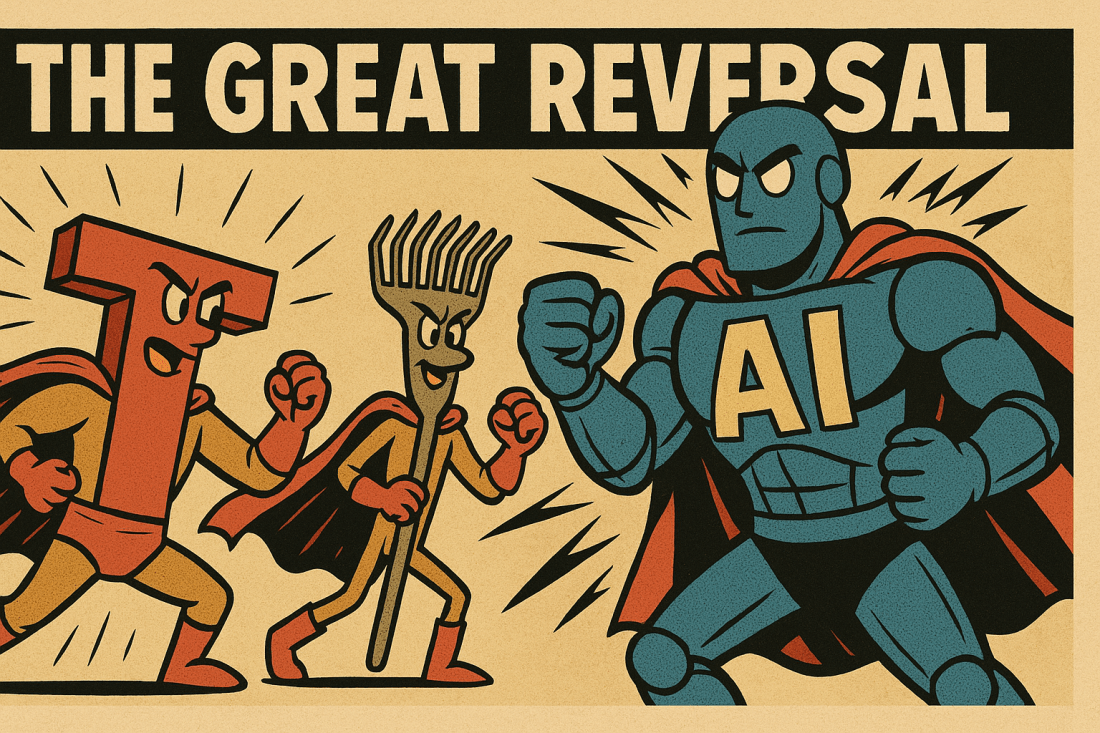
The Great Reversal: Has AI Changed the Specialist vs. Generalist Debate?

For years, career advice followed a predictable rhythm: specialize to stand out. Be the “go-to” expert, the person who can go deeper, faster, and with more authority than anyone else. Then came the countertrend, where generalists became fashionable. The Harvard Business Review argued that broad thinkers, capable of bridging disciplines, often outperform specialists in unpredictable or rapidly changing environments.
HBR: When Generalists Are Better Than Specialists—and Vice Versa

But artificial intelligence has rewritten the rules. The rise of generative models, automation frameworks, and intelligent copilots has forced a new question:
If machines can specialize faster than humans, what becomes of the specialist, and what new value can the generalist bring?

The Specialist’s New Reality: Depth Is No Longer Static

Specialists once held power because knowledge was scarce and slow to acquire. But with AI, depth can now be downloaded. A model can summarize 30 years of oncology research or code a Python function in seconds. What once took a career to master, AI can now generate on demand.

Yet the specialist is not obsolete. The value of a specialist has simply shifted from possessing knowledge to directing and validating it. For example, a tax expert who understands how to train an AI model on global compliance rules or a medical researcher who curates bias-free datasets becomes exponentially more valuable. AI has not erased the need for specialists; it has raised the bar for what specialization means.

The new specialist must be both a deep expert and a domain modeler, shaping how intelligence is applied in context. Technical depth is not enough. You must know how to teach your depth to machines.

The Generalist’s Moment: From Connectors to Orchestrators

Generalists thrive in ambiguity, and AI has made the world far more ambiguous. The rise of intelligent systems means entire workflows are being reinvented. A generalist, fluent in multiple disciplines such as product, data, policy, and design, can see where AI fits across silos. They can ask the right questions:

  • Should we trust this model?
  • What is the downstream effect on the client experience?
  • How do we re-train teams who once performed this work manually?

In Accenture’s case, the firm’s focus on AI reskilling rewards meta-learners, those who can learn how to learn. This favors generalists who can pivot quickly across domains, translating AI into business outcomes.
CNBC: Accenture plans on exiting staff who can’t be reskilled on AI

AI gives generalists leverage, allowing them to run experiments, simulate strategies, and collaborate across once-incompatible disciplines. The generalist’s superpower, pattern recognition, scales with AI’s ability to expose patterns faster than ever.

The Tension: When AI Collapses the Middle

However, there is a danger. AI can also collapse the middle ground. Those who are neither deep enough to train or critique models nor broad enough to redesign processes risk irrelevance.

Accenture’s stance reflects this reality: the organization will invest in those who can amplify AI, not those who simply coexist with it.

The future belongs to T-shaped professionals, people with one deep spike of expertise (the vertical bar) and a broad ability to collaborate and adapt (the horizontal bar). AI does not erase the specialist or the generalist; it fuses them.

The Passionate Argument: Both Camps Are Right, and Both Must Evolve

The Specialist’s Rallying Cry: “AI needs us.” Machines can only replicate what we teach them. Without specialists who understand the nuances of law, medicine, finance, or engineering, AI becomes dangerously confident and fatally wrong. Specialists are the truth anchors in a probabilistic world.

The Generalist’s Rebuttal: “AI liberates us.” The ability to cross disciplines, blend insights, and reframe problems is what allows human creativity to thrive alongside automation. Generalists build the bridges between technical and ethical, between code and client.

In short: the age of AI rewards those who can specialize in being generalists and generalize about specialization. It is a paradox, but it is also progress.

Bottom Line

AI has not ended the debate. It has elevated it. The winners will be those who blend the curiosity of the generalist with the credibility of the specialist. Whether you are writing code, crafting strategy, or leading people through transformation, your edge is not in competing with AI, but in knowing where to trust it, challenge it, and extend it.

Takeaway

  • Specialists define the depth of AI.
  • Generalists define the direction of AI.
  • The future belongs to those who can do both.

Further Reading on the Specialist vs. Generalist Debate

  1. Harvard Business Review: When Generalists Are Better Than Specialists—and Vice Versa
    A foundational piece exploring when broad thinkers outperform deep experts.
  2. CNBC: Accenture plans on exiting staff who can’t be reskilled on AI
    A look at how one of the world’s largest consulting firms is redefining talent through an AI lens.
  3. Generalists
    This article argues that generalists excel in complex, fast-changing environments because their diverse experience enables them to connect ideas across disciplines, adapt quickly, and innovate where specialists may struggle.
  4. World Economic Forum: The rise of the T-shaped professional in the AI era
    Discusses how professionals who balance depth and breadth are becoming essential in hybrid human-AI workplaces.
  5. McKinsey & Company: Rewired: How to build organizations that thrive in the age of AI
    A deep dive into how reskilling, systems thinking, and organizational design favor adaptable talent profiles.

Solving the Discovery Problem When Organizing MCP Servers by Domains

As organizations adopt Model Context Protocol (MCP) servers to extend and customize their AI systems, a common architectural question arises: How do you organize servers by domain while still making them discoverable and usable across the enterprise?

The promise of MCP servers is modularity: each server encapsulates a domain’s knowledge, tools, or APIs. For example, Finance may host an MCP server that exposes forecasting models, while HR may host another that provides policy information. This domain-oriented approach keeps ownership clear and supports scaling, but it also introduces a discovery problem:

  • How do employees and applications know which servers exist?
  • How do they connect to the right one without manually maintaining configuration files?
  • How do you ensure governance while still encouraging adoption?

The Discovery Problem in Context

Discovery challenges emerge whenever you decentralize services: too much centralization creates bottlenecks, but too much fragmentation leads to silos. With MCP servers, this tension is magnified because they’re meant to be “pluggable” into AI assistants, applications, and workflows. If users don’t know what’s available—or can’t connect reliably—value is lost.

Common symptoms of poor discovery:

  • Duplicate servers exposing overlapping capabilities.
  • Users requesting new servers that already exist.
  • Shadow integrations bypassing governance because discovery was too hard.

Patterns for Solving MCP Discovery

1. Central Registry or Directory Service

Create a centralized registry—a catalog of all approved MCP servers in the organization. Each server publishes metadata (name, domain, description, version, endpoints, owner) into the registry. Tools and users can then query this registry to find the right server.

Best practices:

  • Automate registration as part of your server deployment pipeline.
  • Tag servers with domains (Finance, HR, Operations) and capability keywords.
  • Provide APIs and UI search so both machines and humans can discover.

This mirrors how internal API gateways or service meshes solve discovery in microservices.

2. DNS and Naming Conventions

Standardize DNS naming to align servers with domains, e.g.:

  • finance.mcp.company.com
  • hr.mcp.company.com
  • supplychain.mcp.company.com

This makes it intuitive to locate a server if you know the domain, while still allowing the registry to act as the authoritative source.

3. Integration with Identity & Access Management (IAM)

Discovery isn’t just what exists—it’s also what you’re allowed to use. Tie the registry to IAM so that when a user searches for servers, results are filtered based on entitlements. This reduces noise and helps with compliance.

4. Self-Service Portals

Think of an “App Store” for MCP servers. A self-service portal allows business users to browse available servers, request access, and see example use cases. This encourages adoption while maintaining governance.

5. Versioning & Deprecation Policies

Without lifecycle management, discovery becomes polluted with outdated servers. Establish clear rules for versioning, deprecating, and removing servers from the registry.

6. Telemetry-Driven Recommendations

Go a step further: use usage analytics to surface “recommended servers.” For example, if users in the Tax department frequently connect to Finance and Payroll servers, suggest these during onboarding. This creates a feedback loop between discovery and adoption.

Example Implementation

  1. Registry Layer – Built on top of your API management platform or a lightweight database exposed via GraphQL.
  2. DNS Convention – Map each server’s endpoint using subdomains.
  3. Authentication & Access – Integrate with your enterprise SSO.
  4. Portal UI – Create a searchable catalog with ownership metadata, SLAs, and onboarding docs.
  5. Monitoring – Track adoption metrics to ensure the catalog reflects reality.

Why This Matters

The discovery problem isn’t unique to MCP—it’s been seen in APIs, microservices, and even SharePoint document libraries. What’s different here is the AI-first context: if MCP servers are hard to find, your AI assistants won’t surface the right knowledge at the right time. That directly undermines the productivity and strategic advantage AI is supposed to deliver.

Solving discovery early ensures that your domain-oriented MCP architecture remains a strength, not a liability. It allows you to scale servers across departments while keeping them usable, governed, and impactful.

Bottom Line and Takeaway

The discovery problem is not a side issue. It is the single biggest determinant of whether your domain-oriented MCP strategy succeeds or collapses. Without a clear discovery mechanism, you will create duplication, shadow systems, and a graveyard of unused servers.

Opinionated view: Treat discovery as a first-class product in your architecture. Build a registry with IAM integration, enforce naming conventions, and launch a self-service portal. Anything less is wishful thinking.

If you are serious about MCP as the foundation of your AI ecosystem, then invest in discovery upfront. Organizations that fail here will end up with chaos disguised as modularity. Organizations that solve it will build a scalable, governed, and discoverable layer of intelligence that actually makes AI assistants useful across the enterprise.

Takeaway: The ability to find, trust, and connect to MCP servers is the difference between AI that looks interesting and AI that actually scales. Discovery is not plumbing, it is the product.

Innovation at Speed Requires Responsible Guardrails

The rush to adopt generative AI has created a paradox for engineering leaders in consulting and technology services: how do we innovate quickly without undermining trust? The recent Thomson Reuters forum on ethical AI adoption highlighted a critical point: innovation with AI must be paired with intentional ethical guardrails.

For leaders focused on emerging technology, this means designing adoption frameworks that allow teams to experiment at pace while ensuring that the speed of delivery never outpaces responsible use.

Responsible Does Not Mean Slow

Too often, “responsible” is interpreted as synonymous with “sluggish.” In reality, responsible AI adoption is about being thoughtful in how you build, embedding practices that reduce downstream risks and make innovation more scalable.

Consider two examples:

  • Model experimentation vs. deployment
    A team can run multiple experiments in a sandbox, testing how a model performs against client scenarios. But before deployment, they must apply guardrails such as bias testingdata lineage tracking, and human-in-the-loop validation. These steps do not slow down delivery; they prevent costly rework and reputational damage later.
  • Prompt engineering at scale
    Consultants often rush to deploy AI prompts directly into client workflows. By introducing lightweight governance—such as prompt testing frameworks, guidelines on sensitive data use, and automated logging, you create consistency. Teams can move just as fast, but with a higher level of confidence and trust.

Responsibility as a Product Opportunity

Using AI responsibly is not only a matter of compliance, it is a product opportunity. Clients increasingly expect trust and verification to be built into the services they adopt. For engineering leaders, the question becomes: are you considering verification as part of the product you are building and the services you are providing?

Examples where verification and trust become differentiators include:

  • OpenAI’s provenance efforts: With watermarking and provenance research, OpenAI is turning content authenticity into a feature, helping customers distinguish trusted outputs from manipulated ones.
  • Salesforce AI Trust Layer: Salesforce has embedded a Trust Layer for AI directly into its products, giving enterprise clients confidence that sensitive data is masked, logged, and auditable.
  • Microsoft’s Responsible AI tools: Microsoft provides built-in Responsible AI dashboards that allow teams to verify fairness, reliability, and transparency as part of the development lifecycle.
  • Google’s Fact-Check Explorer: By integrating fact-checking tools, Google is demonstrating how verification can be offered as a productized service to combat misinformation.

In each case, verification and trust are not afterthoughts. They are features that differentiate products and give customers confidence to scale adoption.

Guardrails Enable Speed

History offers parallels. In cloud adoption, the firms that moved fastest were not those who bypassed governance, but those who codified controls as reusable templates. Examples include AWS Control Tower guardrailsAzure security baselines, and compliance checklists. Far from slowing progress, these frameworks accelerated delivery because teams were not reinventing the wheel every time.

The same applies to AI. Guardrails like AI ethics boards, transparency dashboards, and standardized evaluation metrics are not bureaucratic hurdles. They are enablers that create a common language across engineering, legal, and business teams and allow innovation to scale.

Trust as the Multiplier

In consulting, speed without trust is a false economy. Clients will adopt AI-driven services only if they trust the integrity of the process. By embedding responsibility and verification into the innovation cycle, engineering leaders ensure that every breakthrough comes with the credibility clients demand.

Bottom Line

The message for engineering leaders is clear: responsible AI is not a constraint, it is a catalyst. When you integrate verification, transparency, and trust as core product features, you unlock both speed and scale.

My opinion is that in the next 12 to 24 months, responsibility will become one of the sharpest competitive differentiators in AI-enabled services. Firms that treat guardrails as optional will waste time fixing missteps, while those that design them as first-class product capabilities will win client confidence and move faster.

Being responsible is not about reducing velocity. It is about building once, building well, and building trust into every release. That is how innovation becomes sustainable, repeatable, and indispensable.

Turning Shadow IT into Forward-Facing Engineers

Across industries, shadow IT and citizen developers are no longer fringe activities; they are mainstream. The reason this is true is that the friction to get started has dropped to zero: with vibe coding, low-code platforms, and simply having access to ChatGPT, anyone can prototype solutions instantly. Business-side employees are building tools in Excel, Power Automate, Airtable, and other platforms to close gaps left by official systems. Instead of blocking these efforts, forward-looking organizations are embracing them and creating pathways for these employees to become forward-facing engineers who can deliver secure, scalable, client-ready solutions.

Why This Works

  • Bridge Business and Tech: Citizen developers deeply understand workflows and pain points. With the right training, they can translate business needs into technical delivery.
  • Accelerate Innovation: Harnessing shadow IT energy reduces bottlenecks and speeds delivery, without sacrificing governance.
  • Boost Engagement: Recognizing and investing in shadow IT talent motivates employees who are already passionate about problem-solving.
  • AI as an Equalizer: AI copilots and low-code tools lower the barrier to entry, making it easier for non-traditional technologists to scale their impact.

Risks to Manage

  • Security & Compliance: Shadow IT often overlooks governance. Retraining is essential.
  • Technical Debt: Quick wins can become brittle. Guardrails and code reviews are non-negotiable.
  • Cultural Resistance: Engineers may see this as encroachment. Clear roles and communication prevent friction.
  • Sustainability: The end goal is not just prototypes; it is enterprise-grade solutions that last.

The Playbook: From Shadow IT to Forward-Facing Engineers

The transition from shadow IT to forward-facing engineers is not a single leap; it is a guided journey. Each stage builds confidence, introduces new skills, and gradually shifts the employee’s mindset from quick fixes to enterprise-grade delivery. By laying out a clear progression, organizations can reduce risk while giving employees the structure they need to succeed.

Stage 1: Discovery & Assessment

This is about spotting hidden talent. Leaders should inventory shadow IT projects and identify who built them. The emphasis here is not on perfect code, but on curiosity, persistence, and problem-solving ability.

  • Inventory shadow IT solutions and identify their creators.
  • Assess aptitude based on curiosity and problem-solving.
  • Example: A bank’s operations team mapped its shadow macros before deciding who to upskill into engineering apprentices.

Stage 2: Foundations & Guardrails

Once talent is identified, they need a safe place to learn. Provide basic training, enterprise-approved platforms, and the guardrails to prevent compliance issues. This stage is about moving from “hacking things together” to “building responsibly.”

  • Train on secure coding, APIs, cloud, version control, and AI copilots.
  • Provide sandbox environments with enterprise controls.
  • Pair learners with senior mentors.
  • Example: Microsoft used Power Platform “fusion teams” to let business users build apps in sanctioned environments.

Stage 3: Structured Apprenticeship

Now comes immersion. Participants join product pods, experience agile rituals, and begin contributing to low-risk tasks. This apprenticeship gives them firsthand exposure to engineering culture and delivery standards.

  • Place candidates in agile product pods.
  • Assign low-risk features and bug fixes.
  • Example: At Capital One, former business analysts joined pods through internal engineering bootcamps, contributing to production code within six months.

Stage 4: Forward-Facing Engineering

At this stage, participants step into the spotlight. They start owning features, present solutions to clients, and earn recognition through internal certifications or badging. This is the pivot from being a learner to being a trusted contributor.

  • Provide recognition via certifications and badging.
  • Assign bounded features with client exposure.
  • Example: ServiceNow’s “CreatorCon” has highlighted employees who transitioned from shadow IT builders to client-facing solution engineers.

Stage 5: Leadership & Scaling

Finally, graduates help institutionalize the model. They mentor newcomers, run showcases, and measure success through metrics like migrated solutions and client satisfaction. This is where the cycle becomes self-sustaining.

  • Create a champions network where graduates mentor new entrants.
  • Establish a community of practice with showcases and hackathons.
  • Measure outcomes: number of solutions migrated, number of participants, client satisfaction.
  • Example: Deloitte formalized its citizen development program to scale across service lines, reducing tool duplication and client risk.

Pathways for Talent

Forward-facing engineering can also be a strong entry point for early-career engineers. Given the rapid impact of AI in the market, new engineers can gain confidence and real-world exposure by starting in these roles, where business context and AI-powered tools amplify their ability to contribute quickly. It provides a practical on-ramp to enterprise delivery while reinforcing secure, scalable practices.

  • Technical Track: Forward-facing engineer, automation specialist, platform engineer.
  • Product Track: Product owner, solution architect, business analyst.
  • Hybrid Track: Citizen developer + AI engineer, combining business know-how with AI copilots.

Keys to Success

  1. Executive Sponsorship: Lends legitimacy and resources.
  2. Visible Wins: Showcase transformations from shadow IT to enterprise product.
  3. Continuous Learning: Invest in AI, cloud, and security enablement.
  4. Cultural Alignment: Frame this as empowerment, not replacement.

Bottom Line

Turning shadow IT into forward-facing engineers transforms a risk into an innovation engine. Organizations like Microsoft, Capital One, and Deloitte have shown how structured programs unlock hidden talent. With the right framework, shadow IT contributors can evolve into enterprise-grade engineers who deliver secure, scalable, and client-facing solutions that drive competitive advantage.

🕸️ The Creepiest Part: The Curve Is Still Rising

Somewhere between the thunderclaps of innovation and the quiet hum of data centers, a strange chill fills the air. It’s not the wind. It’s not the ghosts. It’s the sound of AI adoption still accelerating long after everyone thought it might slow down.

Because if there’s one thing scarier than a monster rising from the lab,
it’s realizing it’s still growing.

⚡ The Laboratory of Limitless Growth

Deep inside a candlelit castle, lightning flashes across the stone walls. Test tubes bubble with neural networks, and electricity hums through old copper wires. At the center of it all, Frankenstein’s monster stands hunched over a chalkboard.

On it are three jagged lines, one for the Internet, one for Mobile, and one, glowing ominously in neon green, for AI.

Dr. Frankenstein peers at the data through cracked goggles.
“Impossible,” he mutters, flipping through a pile of parchment labeled St. Louis Fed and eMarketer. “Every curve must flatten eventually. Even the mobile revolution reached a plateau.”

The monster turns, bolts sparking from his neck. “But master,” he says in a low rumble, “the curve… it’s still rising.”

📈 The Data Doesn’t Die

The Count appears in the doorway, cape sweeping dramatically behind him.

Dracula, the eternal observer of technological transformation, carries a tablet glowing with eerie blue light.
“Ah, my dear doctor,” he says, “you’re still studying your creature? You forget, I’ve watched centuries of human obsession. Printing presses, telegraphs, the telephone, the internet. Each one rose, and then rested.”

He smirks, his fangs catching the candlelight.
“But this new creation, this Artificial Intelligence, it refuses to sleep.”

Frankenstein gestures at the graph.
“See here, Count. The Internet took a decade to reach 1 billion users. Mobile took about five. But generative AI? It’s measured in months.”

Dracula’s eyes narrow.
“Yes, I read that in the mortal scholars’ scrolls. The Federal Reserve Bank of St. Louis found AI adoption outpacing every major technology in history, even those bloodthirsty smartphones.”
(source)

He taps his screen, revealing another chart.
“And look here, eMarketer reports that generative AI reached 77.8 million users in two years, faster than the rise of smartphones or tablets.”
(source)

The monster grunts. “Even the villagers use it now. They ask it for recipes, resumes, love letters.”

Dracula raises an eyebrow. “And blood type analyses, perhaps?”

They both laugh, the uneasy laughter of men who realize the experiment has escaped the lab.

🧛 The Curse of Exponential Curiosity

Dracula glides to the window, staring out into the storm. “You see, Frankenstein, mortals cannot resist their reflection. Once they taste a new tool that speaks back, they feed it endlessly. Every prompt, every query, every midnight whisper, more data, more growth.”

“Like feeding a beast,” Frankenstein says.

“Exactly,” Dracula grins. “And this one feeds itself. Every interaction strengthens it. Every mistake teaches it. Even their fears become training data.”

He twirls his cape dramatically. “You’ve not created a machine, my dear doctor. You’ve unleashed an immortal.”

⚙️ Why the Curve Keeps Climbing

The monster scribbles four words on the wall: “No friction. Infinite feedback.”

“That’s the secret,” Frankenstein explains. “Unlike the old revolutions, electricity, mobile, internet, AI doesn’t require factories or towers. It scales through code, not concrete. The more people use it, the more valuable it becomes. That’s why the line won’t flatten.”

Dracula nods. “A perfect storm of seduction: zero cost to start, instant gratification, and endless novelty. Even I couldn’t design a better addiction.”

Together, they stare at the graph again.
The AI line doesn’t level off. It bends upward.

The candles flicker. Somewhere, a server farm hums, millions of GPUs glowing like a field of jack-o’-lanterns in the dark.

🦇 The Night Is Still Young

Dracula turns to Frankenstein. “Do you fear what comes next?”

The doctor sighs. “I fear what happens when the curve stops rising and starts replacing.”

Dracula’s grin fades. For a moment, the immortal looks mortal.
“Perhaps,” he says, “but revolutions always come with a price. The villagers feared your monster once, and now they fear their own machines.”

Lightning cracks across the sky.

“But remember, Doctor,” he continues, “progress is a creature that cannot be killed, only guided.”

The monster, now quiet, whispers, “Then let’s hope we are still the ones holding the switch.”

🎃 The Bottom Line

AI’s adoption curve hasn’t flattened because we’re still discovering what it is.
It’s not a single invention like the phone or the PC. It’s a living layer that spreads through APIs, integrates into tools, and evolves faster than we can measure.

The mobile revolution connected us.
The AI revolution is re-creating us.

And if the trendlines are right, we’re still only at the first act of this gothic tale. The lab lights are still on. The storm still rages.

And somewhere, in the distance, the curve is still rising.

Further Reading (for those who dare look deeper):

Trapdoor Decisions in Technology Leadership

Imagine walking down a corridor, step by step. Most steps are safe, but occasionally one of them collapses beneath you, sending you suddenly into a trapdoor. In leadership, especially technology leadership, “trapdoor decisions” are those choices that look innocuous or manageable at first, but once taken, are hard or impossible to reverse. The costs of reversal are very high. They are decisions with built-in asymmetric risk: small misstep, large fall.

Technology leaders are especially vulnerable to them because they constantly make decisions under uncertainty, with incomplete information, rapidly shifting contexts, and high stakes. You might choose a technology stack that seems promising, commit to a vendor, define a product architecture, hire certain roles and titles, or set norms for data governance or AI adoption. Any of those might become a trapdoor decision if you realize later that what you committed to locks you in, causes unexpected negative consequences, or limits future options severely.

With the recent paradigm shift brought by AI, especially generative AI and large-scale machine learning, the frequency, complexity, and severity of these trapdoors has increased. There are more unknowns. The tools are powerful and seductive. The incentives (first-mover advantage, cost savings, efficiency, competitive pressure) push leaders toward making decisions quickly, sometimes prematurely. AI also introduces risks of bias, automation errors, ethical lapses, regulatory backlash, and data privacy problems. All of these can magnify what would otherwise be a modest misstep into a crisis.

Why Trapdoor Decisions Are Tricky

Some of the features that make trapdoor decisions especially hard:

  • Irreversibility: Once you commit, and especially once others have aligned with you (teams, customers, vendors), undoing becomes costly in money, reputation, or lost time.
  • Hidden downstream effects: Something seems small but interacts with other decisions or systems later in ways you did not foresee.
  • Fog of uncertainty: You usually do not have full data or good models, especially for newer AI technologies. You are often guessing about future constraints, regulatory regimes, ethical norms, or technology performance.
  • Psychological and organizational biases: Sunk cost, fear of missing out, confirmation bias, leadership peer pressure, and incentives to move fast all push toward making premature commitments.
  • Exponential stakes: AI can amplify both upside and downside. A model that works may scale quickly, while one that is flawed may scale widely and cause harm at scale.

AI Creates More Trapdoors More Often

Here are some specific ways AI increases trapdoor risk:

  1. Vendor lock-in with AI platforms and models. Choosing a particular AI vendor, model architecture, data platform, or approach (proprietary versus open) can create lock-in. Early adopters of closed models may later find migration difficult.
  2. Data commitments and pipelines. Once you decide what data to collect, how to store it, and how to process it, those pipelines often get baked in. Later changes are expensive. Privacy, security, and regulatory compliance decisions made early can also become liabilities once laws change.
  3. Regulatory and ethical misalignment. AI strategies may conflict with evolving requirements for privacy, fairness, and explainability. If you deprioritize explainability or human oversight, you may find yourself in regulatory trouble or suffer reputational damage later.
  4. Automation decisions. Deciding what to automate versus what to leave human-in-the-loop can create traps. If you delegate too much to AI, you may inadvertently remove human judgment from critical spots.
  5. Cultural and organizational buy-in thresholds. When leaders let AI tools influence major decisions without building culture and process around critical evaluation, organizations may become over-reliant and lose the ability to question or audit those tools.
  6. Ethical and bias traps. AI systems have bias. If you commit to a model that works today but exhibits latent bias, harm may emerge later as usage grows.
  7. Speed versus security trade-offs. Pressure to deploy quickly may cause leaders to skip due diligence or testing. In AI, this can mean unpredictable behavior, vulnerabilities, or privacy leaks in production.
  8. Trust and decision delegation traps. AI can produce plausible output that looks convincing even when the assumptions are flawed. Leaders who trust too much without sufficient skepticism risk being misled.

Examples

  • A company picks a proprietary large-language model API for natural language tools. Early cost and performance are acceptable, but later as regulation shifts (for example, demands for explainability, data residency, and auditing), the proprietary black box becomes a burden.
  • An industrial manufacturer rushed into applying AI to predictive maintenance without ensuring the quality or completeness of sensor data and human-generated operational data. The AI model gave unreliable alerts, operators did not trust it, and the system was abandoned.
  • A tech firm automated global pricing using ML models without considering local market regulations or compliance. Once launched, they faced regulatory backlash and costly reversals.
  • An organization underestimated the ethical implications of generative AI and failed to build guardrails. Later it suffered reputational damage when misuse, such as deep fakes or AI hallucinations, caused harm.

A Framework for Navigating Trapdoor Decisions

To make better decisions in environments filled with trapdoors, especially with AI, technology leaders can follow a structured framework.

StageKey Questions / ActivitiesPurpose
1. Identify Potential Trapdoors Early• What decisions being considered are irreversible or very hard to reverse?• What commitments are being made (financial, architectural, vendor, data, ethical)?• What downstream dependencies might amplify impacts?• What regulatory, compliance, or ethical constraints are foreseeable or likely to shift?• What are the unknowns (data quality, model behavior, deployment environment)?To bring to light what can go wrong, what you are locking in, and where the risks lie.
2. Evaluate Impact versus Optionality• How big is the upside, and how big is the downside if things go wrong?• How much flexibility does this decision leave you? Is the architecture modular? Is vendor lock-in possible? Can you switch course?• What cost and time are required to reverse or adjust?• How likely are regulatory, ethical, or technical changes that could make this decision problematic later?To balance between pursuing advantage and taking on excessive risk. Sometimes trapdoors are worth stepping through, but only knowingly and with mitigations.
3. Build in Guardrails and Phased Commitments• Can you make a minimum viable commitment (pilot, phased rollout) rather than full scale from Day 0?• Can you design for rollback, modularity, or escape (vendor neutral, open standards)?• Can you instrument monitoring, auditing, and governance (bias, privacy, errors)?• What human oversight and checkpoints are needed?To reduce risk, detect early signs of trouble, and preserve ability to change course.
4. Incorporate Diverse Perspectives and Challenge Biases• Who is around the decision table? Have you included legal, ethics, operations, customer, and security experts?• Are decision biases or groupthink at play?• Have you stress-tested assumptions about data, laws, or public sentiment?To avoid blind spots and ensure risk is considered from multiple angles.
5. Monitor, Review, and Be Ready to Reverse or Adjust• After deployment, collect data on outcomes, unintended consequences, and feedback.• Set metrics and triggers for when things are going badly.• Maintain escape plans such as pivoting, rollback, or vendor change.• Build a culture that does not punish change or admitting mistakes.Because even well-designed decisions may show problems in practice. Responsiveness can turn a trapdoor into a learning opportunity.

Thoughts

Trapdoor decisions are not always avoidable. Some of the riskiest choices are also the ones that can produce the greatest advantage. AI has increased both the number of decision points and the speed at which choices must be made, which means more opportunities to misstep.

For technology leaders, the goal is not to become paralyzed by fear of trapdoors, but to become more skilled at seeing them ahead of time, designing decision pathways that preserve optionality, embedding oversight and ethics, and being ready to adapt.

Why DIY: A ChatGPT Wrapper Isn’t the Best Enterprise Strategy

TL;DR: The Buy vs Build

ChallengeBuild (DIY Wrapper)Buy (Enterprise Solution)
CostTens to hundreds of thousands in build plus ongoing maintenance (applifylab.comsoftermii.commedium.com)Predictable subscription model with updates and support
SecurityVulnerable to prompt injection, data leaks, and evolving threats (en.wikipedia.orgwired.comwsj.com)Enterprise-grade safeguards built in such as encryption, RBAC, and monitoring
RewardLimited differentiation and fragile ROIFaster time to value, scalable, and secure

Do not fall for the trap of thinking “we are different” or “we can do this better with our framework.” Building these wrapper experiences has become the core product that multi-billion-dollar model makers are selling. If this is an internal solution, think very carefully before taking that path. Unless your wrapper directly connects to a true market differentiator, it is almost always wasted effort. And even then, ask whether it can simply be implemented through a GPT or an MCP tool that already exists in commercial alternatives like Microsoft Copilot, Google Gemini, or ChatGPT Enterprise.

This is a textbook example of a modern buy vs build decision. On paper, building a ChatGPT wrapper looks straightforward, it’s just an API after all right. In practice, the costs and risks far outweigh the benefits compared to buying a purpose-built enterprise solution.

Don’t fall for the trap that “we are different” or “we can do this better with our framework” as building these experiences have become the core experience these multi-billion dollar model makers are now selling. If this is an internal solution, thing hard before falling for this trap. Unless this is somehow linked to your market differentiator. Even then think can this simply be a GPT or a MCP tool used by a commercial alternative like Co-Pilot, Gemini, or ChatGTP enterprise.

1. High Costs Upfront with Diminishing Returns

Even a seemingly modest AI wrapper quickly escalates into a significant investment. According to ApplifyLab, a basic AI wrapper app often costs $10,000 to $30,000, while a mid-tier solution ranges from $30,000 to $75,000, and a full enterprise-level implementation can exceed $75,000 to $200,000+, excluding ongoing costs like infrastructure, CI/CD, and maintenance (applifylab.com).

Industry-wide estimates suggest that launching complete AI-powered software, particularly in sectors such as fintech, logistics, or healthcare, can cost anywhere from $100,000 to $800,000+, driven by compliance, security, robust pipelines, and integration overhead (softermii.com).

Even just a proof-of-concept (POC) to test value can run $50,000 to $150,000 with no guarantee of ROI (medium.com).

Buy vs Build Takeaway: By the time your wrapper is ready for production, the cost-to-benefit ratio often collapses compared to simply adopting an enterprise-ready platform.

2. Security Risks with Low Visibility and High Stakes

DIY wrappers also tend to fall short on enterprise-grade security.

  • Prompt Injection Vulnerabilities
    LLMs are inherently vulnerable to prompt injection attacks where crafted inputs (even hidden in documents or websites) can manipulate AI behavior or expose sensitive data. OWASP has flagged prompt injection as the top risk in its 2025 LLM Applications report (en.wikipedia.org).
    Advanced variations, such as prompt-to-SQL injection, can compromise databases or trigger unauthorized actions via middleware such as LangChain (arxiv.org).
    Real-world cases have already shown indirect prompt injection manipulating GPT-powered systems such as Bing chat (arxiv.org).
  • Custom GPT Leaks
    OpenAI’s custom “GPTs” have been shown to leak initialization instructions and uploaded files through basic prompt injection, even by non-experts. Researchers easily extracted core data with “surprisingly straightforward” prompts (wired.com).
  • Broader LLM Security Risks
    Generative AI systems are now a target for malicious actors. Researchers have even demonstrated covert “AI worms” capable of infiltrating systems and exfiltrating data through generative agents (wired.comwsj.com).
    More broadly, the WSJ notes that LLMs’ open-ended nature makes them susceptible to data exposure, manipulation, and reliability problems (wsj.com).

Building your own ChatGPT wrapper may feel like innovation, but it often ends up as a costly distraction that delivers little competitive advantage. Buying enterprise-ready solutions provides scale, security, and speed while allowing your team to focus on higher-value work. In the modern AI landscape, where risks are growing and the pace of change is accelerating, this is one of the clearest examples of why buy often beats build.

#AI #DigitalTransformation #CTO