
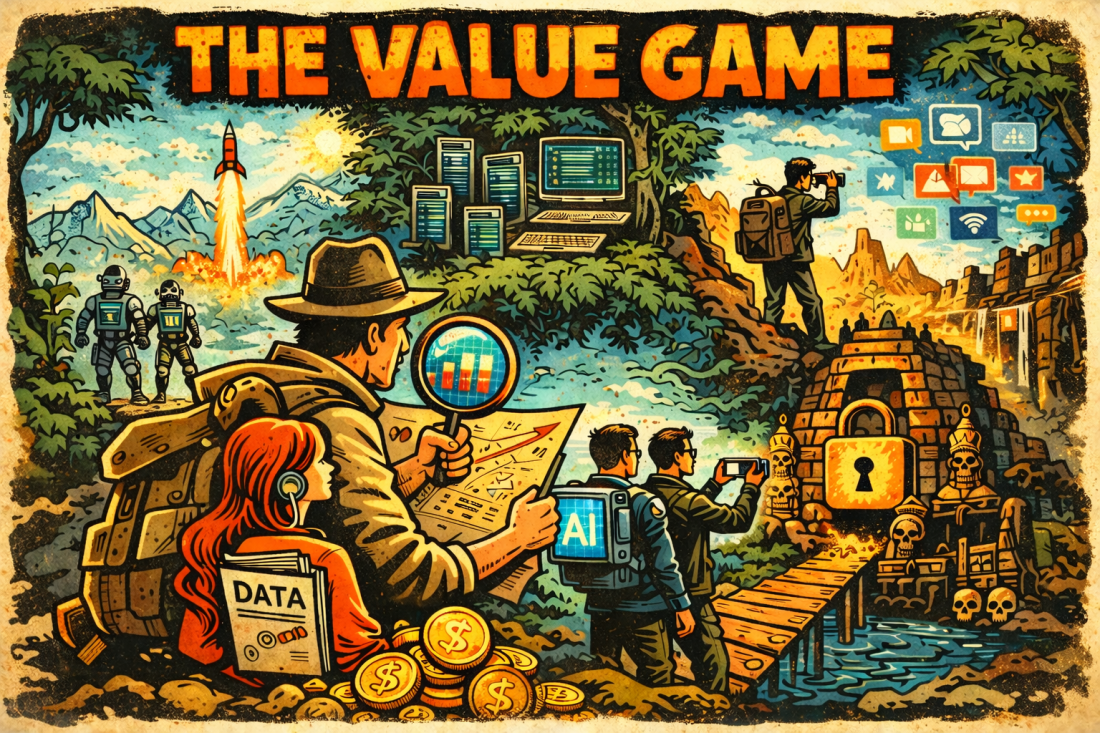
Most leadership teams say they are building “product value,” then immediately measure it like a finance exercise. ROI. LTV. Payback period. Those numbers matter, but they are also the fastest way to undervalue the most important products you will ever build. The uncomfortable truth is that many of the products that changed industries looked irrational on a spreadsheet in year one. They were not irrational. They were investments that created new compounding loops: better distribution, better data, stronger ecosystems, lower marginal cost to serve, and tighter control of the customer relationship.
Amazon has been blunt about this philosophy for decades: prioritize long-term market leadership over short-term profitability and measure investments analytically over time. (Corporate Investor Relations) That mindset is not a motivational poster. It is a valuation model. When you treat product as an investment vehicle, you stop asking “what is the ROI of this feature?” and start asking “what new asset does this create, and what future options does it unlock?”
ROI and LTV are necessary, but they are not sufficient
ROI and LTV are great at valuing direct monetization. They are weak at valuing strategic leverage.
They struggle with:
- Platform effects where value accrues to the ecosystem first, and only later to you.
- Capability-building where the product’s “profit” is speed, quality, and resilience across everything else you do.
- Trust and risk reduction where the return shows up as avoided loss, regulatory confidence, and sales velocity.
- Option value where the real payoff is the ability to launch the next thing faster and cheaper.
If you only use ROI and LTV, you will systematically underfund the products that create compounding advantage and overfund the products that create short-term optics.
A better question: What kind of value are we creating?
Here is the shift that changes everything. Instead of asking, “How much value does this product have?”, ask, “What typeof value is this product designed to create?” In my experience, modern product value shows up in five forms that compound when you get them right.
1) Ecosystem value: when your product becomes the market’s default surface area
Apple’s App Store is a masterclass in valuing the ecosystem, not just the transaction. Apple highlights that the App Store ecosystem facilitated roughly $1.3 trillion in billings and sales in 2024. (Apple) Whether you agree with every policy choice, the valuation insight is undeniable: the product’s value is not only Apple’s direct revenue. It is the gravitational pull that attracts developers, anchors users, and reinforces the platform.
If you try to measure a platform strictly by ROI in the early innings, you will miss the point. Platforms often look “expensive” until they become unavoidable.
2) Capability value: when the product is a factory for future products
AWS is the canonical example of a capability investment that turned into a new business category. It began as internal infrastructure discipline and APIs that made Amazon faster and more reliable, then became a product that changed how software is built. (Corporate Investor Relations) The early value was operational leverage. The later value was market creation.
You can see a modern version of this pattern inside software teams adopting AI-assisted development. Controlled studies and research report meaningful productivity gains with tools like GitHub Copilot, including faster task completion in experimental settings. (Microsoft) The point is not “AI will save us.” The point is that a tool can be a product investment when it upgrades throughput, developer experience, and time-to-market across everything you ship.
3) Data value: when learning becomes the moat
Netflix has long treated personalization as a value engine because it converts data into better decisions about discovery and engagement. External analyses describe that recommendations drive a large share of viewing activity, reinforcing retention and content discovery. (New America) You do not measure that with a single-feature ROI. You measure it as a learning system that compounds: every interaction makes the product smarter, and every improvement makes the next interaction more valuable.
In AI-first product design, this becomes even more direct. Your differentiation is rarely the model. Your differentiation is the feedback loop: the quality of your signals, the speed of iteration, and the discipline of your evaluation.
4) Distribution value: when the product lowers customer acquisition friction
Some products are valuable because they become your “front door,” even if they are not the primary revenue engine. Salesforce has invested heavily in enablement and ecosystem building, framing the broader “Salesforce Economy” as massive job and revenue creation beyond Salesforce itself. (Trailhead) You can debate methodologies, but the strategic idea is powerful: if your ecosystem grows faster than your competitors’ ecosystems, you win distribution, talent gravity, and partner momentum.
For CTOs and CPOs, distribution value often hides inside developer platforms, integrations, workflow surfaces, and anything that makes your product the easiest place to start.
5) Trust value: when the product accelerates sales and reduces existential risk
Trust is not soft. It is a growth lever and a risk hedge. Products that embed privacy, security, and compliance create value by shortening procurement cycles, reducing churn from security concerns, and preventing catastrophic downside. Many teams only “feel” this value when something goes wrong. That is too late.
If you want to value trust properly, treat it like an asset that increases conversion rates and protects cash flows under stress. It is not just cost avoidance. It is sales velocity and renewal confidence.
The valuation move that changes portfolio decisions: treat product like a set of real options
Here is a practical way to think about it without turning your operating rhythm into a finance seminar. A real option is the right, not the obligation, to make a future move. Great products create options: launch new modules, expand into new segments, partner with an ecosystem, shift pricing models, automate service delivery, or apply AI safely because your data and governance are ready.
That is why “feature ROI” often feels like a trap. The value is frequently not the feature. The value is the new option it creates.
Amazon’s long-term posture makes this explicit: invest for market leadership, measure what works, cut what does not, and double down on what compounds. (Corporate Investor Relations) That is real-option thinking in plain language.
Where AI changes the game for product value
AI does not just add features. It changes the unit economics of building, shipping, and operating products.
When you combine engineering management, product management, and software craftsmanship with AI, you can:
- Reduce the cost of iteration, which increases experimentation volume and learning speed.
- Improve quality through better testing, review support, and faster refactoring cycles, if you apply discipline.
- Turn workflows into intelligent systems, where value compounds through feedback loops rather than static releases.
But AI also punishes sloppy teams. If you do not invest in evaluation, safety, and engineering fundamentals, you will ship confident nonsense at scale. That destroys trust value faster than it creates novelty.
The Point…
If you only value products by ROI and LTV, you will keep funding what looks safe and starving what creates durable advantage. The products that matter most often create value sideways first: ecosystems, capabilities, data loops, distribution, and trust. The cash shows up later, and when it does, it tends to compound.
The leadership move is to name the value you are building, instrument it like you mean it, and allocate investment like a portfolio manager, not a project sponsor. That is how you stop shipping features and start building assets.
If you want, I can turn this into a tighter LinkedIn version with one core story arc and two supporting examples, while keeping the same POV and evidence.



 bencoding