🕸️ The Creepiest Part: The Curve Is Still Rising

Somewhere between the thunderclaps of innovation and the quiet hum of data centers, a strange chill fills the air. It’s not the wind. It’s not the ghosts. It’s the sound of AI adoption still accelerating long after everyone thought it might slow down.

Because if there’s one thing scarier than a monster rising from the lab,
it’s realizing it’s still growing.

⚡ The Laboratory of Limitless Growth

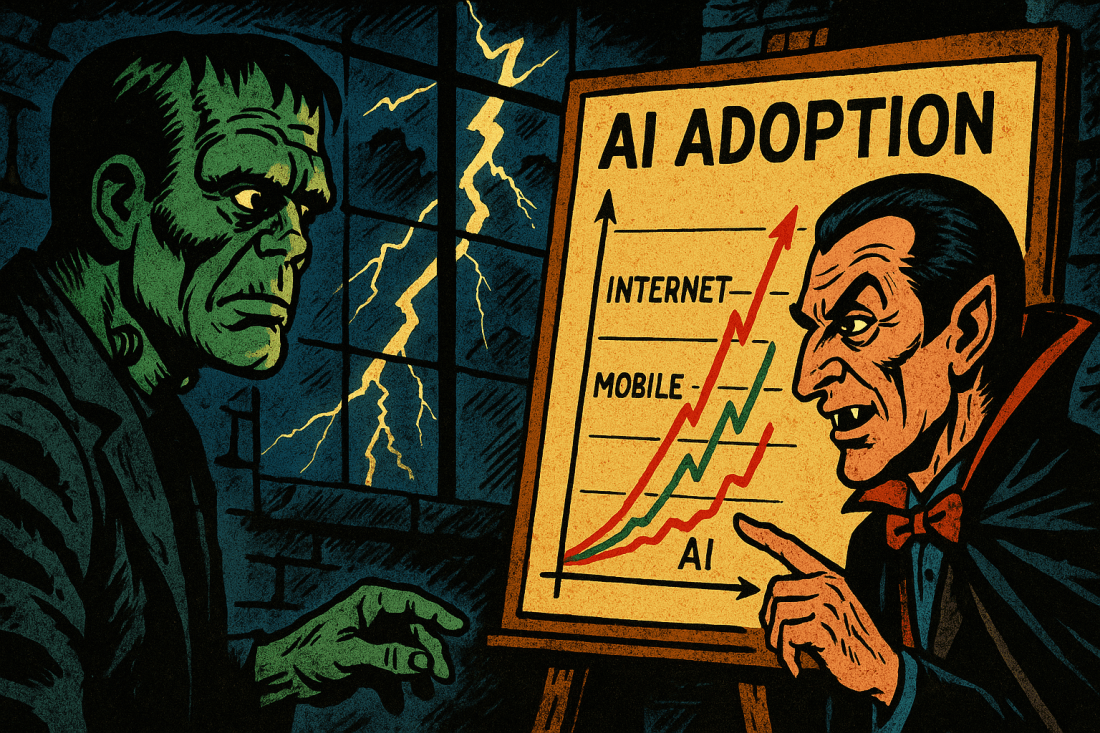
Deep inside a candlelit castle, lightning flashes across the stone walls. Test tubes bubble with neural networks, and electricity hums through old copper wires. At the center of it all, Frankenstein’s monster stands hunched over a chalkboard.

On it are three jagged lines, one for the Internet, one for Mobile, and one, glowing ominously in neon green, for AI.

Dr. Frankenstein peers at the data through cracked goggles.
“Impossible,” he mutters, flipping through a pile of parchment labeled St. Louis Fed and eMarketer. “Every curve must flatten eventually. Even the mobile revolution reached a plateau.”

The monster turns, bolts sparking from his neck. “But master,” he says in a low rumble, “the curve… it’s still rising.”

📈 The Data Doesn’t Die

The Count appears in the doorway, cape sweeping dramatically behind him.

Dracula, the eternal observer of technological transformation, carries a tablet glowing with eerie blue light.
“Ah, my dear doctor,” he says, “you’re still studying your creature? You forget, I’ve watched centuries of human obsession. Printing presses, telegraphs, the telephone, the internet. Each one rose, and then rested.”

He smirks, his fangs catching the candlelight.
“But this new creation, this Artificial Intelligence, it refuses to sleep.”

Frankenstein gestures at the graph.
“See here, Count. The Internet took a decade to reach 1 billion users. Mobile took about five. But generative AI? It’s measured in months.”

Dracula’s eyes narrow.
“Yes, I read that in the mortal scholars’ scrolls. The Federal Reserve Bank of St. Louis found AI adoption outpacing every major technology in history, even those bloodthirsty smartphones.”
(source)

He taps his screen, revealing another chart.
“And look here, eMarketer reports that generative AI reached 77.8 million users in two years, faster than the rise of smartphones or tablets.”
(source)

The monster grunts. “Even the villagers use it now. They ask it for recipes, resumes, love letters.”

Dracula raises an eyebrow. “And blood type analyses, perhaps?”

They both laugh, the uneasy laughter of men who realize the experiment has escaped the lab.

🧛 The Curse of Exponential Curiosity

Dracula glides to the window, staring out into the storm. “You see, Frankenstein, mortals cannot resist their reflection. Once they taste a new tool that speaks back, they feed it endlessly. Every prompt, every query, every midnight whisper, more data, more growth.”

“Like feeding a beast,” Frankenstein says.

“Exactly,” Dracula grins. “And this one feeds itself. Every interaction strengthens it. Every mistake teaches it. Even their fears become training data.”

He twirls his cape dramatically. “You’ve not created a machine, my dear doctor. You’ve unleashed an immortal.”

⚙️ Why the Curve Keeps Climbing

The monster scribbles four words on the wall: “No friction. Infinite feedback.”

“That’s the secret,” Frankenstein explains. “Unlike the old revolutions, electricity, mobile, internet, AI doesn’t require factories or towers. It scales through code, not concrete. The more people use it, the more valuable it becomes. That’s why the line won’t flatten.”

Dracula nods. “A perfect storm of seduction: zero cost to start, instant gratification, and endless novelty. Even I couldn’t design a better addiction.”

Together, they stare at the graph again.
The AI line doesn’t level off. It bends upward.

The candles flicker. Somewhere, a server farm hums, millions of GPUs glowing like a field of jack-o’-lanterns in the dark.

🦇 The Night Is Still Young

Dracula turns to Frankenstein. “Do you fear what comes next?”

The doctor sighs. “I fear what happens when the curve stops rising and starts replacing.”

Dracula’s grin fades. For a moment, the immortal looks mortal.
“Perhaps,” he says, “but revolutions always come with a price. The villagers feared your monster once, and now they fear their own machines.”

Lightning cracks across the sky.

“But remember, Doctor,” he continues, “progress is a creature that cannot be killed, only guided.”

The monster, now quiet, whispers, “Then let’s hope we are still the ones holding the switch.”

🎃 The Bottom Line

AI’s adoption curve hasn’t flattened because we’re still discovering what it is.
It’s not a single invention like the phone or the PC. It’s a living layer that spreads through APIs, integrates into tools, and evolves faster than we can measure.

The mobile revolution connected us.
The AI revolution is re-creating us.

And if the trendlines are right, we’re still only at the first act of this gothic tale. The lab lights are still on. The storm still rages.

And somewhere, in the distance, the curve is still rising.

Further Reading (for those who dare look deeper):

The Role of the Directly Responsible Individual (DRI) in Modern Product Development

Why This Matters to Me

I have been in too many product discussions where accountability was fuzzy. Everyone agreed something mattered, but no one owned it. Work stalled, deadlines slipped, and frustration grew. I have also seen the opposite, projects where one person stepped up, claimed ownership, and pushed it forward.

That is why the Directly Responsible Individual (DRI) matters. It is more than a process borrowed from Apple or GitLab. It is a mindset shift toward empowerment and clarity.

What Is a DRI?

DRI is the single person accountable for a project, decision, or outcome. They may not do all the work, but they ensure it gets done. Steve Jobs made the practice famous at Apple, where every important task had a DRI so ownership was never in doubt. (handbook.gitlab.combitesizelearning.co.uk)

In my experience, this clarity is often the difference between projects that deliver and those that linger.

Strengths and Weaknesses

The DRI model works because it removes ambiguity. With a clear owner, decisions move faster, resources are coordinated, and teams feel empowered. Assigning someone as a DRI is a signal of trust: we believe you can make this happen. (tettra.com)

The risks are real too. A DRI without proper authority can be set up to fail. Too much weight on one individual can stifle collaboration or lead to burnout. And if organizations treat the role as a label without substance, it quickly collapses. (levelshealth.comdbmteam.com)

Examples in Practice

  • GitLab: Embeds DRIs across the organization, with clear documentation and real authority. (GitLab Handbook)
  • Levels Health: Uses DRIs in its remote-first culture, often as volunteers, supported by “buddies” and documentation. (Levels Blog)
  • Coda: Assigns DRIs or “drivers” for OKRs and pairs them with sponsors for balance. (Coda Blog)

The lesson is clear. DRIs succeed when paired with support and clear scope. They fail when given responsibility without authority.

Rolling Out DRIs

Adopting DRIs is a cultural shift, not just a process tweak. Some organizations roll them out gradually, starting with a few high-visibility initiatives. Others go all in at once. I lean toward gradual adoption. It builds confidence and proves impact before scaling.

Expect the early days to feel uncomfortable. Accountability brings clarity but also pressure. Some thrive, others resist. Over time, the culture shifts and momentum builds.

Change management matters. Leaders must explain why DRIs exist, provide support structures like sponsors, and create psychological safety. If failure leads to punishment, no one will volunteer.

The Clash with Command-and-Control IT

The DRI model often collides with the command-and-control style of traditional enterprise IT. Command-and-control relies on centralized approvals and shared accountability. The DRI approach decentralizes decisions and concentrates accountability.

I believe organizations that cling to command-and-control will fall behind. The only path forward is to create space for DRIs in product teams while still meeting enterprise compliance needs.

How AI Is Shaping DRIs

AI is becoming a force multiplier for DRIs. It can track progress, surface risks, and summarize input, giving individuals more time to focus on outcomes. But accountability cannot be outsourced to an algorithm. AI should make the DRI role easier, not weaker.

Empowerment and Conclusion

At its core, the DRI model is about empowerment. When someone is trusted with ownership, they rise to the challenge. They move faster, make decisions with confidence, and inspire their teams. I have seen people flourish under this model once they are given the chance.

For senior leaders, the next steps are clear. Identify accountability gaps, assign DRIs to a few strategic initiatives, and make those assignments visible. Pair them with sponsors, support them with AI, and commit publicly to backing them.

If you want empowered teams, faster results, and less ambiguity, DRIs are one of the most effective levers available. Those that embrace them will build stronger cultures of ownership. Those that resist will remain stuck in command and control. I know which side I want to be on.

Why DIY: A ChatGPT Wrapper Isn’t the Best Enterprise Strategy

TL;DR: The Buy vs Build

ChallengeBuild (DIY Wrapper)Buy (Enterprise Solution)
CostTens to hundreds of thousands in build plus ongoing maintenance (applifylab.comsoftermii.commedium.com)Predictable subscription model with updates and support
SecurityVulnerable to prompt injection, data leaks, and evolving threats (en.wikipedia.orgwired.comwsj.com)Enterprise-grade safeguards built in such as encryption, RBAC, and monitoring
RewardLimited differentiation and fragile ROIFaster time to value, scalable, and secure

Do not fall for the trap of thinking “we are different” or “we can do this better with our framework.” Building these wrapper experiences has become the core product that multi-billion-dollar model makers are selling. If this is an internal solution, think very carefully before taking that path. Unless your wrapper directly connects to a true market differentiator, it is almost always wasted effort. And even then, ask whether it can simply be implemented through a GPT or an MCP tool that already exists in commercial alternatives like Microsoft Copilot, Google Gemini, or ChatGPT Enterprise.

This is a textbook example of a modern buy vs build decision. On paper, building a ChatGPT wrapper looks straightforward, it’s just an API after all right. In practice, the costs and risks far outweigh the benefits compared to buying a purpose-built enterprise solution.

Don’t fall for the trap that “we are different” or “we can do this better with our framework” as building these experiences have become the core experience these multi-billion dollar model makers are now selling. If this is an internal solution, thing hard before falling for this trap. Unless this is somehow linked to your market differentiator. Even then think can this simply be a GPT or a MCP tool used by a commercial alternative like Co-Pilot, Gemini, or ChatGTP enterprise.

1. High Costs Upfront with Diminishing Returns

Even a seemingly modest AI wrapper quickly escalates into a significant investment. According to ApplifyLab, a basic AI wrapper app often costs $10,000 to $30,000, while a mid-tier solution ranges from $30,000 to $75,000, and a full enterprise-level implementation can exceed $75,000 to $200,000+, excluding ongoing costs like infrastructure, CI/CD, and maintenance (applifylab.com).

Industry-wide estimates suggest that launching complete AI-powered software, particularly in sectors such as fintech, logistics, or healthcare, can cost anywhere from $100,000 to $800,000+, driven by compliance, security, robust pipelines, and integration overhead (softermii.com).

Even just a proof-of-concept (POC) to test value can run $50,000 to $150,000 with no guarantee of ROI (medium.com).

Buy vs Build Takeaway: By the time your wrapper is ready for production, the cost-to-benefit ratio often collapses compared to simply adopting an enterprise-ready platform.

2. Security Risks with Low Visibility and High Stakes

DIY wrappers also tend to fall short on enterprise-grade security.

  • Prompt Injection Vulnerabilities
    LLMs are inherently vulnerable to prompt injection attacks where crafted inputs (even hidden in documents or websites) can manipulate AI behavior or expose sensitive data. OWASP has flagged prompt injection as the top risk in its 2025 LLM Applications report (en.wikipedia.org).
    Advanced variations, such as prompt-to-SQL injection, can compromise databases or trigger unauthorized actions via middleware such as LangChain (arxiv.org).
    Real-world cases have already shown indirect prompt injection manipulating GPT-powered systems such as Bing chat (arxiv.org).
  • Custom GPT Leaks
    OpenAI’s custom “GPTs” have been shown to leak initialization instructions and uploaded files through basic prompt injection, even by non-experts. Researchers easily extracted core data with “surprisingly straightforward” prompts (wired.com).
  • Broader LLM Security Risks
    Generative AI systems are now a target for malicious actors. Researchers have even demonstrated covert “AI worms” capable of infiltrating systems and exfiltrating data through generative agents (wired.comwsj.com).
    More broadly, the WSJ notes that LLMs’ open-ended nature makes them susceptible to data exposure, manipulation, and reliability problems (wsj.com).

Building your own ChatGPT wrapper may feel like innovation, but it often ends up as a costly distraction that delivers little competitive advantage. Buying enterprise-ready solutions provides scale, security, and speed while allowing your team to focus on higher-value work. In the modern AI landscape, where risks are growing and the pace of change is accelerating, this is one of the clearest examples of why buy often beats build.

#AI #DigitalTransformation #CTO

Strategic Planning vs. Strategic Actions: The Ultimate Balancing Act

Let’s be blunt: If you are a technology leader with a brilliant strategy deck but nothing shipping, you are a fraud. If you are pumping out features without a clear strategy, you are gambling with other people’s money. The uncomfortable truth is that in tech leadership, vision without execution is delusion, and execution without vision is chaos.

Think about the companies we have watched implode. Kodak literally invented the digital camera but failed to commit to shifting their business model in time (Investopedia). Blockbuster had a roadmap for streaming before Netflix took off but never acted decisively, choosing comfort over speed. Their strategies looked great on paper right up until the moment they became cautionary tales.

The reverse problem of being all action and no plan is just as dangerous. Teams that constantly chase shiny objects, launch half-baked features, or pivot every few months might look busy, but they are building on quicksand. Yes, they might get lucky once or twice, but luck does not scale. Without a coherent plan, every success is an accident waiting to be reversed.

The leaders who get it right treat plans and actions as inseparable. Procter & Gamble’s OGSM framework aligns global teams on objectives, strategies, and measurable actions (Wikipedia). The Cascade Model starts with vision and values, then connects them directly to KPIs and delivery timelines (Cascade). Best Buy’s turnaround in the early 2010s, with price matching Amazon, investing in in-store experience, and expanding services, worked because it was both a clear plan and a relentless execution machine (ClearPoint Strategy). Nike’s 2021–2025 roadmap is another example, with 29 public targets supported by measurable actions (SME Strategy).

If you are leading tech without both vision and velocity, you are either drifting or spinning in place. Neither wins markets. Your job is not just to make a plan, it is to make sure the plan lives through your delivery cadence, your roadmap decisions, and your metrics.

Applying the Balance to AI Adoption

The AI revolution is no longer approaching, it is here. Nearly half of Fortune 1000 companies have embedded AI into workflows and products, shifting from proving its value to scaling it across the organization (AP News). But AI adoption demands more than flashy pilots. It requires the same balance of strategic planning and relentless execution.

Many organizations are experiencing AI creep through grassroots experiments. A recent survey found that 72% of employees using AI report saving time weekly, yet most businesses still lack a formal AI strategy (TechRadar). This gap is risky. Spontaneous adoption delivers early wins, but without an intentional rollout these remain one-off tricks rather than transformative advances.

The shift is forcing companies to formalize leadership. Chief AI Officers are now often reporting directly to CEOs to steer AI strategy, manage risks, and align use cases with business priorities (The Times). Innovators like S&P Global are mandating AI training, moving developer AI use from 7% to 33% of code generation in months, and building “Grounding Agents” for autonomous research on proprietary data (Business Insider).

Steering AI at scale requires a framework, not spontaneity. Gartner’s AI roadmap outlines seven essential workstreams, from strategy, governance, and data to talent, engineering, and value portfolios, so leaders can prioritize AI with clarity and sequence (Gartner). AI adoption also succeeds only when trust, transparency, and cultural fit are embedded, particularly around fairness, peer validation, and organizational norms (Wendy Hirsch).

Introducing AI into your product development process without a strategic scaffold is like dropping nitro on a house of cards. You might move fast, but any misalignment, governance gap, or cultural mismatch will bring it all down. The antidote is to anchor AI initiatives in concrete business outcomes, empower cross-functional AI working groups, invest in upskilling and transparency, and govern with clear risk guardrails and metrics.

Your Next Action

In your experience, which derails AI transformation faster: lack of strategic planning or reckless execution without governance? Share the AI initiatives that flamed out or flipped your company upside down, and let us unpack what separates legendary AI adoption from another shiny pilot. Because in tech leadership, if vision and velocity are not joined in your AI strategy, you are either running illusions or waiting for a miracle.

Widen Your AI Surface Area and Watch the Returns Compound

Cate Hall’s surface-area thesis is simple: serendipity = doing × telling. The more experiments you run and the more publicly you share the lessons, the more good luck finds you. (usefulfictions.substack.com)

Generative AI is the ultimate surface-area amplifier. Models get cheaper, new use cases emerge weekly, and early wins snowball once word spreads. Below is a playbook, rooted in real-world data, for technology leaders who want to stay ahead of the AI wave and translate that edge into concrete gains for their organizations and their own careers.

1. Run More (and Smaller) Experiments

TacticRecent proof-point
Quarterly hack-days with a “ship in 24 hours” rule.Google Cloud’s Agentic AI Day gathered 2,000+ developers who built 700 prototypes in 30 hours, earning a Guinness World Record and seeding multiple production pilots. (blog.googleThe Times of India)
30-day “two-pizza” squads on nagging pain points.Walmart’s internal “Associate” and “Developer” super-agents started as 30-day tiger-teams and are now rolling out across stores and supply-chain tools. (ReutersForbes)

Organizational upside: frequent, low-cost trials de-risk big bets and surface unexpected wins early.
Career upside: you become the executive who can reliably turn “weekend hacks” into measurable ROI.

2. Create an Adoption Flywheel

“AI is only as powerful as the people behind it.” – Telstra AI team

Levers

  1. Default-on pilots. Telstra rolled out “Ask Telstra” and “One Sentence Summary” to every frontline agent; 90% report time-savings and 20% fewer follow-up calls. (Microsoft)
  2. Communities of practice. Weekly show-and-tell sessions let power users demo recipes, prompts, or dashboards.
  3. Transparent metrics. Publish adoption, satisfaction, and hours-saved to neutralise fear and spark healthy competition.

Organizational upside: time-to-value shrinks, shadow-IT falls, and culture shifts from permission-based to experiment-by-default.
Career upside: you gain a track record for change management, a board-level differentiator.

3. Build Platforms, Not One-Offs

Platform moveResult
Expose reusable agent frameworks via internal APIs.Walmart’s “Sparky” customer agent is just one of four AI “super-agents” that share common services, accelerating new use-case launches and supporting a target of 50% online sales within five years. (Reuters)
Offer no-code tooling to frontline staff.Telstra’s agents let 10k+ service reps mine CRM history in seconds, boosting first-contact resolution and agent NPS. (Telstra.comMicrosoft)

Organizational upside: every new bot enriches a shared knowledge graph, compounding value.
Career upside: platform thinking signals enterprise-scale vision, which is catnip for CEO succession committees.

4. Broadcast Wins Relentlessly

“Doing” is only half the surface-area equation; the other half is telling:

  • Internal road-shows. Add Ten-minute demos into your team meetings.
  • External storytelling. Publish case studies or open-source prompt libraries to attract talent and partners.
  • Metric snapshots. Microsoft found Copilot adoption surged once leaders shared that 85% of employees use it daily and save up to 30% of analyst time. (MicrosoftThe Official Microsoft Blog)

Organizational upside: shared vocabulary and proof accelerate cross-team reuse.
Career upside: your public narrative positions you as an industry voice, opening doors to keynote slots, advisory boards, and premium talent pipelines.

5. Quantify the Payoff

OutcomeEvidence you can quote tomorrow
ProductivityUK government Copilot trial: 26 minutes saved per employee per day across 14,500 staff. (Barron’s)
Client speedMorgan Stanley advisors auto-generate meeting summaries and email drafts, freeing prep time for higher-margin advice. (Morgan Stanley)
RevenueWalmart expects agentic commerce to accelerate its push to $300 B online revenue. (Reuters)

Use numbers like these to build cost-benefit cases and secure funding.

6. Personal Career Playbook

Focus AreaActionWhy It Pays Off
Public CredibilityShare what you learn, whether on LinkedIn, Github, YouTube, or other channel.Consistently sharing insights brands you as a thought leader and attracts high-caliber talent.
Hands-On InsightPair with an engineer or data scientist for one sprint each quarter.Staying close to the build process sharpens your intuition about real-world AI capabilities and constraints.
Continuous LearningCommit to one AI-focused certification or course each year.Ongoing education signals a growth mindset and keeps your expertise relevant in a fast-moving field.

Make your own luck

Boosting your AI surface area is not about chasing shiny tools. It is a disciplined loop of many small bets + aggressive storytelling. Organizations reap faster innovation, richer data moats, and happier talent. Leaders who orchestrate that loop accrue reputational capital that outlives any single technology cycle.

Start widening your surface area today, before the next wave passes you by.

Beyond Busywork: Rethinking Productivity in Product Development

We have all seen the dashboards: velocity charts, commit counts, ticket throughput.
They make for tidy reports. They look great in an executive update. But let’s be honest, do they actually tell us if our teams are building the right things, in the right way, at the right time?

A recent Hacker News discussion, Let’s stop pretending that managers and executives care about productivity, hit a nerve. It pointed out a hard truth: too often, “productivity” is measured by what is easy to count rather than what actually matters. For technology leaders, this raises a critical question: are we optimizing for activity or for impact?

Before we can improve how we measure productivity, we first need to understand why so many traditional metrics fall short. Many organisations start with good intentions, tracking indicators that seem logical on the surface. Over time, these measures can drift away from reflecting real business value and instead become targets in their own right. This is where the gap emerges between looking productive and actually creating outcomes that matter.

We have seen this play out in practice. Atlassian warns on relying heavily on raw JIRA velocity scores when they realized it encouraged teams to inflate story point estimates rather than improve delivery outcomes. Google’s engineering teams have spoken about the risk of “metric gaming” and have stressed the importance of pairing speed indicators with measures of impact and reliability.

Why Shallow Metrics Fail

Several years ago, I was in a leadership meeting where a project was declared a success because the team had delivered 30% more story points than the previous quarter. On paper, it was an impressive jump. In reality, those features did not move the needle on adoption, customer satisfaction, or revenue. We had measured output, not outcome.

High-functioning teams do not just ship more. They deliver meaningful business value. That is where our measurement frameworks need to evolve.

DORA Metrics: A Better Starting Point

The DevOps Research and Assessment (DORA) group has done extensive research to identify four key metrics that balance speed and stability:

  1. Deployment Frequency – How often you deploy code to production.
  2. Lead Time for Changes – How quickly a change moves from code commit to production.
  3. Change Failure Rate – How often deployments cause a failure in production.
  4. Mean Time to Recovery (MTTR) – How fast you recover from a failure.

These are powerful because they connect process efficiency with system reliability. For example, I joined a project that was deploying only once a quarter. While this schedule reduced change risk, it also created long lead times for customer-facing features and made responding to feedback painfully slow. Over the course of six months, we incrementally improved our processes, automated more of our testing, and streamlined our release management. The result was moving to a two-week deployment cycle, which allowed the team to deliver value faster, respond to market needs more effectively, and reduce the risk of large-scale release failures by making changes smaller and more manageable.

The caution: if you treat DORA as a leaderboard, you will get teams “optimizing” metrics in ways that undermine quality. Used correctly, they are a diagnostic tool, not a performance scorecard.

Connecting DORA to Business Outcomes

For technology leaders, DORA metrics should not exist in isolation. They are most valuable when they are tied to business results that the board cares about.

  • Deployment Frequency is not just about speed, it is about how quickly you can respond to market shifts, regulatory changes, or customer feedback.
  • Lead Time for Changes impacts time-to-revenue for new features and directly affects competitive advantage.
  • Change Failure Rate affects customer trust and brand reputation, both of which have measurable financial consequences.
  • MTTR influences client retention, contractual SLAs, and the ability to contain operational risk.

When framed this way, engineering leaders can make the case that improving DORA scores is not just a technical goal, but a growth and risk mitigation strategy. This connection between delivery performance and commercial outcomes is what elevates technology from a support function to a strategic driver.

Innovative Metrics to Watch

Forward-thinking companies are experimenting with new ways to measure productivity:

  • Diff Authoring Time (DAT) – Used at Meta, this tracks how long engineers spend authoring a change. In one experiment, compiler optimisations improved DAT by 33%, freeing up engineering cycles for higher-value work.
  • Return on Time Invested (ROTI) – A simple but powerful concept: for every hour spent, what is the measurable return? This is especially useful in evaluating internal meetings, process reviews, or new tool adoption.

The Pitfalls of Over-Measurement

There is a dark side to metrics. Wired recently called out the “toxic” productivity obsession in tech where every keystroke is tracked and performance is reduced to a spreadsheet. It is a quick path to burnout, attrition, and short-term thinking.

As leaders, our job is not to watch the clock. It is to create an environment where talented people can do their best work, sustainably.

Takeaway

Productivity in product development is not about being busy. It is about delivering lasting value.
Use DORA as a starting point, augment it with reliability, developer experience, and business outcome metrics, and experiment with emerging measures like DAT and ROTI. But always remember: metrics are there to inform, not to define, your team’s worth.

Thoughts

The best technology organizations measure what matters, discard vanity metrics, and connect engineering performance directly to business value. Metrics like DORA, when used thoughtfully, help teams identify bottlenecks and improve delivery. Innovative measures such as DAT and ROTI push our understanding of productivity further, but they only work in cultures that value trust and sustainability. As technology leaders, our challenge is to ensure that our measurement practices inspire better work rather than simply more work.

Why Technical Priorities Consistently Get Pushed Aside Without Clear Business Value?

There’s a tough reality facing engineering teams everywhere: technical priorities consistently get pushed aside when they aren’t clearly linked to business value. We see this pattern again and again. Teams raise concerns about technical debt, system architecture, or code quality, only to have those concerns deprioritized in favor of visible business initiatives.

The problem isn’t a lack of understanding from leadership or CTOs. Instead, the real challenge lies in how we communicate the importance of technical work. When the business impact isn’t clear, technical projects become easy to delay or ignore, even when they are critical for long-term success.

To shift this dynamic, technologists need to translate technical needs into measurable business outcomes. Only then do our priorities get the attention and investment they deserve.

The Real Challenge: Bridging the Business-Technology Divide

Too often, technical teams speak their own language. We say, “We need better observability,” and leadership hears, “More dashboards for tech’s sake.” We argue for automated testing, and management hears, “You want to slow us down.” The disconnect is clear. Technical needs get ignored unless we connect them to measurable business outcomes.

This isn’t just anecdotal. Charity Majors, CTO at Honeycomb, puts it simply:
“If you can’t connect your work to business value, you’re not going to get buy-in.”

Similarly, The Pragmatic Engineer notes that the most effective engineers are those who translate technical decisions into business impact.

Reframing Technical Work: From Features to Business Outcomes

Technical excellence is not an end in itself. It is a lever for achieving business goals. The key is to frame our technical priorities in language that resonates with business leaders. Here are some examples:

  • Observability:
    • Tech speak: “We need better observability.”
    • Business outcome: “Our customers reported outages. Enhanced observability helps us detect and fix issues before clients are impacted, cutting response time in half.”
  • Automated Testing:
    • Tech speak: “Let’s add more automated tests.”
    • Business outcome: “Recent critical bugs delayed product launches. Automated testing helps us catch issues earlier, so we deliver on time.”
  • Infrastructure as Code:
    • Tech speak: “We should automate infrastructure.”
    • Business outcome: “Manual setup takes days. With infrastructure as code, we can onboard new clients in minutes, using fewer resources.”

Supporting Reference:
Accelerate: The Science of Lean Software and DevOps shows that elite engineering teams connect technical practices such as automation and observability directly to improved business performance, faster deployments, fewer failures, and happier customers.

The Business Value of Code Quality

When we talk about refactoring, testing, or reducing technical debt, we must quantify the benefits in business terms:

  • Faster time-to-market: Better code quality and automation mean quicker releases, leading to competitive advantage. (Martin Fowler on Refactoring)
  • Lower support costs: Reliable systems and early bug detection lead to fewer incidents and reduced customer complaints. (InfoQ on Technical Debt)
  • Employee efficiency: Automating manual tasks lets teams focus on innovation, not firefighting.

Google’s DORA research (State of DevOps Report) consistently shows that organizations aligning technical practices with business goals outperform their peers.

Actionable Takeaways: How to Make Technical Work Matter

  1. Speak in Outcomes:
    Always explain how technical decisions impact revenue, customer satisfaction, or risk.
  2. Quantify the Impact:
    Use metrics. For example, “This change will save X hours per month,” or, “This will reduce client onboarding from days to minutes.”
  3. Connect to Business Goals:
    Align your technical arguments with the company’s strategic priorities such as growth, retention, efficiency, or compliance.
  4. Reference External Proof:
    Bring in supporting research and case studies to back up your proposals. (ThoughtWorks: The Business Value of DevOps)

Summary

The most influential engineers and technologists are those who relentlessly tie their work to business outcomes. Technical excellence is a business multiplier, not a checkbox. The real challenge is ensuring every technical priority is translated into language that leadership understands and values.

The question we should all ask:
How are we connecting our technical decisions to measurable business results?

Further Reading


#EngineeringLeadership #CTO #CIO #ProductStrategy

Financial Metrics Beyond CapEx and OpEx: A CTO’s Essential Guide

For CTOs, CIOs, and technology leaders, mastering the financial language of the business is crucial. This fluency not only empowers informed decision-making but also ensures you communicate effectively with executive peers, investors, and board members. While CapEx (Capital Expenditures) and OpEx (Operational Expenditures) are commonly discussed, technology leaders must understand additional financial metrics to truly drive business success.

Key Financial Metrics Technology Leaders Should Know:

1. Gross Margin (GM%)

  • Definition: Revenue minus the cost of goods sold (COGS), expressed as a percentage.
  • Example: A SaaS company generates $10M in revenue with $4M in direct technology and hosting costs, yielding a GM% of 60%.
  • Importance: Indicates efficiency in service delivery and informs pricing strategies.
  • Tech Link: Optimize infrastructure efficiency to boost GM%. Technology improvements such as automation and efficient architecture reduce direct costs. Regularly report these efficiency gains to demonstrate impact.
  • Further Reading

2. Earnings Before Interest, Taxes, Depreciation, and Amortization (EBITDA)

  • Definition: A measure of a company’s overall financial performance and profitability.
  • Example: Investing in automation reduces manual labor, improving EBITDA by lowering operating expenses.
  • Importance: Frequently used by investors, especially in Private Equity.
  • Tech Link: Automation and efficiency projects directly improve EBITDA. Clearly document savings and incremental EBITDA impact in regular reports.
  • Further Reading

3. Annual Recurring Revenue (ARR)

  • Definition: Predictable annual revenue from subscription-based services.
  • Example: A SaaS company with 100 customers each paying $10,000 annually has an ARR of $1M.
  • Importance: Provides predictability of revenue, crucial for growth forecasting.
  • Tech Link: Technology enhancements that improve customer retention directly boost ARR. Report on retention and churn metrics linked to technology improvements.
  • Further Reading

4. Monthly Recurring Revenue (MRR)

  • Definition: Predictable monthly revenue from subscription-based services.
  • Example: 500 customers each paying $100 monthly equals $50,000 MRR.
  • Importance: Vital for short-term forecasting and agile business adjustments.
  • Tech Link: Regular technology updates that enhance user experience help maintain and increase MRR. Report monthly changes linked to technology deployments.
  • Further Reading

5. Annual Contract Value (ACV)

  • Definition: The average annual revenue per customer contract.
  • Example: A new enterprise client signs a 3-year deal worth $600,000, resulting in an ACV of $200,000.
  • Importance: Helps measure and forecast revenue stability and client value.
  • Tech Link: Tech solutions that enable upselling and increased client value directly impact ACV. Regularly track and report ACV impacts from feature enhancements.
  • Further Reading

6. Customer Lifetime Value (LTV)

  • Definition: Total revenue a company expects from a single customer over time.
  • Example: Improving platform usability to extend customer retention boosts LTV.
  • Importance: Demonstrates long-term customer profitability.
  • Tech Link: Measure and report the impact of technology on extending customer retention and revenue per user.
  • Further Reading

7. Burn Rate

  • Definition: Rate at which a company uses cash, typically in startups.
  • Example: A startup spending $200K monthly with $1M cash on hand has a 5-month runway.
  • Importance: Crucial for managing funding and operational sustainability.
  • Tech Link: Technology efficiency and cost management directly reduce burn rate. Regularly monitor and report cost-saving initiatives and their impact on burn rate.
  • Further Reading

8. Return on Investment (ROI)

  • Definition: Measures profitability of an investment.
  • Example: Cloud migration yielding $500K annual savings from a $1M investment offers a 50% annual ROI.
  • Importance: Validates technology spending by demonstrating financial returns.
  • Tech Link: Frame and track technology investments clearly in ROI terms.
  • Further Reading

9. Compound Annual Growth Rate (CAGR)

  • Definition: Annualized average rate of revenue growth over a specific period.
  • Example: Growth from $1M to $4M over four years represents a CAGR of approximately 41%.
  • Importance: Indicates business scalability and growth trajectory.
  • Tech Link: Report how product enhancements and scalability directly impact CAGR.
  • Further Reading

Considerations for Private Equity (PE) -backed Companies:

PE firms prioritize efficiency, EBITDA, and rapid ROI. Focus on clear cost reduction, operational efficiency, and short payback periods, demonstrating immediate and measurable technology impacts.

Considerations for Venture Capital (VC)-backed Companies:

VC-backed companies emphasize ARR, MRR, growth metrics like CAC and LTV, and burn rate management. Clearly demonstrate technology’s role in accelerating growth, enhancing customer retention, and controlling burn rate.

Considerations for Public Companies:

Public companies prioritize consistent revenue growth, profitability, regulatory compliance, and transparency. Technology leaders must focus on clear reporting, compliance measures, and technology-driven growth that aligns with shareholder interests.

Considerations for Privately Held Companies:

Privately held firms value long-term stability, sustainable growth, cash flow, and cost control. Technology initiatives must emphasize predictable financial outcomes, stability, and prudent investments.

Summary

Understanding and demonstrating your contribution to financial metrics beyond CapEx and OpEx empowers technology leaders to drive impactful decisions, communicate clearly with stakeholders, and align technology strategies with business objectives. Your fluency in these metrics enhances your value as a strategic business leader.

#CTO #CIO #CPO #FinancialMetrics #ProductStrategy

Brand vs. Price: What Product Managers Need to Understand

In product management, we often obsess over features, user stories, and roadmaps. But the most strategic conversations often center around two deceptively simple questions: How much should we charge? and What do people think we’re worth? These two questions cut to the heart of the relationship between brand and price, a relationship every product leader must learn to navigate.

Brand and Price Are Not Separate Tracks

Too often, brand is viewed as a marketing function and price as a finance lever. But in reality, they are deeply interconnected. Your brand defines perceived value, and your price captures it.

If your product is seen as premium, strategic, or mission-critical, you can justify higher pricing, lower churn, and even slower delivery cycles. If your brand is weak or undifferentiated, you may find yourself in a race to the bottom, competing primarily on features and discounts.

How Brand Impacts Product Strategy

A strong brand gives product managers room to:

  • Delay commoditization. Apple’s iPhone rarely leads in specs but consistently leads in margins.
  • Build for long-term value. Atlassian’s success came from building utility over time, not hype at launch.
  • Design pricing tiers around perceived value. Notion and Figma used design and UX to justify professional pricing, even with freemium entry points.

How Pricing Shapes Brand Perception

Pricing is not just a revenue tactic. It is also a clear statement of positioning.

  • Zoom vs. Google Meet. Zoom priced higher and leaned into reliability and enterprise readiness. Meet was bundled into G Suite, signaling simplicity and convenience.
  • Airtable vs. Excel. Airtable’s polished experience and higher per-seat cost suggest modernity and innovation, compared to Excel’s utilitarian legacy.

Low pricing can diminish perceived value. Overpricing without strong brand signals can drive away potential customers. Product teams must ensure that pricing reflects strategic intent, not just cost or competitor benchmarks.

A Framework for Brand and Price Alignment

To align brand and price through product decisions, ask yourself:

  1. What does our target market value most: price, prestige, reliability, or speed?
  2. Does our current roadmap reinforce our brand promise or contradict it?
  3. Are we bundling and pricing in ways that strengthen our market position?
  4. How does our pricing compare to our competitors, and what does that say about us?

Examples in Action:

  • Slack offers free team versions and usage-based pricing, reinforcing its identity as a friendly, accessible work tool.
  • Salesforce embraces premium and complex pricing that reinforces its reputation as the enterprise standard.
  • Linear maintains a minimalist, premium feel by carefully curating its features and emphasizing speed over bloat.

The Role of Growth Teams

Growth teams act as the connective tissue between product, marketing, and revenue. They provide valuable insights into how users perceive brand and respond to pricing.

  • Conversion data highlights where perceived value breaks down. If users drop off at the paywall, the issue may be the mismatch between expectation and price.
  • Pricing experiments validate assumptions. Growth teams can test package structures and feature gates to learn what resonates.
  • Brand-led growth loops, like Superhuman’s invite-only onboarding or Notion’s template ecosystem, build perceived value without discounting.

In many cases, growth teams help product managers answer the hardest question: Do people value what we’ve built enough to pay for it?

Final Thought

Brand and price are not just marketing or finance concerns. They are fundamental to how your product is designed, delivered, and perceived. Every roadmap decision and packaging choice shapes how customers see your value.

Great product leaders do more than ship features. They shape perception, define value, and build trust through intentional design and strategic pricing.

#ProductStrategy #CPO #CTO #CIO

From Golden Records to Golden Insights: AI Agents Redefining Enterprise Data

The traditional Golden Record, once seen as the pinnacle of enterprise data management and unifying customer, employee, and asset data into a single authoritative truth, is rapidly becoming a legacy pattern. Today, enterprises are shifting towards a more dynamic concept known as the Golden Source, a foundational layer of continuously validated data from which AI Agents generate real-time, actionable Golden Insights.

The Shift from Golden Records to Golden Sources

Historically, enterprises relied on centralized Master Data Management (MDM) or Customer Data Platforms (CDPs) to maintain static golden records. However, these rigid data structures fail to meet the demands of real-time decision-making and agility required by modern businesses.

Now, organizations adopt a more fluid Golden Source, where data remains continuously updated, validated, and accessible in real-time, allowing AI agents to act dynamically and generate immediate, context-rich insights.

AI Agents: Catalysts of Golden Insights

AI agents leverage real-time data from Golden Sources to provide actionable, predictive, and prescriptive insights:

  • Hightouch’s data activation rapidly resolves identity and enriches customer data directly from the Golden Source, empowering agents to instantly deliver personalized interactions (Hightouch).
  • Salesforce’s Data Cloud and Agentforce continuously analyze data streams from a Golden Source, delivering dynamic insights for sales, service, and marketing (Salesforce).

AI agents no longer rely solely on static data snapshots; instead, they generate real-time Golden Insights, informing instant decision-making and workflow automation.

Impact on Enterprise SaaS Solutions

HRIS (Workday)

Workday’s Agent System of Record exemplifies the transition from static employee records to dynamic, real-time insights. Agents proactively manage payroll, onboarding, and compliance using immediate insights drawn directly from an always-updated Golden Source (Workday).

CRMs (Salesforce)

Salesforce leverages its Data Cloud as a dynamic Golden Source. AI agents continuously analyze customer data streams, generating immediate insights that drive autonomous sales outreach and customer support actions.

Enterprise Implications

  1. Dynamic Decision-Making: Enterprises gain agility through real-time Golden Insights, enabling rapid response to market conditions and customer behaviors.
  2. Enhanced Agility and Flexibility: Continuous validation and enrichment of data sources allow businesses to swiftly adapt their strategies based on current insights rather than historical data.
  3. Improved Operational Intelligence: AI agents provide actionable insights in real-time, significantly improving operational efficiency and effectiveness.

Strategic Implications for SaaS Providers: Securing Data Moats

Major SaaS providers such as Salesforce and Workday are embracing the shift from static Golden Records to dynamic Golden Sources to strengthen and preserve their data moats. By embedding these real-time capabilities deeply into their platforms, these providers:

  • Enhance their platform’s value, reinforcing customer dependency.
  • Increase switching costs for enterprises, maintaining long-term customer retention.
  • Position themselves as indispensable partners, central to their customers’ data-driven decision-making processes.

Recommended Actions

StakeholderRecommendations
EnterprisesTransition from static Golden Records to dynamic Golden Sources to enable real-time, actionable insights. Prioritize agile data governance.
Salesforce/WorkdayAccelerate the adoption and promotion of dynamic Golden Source strategies, integrating deeper AI capabilities to maintain competitive differentiation.
Other SaaS VendorsInnovate beyond legacy MDM models by building flexible, interoperable data platforms capable of generating immediate Golden Insights.

✨ Final Thoughts

The evolution from static Golden Records to dynamic Golden Sources and real-time Golden Insights powered by AI agents signifies a transformational shift in enterprise data management. This transition enables enterprises to move from reactive to proactive decision-making, resulting in increased agility, improved customer experiences, and higher operational efficiency. Moreover, it opens the door to innovative business models such as predictive and proactive services, subscription-based insights, and outcome-driven partnerships where real-time data and insights directly contribute to measurable business outcomes. Enterprises embracing this shift are well-positioned to capture significant competitive advantages in the evolving digital landscape.

🔗 Further Reading