
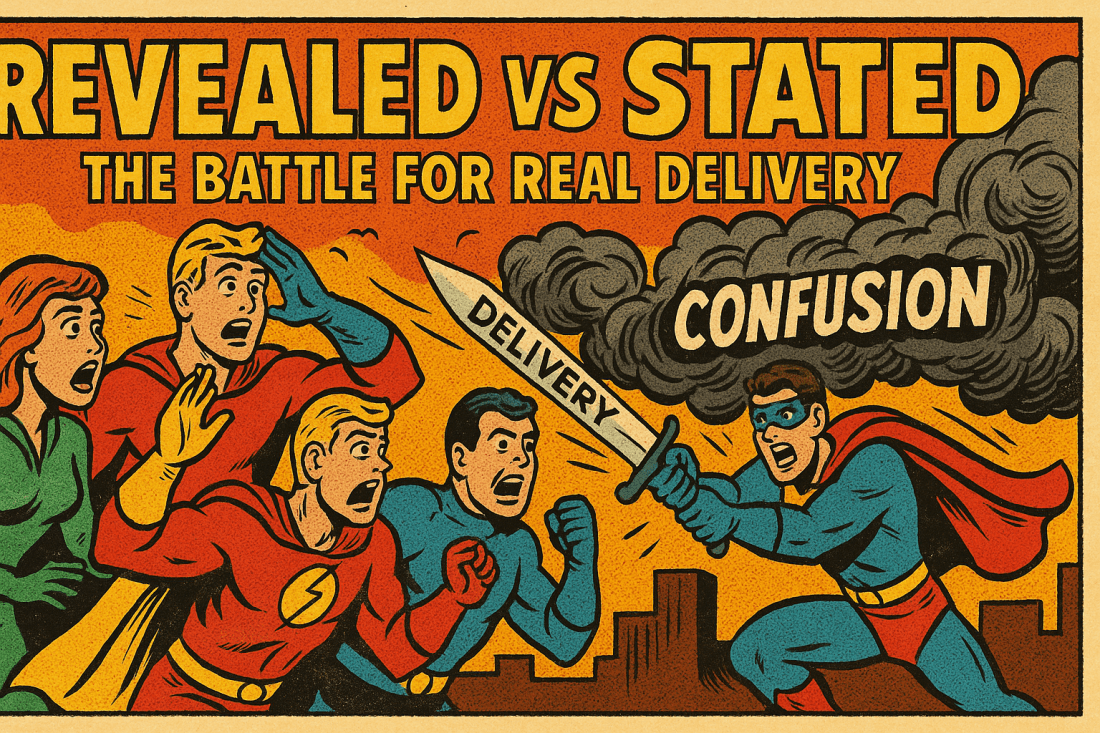
Every product and engineering leader has seen this pattern. A room full of smart people declares:
- “We want fewer priorities.”
- “We will follow the operating model.”
- “This initiative is the top strategic priority.”
- “We are committed to data-driven decisions.”
Then, within days, behavior contradicts what was said. Side work appears. Priorities shift. Leaders quietly push their pet projects. Teams say yes to everything. Decisions made on Monday fall apart by Thursday.
This gap between what people say and what they do is the difference between stated preferences and revealed preferences, a concept rooted in behavioral economics from Paul Samuelson and Gary Becker.
Stated preferences are what people wish were true. Revealed preferences are what they act on. Organizations that ignore this gap drift. Organizations that confront it deliver.
How to Identify Revealed Preferences Inside Your Organization
1. Follow the time, not the talk
Calendars reveal priorities better than strategy decks.
Andy Grove captured this in High Output Management, noting that leaders often claim architectural work is vital while spending all their time on escalations. [Link]
At Google, teams optimized for leadership product reviews, not roadmaps. Those meetings became the real forcing function. [Link]
2. Look for quiet work multipliers
Yahoo pre Marissa Mayer is a classic case. Leaders stated they supported focus while creating hundreds of priorities behind the scenes. [Link]
3. Examine who gets rewarded
Values are revealed through promotions and praise.
Netflix states this clearly in its culture memo: “Values are shown by who gets rewarded and who gets let go.” [Link]
If heroics get rewarded while platform discipline gets ignored, heroics become the true preference.
4. Check what gets escalated
Teams escalate what they believe matters. If pet projects escalate faster than roadmap work, the hidden priorities are obvious.
5. Listen for the quiet “yes, but”
- “Yes, we support the model, but I need this done outside it.”
- “Yes, we want fewer priorities, but we need this exception.”
Chris Argyris documented this pattern as “espoused theory versus theory in use.” [Link]
The truth lives in behavior, not statements.
How to Avoid the Trap: Turning Revealed Preferences Into Better Decisions
1. Stop accepting verbal alignment as alignment
Amazon solved this by requiring written alignment through six page narratives. [Link] If someone will not commit in writing, they are not aligned.
2. Run decision pre mortems
Based on Gary Klein’s research, pre mortems force hidden risks and incentives into the open.[Link] Ask:
- What behavior would contradict this
- Who benefits if this fails
- What incentive might undermine it
3. Build friction into special requests
Atlassian and Shopify use portfolio scorecards that require public tradeoffs for every exception. [Link, Link] This prevents hidden work from overwhelming teams.
4. Tie every priority to measurable outcomes
Google’s Project Aristotle showed that clarity and structure drive performance. Link Metrics force real preferences into daylight.
5. Ask for preferred failure mode
The UK Government Digital Service used this approach to uncover real priorities, often revealing that speed and usability mattered more than perfect accuracy. [Link]
When to Accept Revealed Preferences Instead of Fighting Them
1. Accept it when executive behavior is consistent
If leaders consistently act one way, that behavior is the strategy. Microsoft under Steve Ballmer said innovation mattered, but behavior optimized for Windows and Office. Satya Nadella highlighted this in Hit Refresh. [Link]
2. Accept it when culture contradicts the stated strategy
Clayton Christensen’s The Innovator’s Dilemma shows that organizations follow cultural and economic incentives, not aspirational strategy. [Link]
If firefighting culture dominates, you will get firefighting, not platforms.
3. Accept it when it reveals real power structures
The real org chart is the list of who can successfully redirect a team’s time.
4. Accept it when it reflects external pressure
Fintech leaders stated that velocity mattered until regulators forced compliance to become the true priority. [Link]
Sometimes the revealed preference is survival.
Delivery Happens When You Lead With Reality, Not Rhetoric
Every organization claims it values delivery. Yet delivery consistently fails in the gap between what leaders say they want and what their behavior actually supports.
If a leader claims focus but adds side work, delivery slips.
If a sponsor claims predictability but changes scope constantly, delivery stalls.
If a steering group claims platform maturity but rewards firefighting, delivery dies.
Delivery is not about tools or talent.
Delivery is a revealed preference problem.
Organizations deliver when behavior aligns with the strategy.
When calendars match the roadmap.
When exceptions have a cost.
When incentives reinforce the plan.
Great organizations feel calm and predictable because behavior supports commitments.
Weak organizations feel chaotic because behavior contradicts them.
Closing the gap between stated and revealed preferences is the single most important delivery intervention a leader can make.
Delivery Is What You Prove, Not What You Announce
Every organization carries two delivery strategies:
- The one written in slides.
- The one enforced through behavior.
Only the second one ships.
If you want real delivery, build around what people actually do.
Hold leaders accountable to behavioral alignment.
Confront contradictions early.
Design your operating model around reality, not aspiration.
Once behavior and strategy match, delivery stops being a goal and becomes the natural byproduct of how the organization works.
 bencoding