From Golden Records to Golden Insights: AI Agents Redefining Enterprise Data

The traditional Golden Record, once seen as the pinnacle of enterprise data management and unifying customer, employee, and asset data into a single authoritative truth, is rapidly becoming a legacy pattern. Today, enterprises are shifting towards a more dynamic concept known as the Golden Source, a foundational layer of continuously validated data from which AI Agents generate real-time, actionable Golden Insights.

The Shift from Golden Records to Golden Sources

Historically, enterprises relied on centralized Master Data Management (MDM) or Customer Data Platforms (CDPs) to maintain static golden records. However, these rigid data structures fail to meet the demands of real-time decision-making and agility required by modern businesses.

Now, organizations adopt a more fluid Golden Source, where data remains continuously updated, validated, and accessible in real-time, allowing AI agents to act dynamically and generate immediate, context-rich insights.

AI Agents: Catalysts of Golden Insights

AI agents leverage real-time data from Golden Sources to provide actionable, predictive, and prescriptive insights:

  • Hightouch’s data activation rapidly resolves identity and enriches customer data directly from the Golden Source, empowering agents to instantly deliver personalized interactions (Hightouch).
  • Salesforce’s Data Cloud and Agentforce continuously analyze data streams from a Golden Source, delivering dynamic insights for sales, service, and marketing (Salesforce).

AI agents no longer rely solely on static data snapshots; instead, they generate real-time Golden Insights, informing instant decision-making and workflow automation.

Impact on Enterprise SaaS Solutions

HRIS (Workday)

Workday’s Agent System of Record exemplifies the transition from static employee records to dynamic, real-time insights. Agents proactively manage payroll, onboarding, and compliance using immediate insights drawn directly from an always-updated Golden Source (Workday).

CRMs (Salesforce)

Salesforce leverages its Data Cloud as a dynamic Golden Source. AI agents continuously analyze customer data streams, generating immediate insights that drive autonomous sales outreach and customer support actions.

Enterprise Implications

  1. Dynamic Decision-Making: Enterprises gain agility through real-time Golden Insights, enabling rapid response to market conditions and customer behaviors.
  2. Enhanced Agility and Flexibility: Continuous validation and enrichment of data sources allow businesses to swiftly adapt their strategies based on current insights rather than historical data.
  3. Improved Operational Intelligence: AI agents provide actionable insights in real-time, significantly improving operational efficiency and effectiveness.

Strategic Implications for SaaS Providers: Securing Data Moats

Major SaaS providers such as Salesforce and Workday are embracing the shift from static Golden Records to dynamic Golden Sources to strengthen and preserve their data moats. By embedding these real-time capabilities deeply into their platforms, these providers:

  • Enhance their platform’s value, reinforcing customer dependency.
  • Increase switching costs for enterprises, maintaining long-term customer retention.
  • Position themselves as indispensable partners, central to their customers’ data-driven decision-making processes.

Recommended Actions

StakeholderRecommendations
EnterprisesTransition from static Golden Records to dynamic Golden Sources to enable real-time, actionable insights. Prioritize agile data governance.
Salesforce/WorkdayAccelerate the adoption and promotion of dynamic Golden Source strategies, integrating deeper AI capabilities to maintain competitive differentiation.
Other SaaS VendorsInnovate beyond legacy MDM models by building flexible, interoperable data platforms capable of generating immediate Golden Insights.

✨ Final Thoughts

The evolution from static Golden Records to dynamic Golden Sources and real-time Golden Insights powered by AI agents signifies a transformational shift in enterprise data management. This transition enables enterprises to move from reactive to proactive decision-making, resulting in increased agility, improved customer experiences, and higher operational efficiency. Moreover, it opens the door to innovative business models such as predictive and proactive services, subscription-based insights, and outcome-driven partnerships where real-time data and insights directly contribute to measurable business outcomes. Enterprises embracing this shift are well-positioned to capture significant competitive advantages in the evolving digital landscape.

🔗 Further Reading

The Hidden Superpower in Product Teams: Reverse Mentoring

In most organizations, mentorship flows in one direction. Seasoned professionals guide those earlier in their careers. But as the pace of technology accelerates and the definition of a “well-rounded” product leader evolves, a different kind of mentorship is proving just as valuable: reverse mentoring.

What Is Reverse Mentoring?

Reverse mentoring flips the traditional model. Junior employees, often digital natives or early-career technologists, share insights, tools, and perspectives with more senior colleagues. This is not just about helping executives stay current. It is about creating stronger, more adaptable teams that are built for the future of work.

Why It Matters for Technologists

Product and engineering leaders are expected to stay ahead of emerging tools, platforms, and user behaviors. But no one can track everything. Reverse mentoring creates an intentional space for learning, helping experienced technologists gain hands-on exposure to:

  • New frameworks, SDKs, or platforms gaining traction in developer communities
  • AI and automation tools that are transforming workflows in real time
  • Evolving patterns in UX, content consumption, and digital-native behaviors
  • Fresh takes on developer experience, open-source contributions, and rapid prototyping

This is not theoretical. For example, a Gen Z engineer may introduce a staff engineer to AI-assisted coding tools like Cody or explain how community platforms like Discord are changing the expectations of online collaboration.

Tailoring Reverse Mentoring by Role

Not all reverse mentoring relationships look the same. The value and approach should be shaped by the context of each role:

  • Engineers benefit from reverse mentoring focused on emerging technologies, open-source tools, and new development paradigms. Their junior counterparts often experiment more freely and bring fresh coding philosophies or automation hacks that can streamline legacy workflows.
  • Designers can benefit from exposure to trends in mobile-first design, motion graphics, or inclusive UX principles. Junior creatives often stay closer to the cultural edge, drawing inspiration from social platforms and newer creative tools that can reinvigorate design thinking.
  • Product Managers gain a better understanding of digital-native user behavior, evolving collaboration expectations, and the tools preferred by frontline teams. This insight can make roadmaps more relevant, communication more effective, and prioritization more grounded in reality.

Reverse mentoring should not be one-size-fits-all. A successful program considers each role’s unique learning edge and opportunities for growth.

Challenges and Cautions

While reverse mentoring brings many benefits, it is not without its challenges:

  • Power Dynamics: Junior employees may hesitate to be fully candid. Without psychological safety, reverse mentoring can become performative rather than productive.
  • Time and Commitment: Both parties need dedicated time and a structure for the relationship to work. Ad-hoc meetings tend to lose momentum quickly.
  • Misaligned Expectations: If either party expects immediate results or treats the relationship as a one-way knowledge transfer, the impact will be limited.
  • Cultural Resistance: In some organizations, hierarchies are deeply ingrained. Shifting the perception that learning only flows upward takes deliberate leadership support.

To succeed, reverse mentoring must be treated with the same intention as any leadership or development initiative. Clear objectives, feedback loops, and ongoing support are key.

Building the Next Generation of Leaders

Reverse mentoring is more than a tactical learning tool. It is a leadership accelerator.

For senior employees, it builds curiosity, adaptability, and humility. These are traits that are increasingly critical for leading modern teams. For junior employees, it cultivates confidence, communication skills, and exposure to strategic thinking far earlier in their careers than traditional paths allow.

Embedding reverse mentoring into your product and engineering culture creates a stronger leadership bench at every level. It also signals to your organization that learning is not a function of age or title. It is a function of mindset and engagement.

The Bottom Line

In an industry focused on what comes next, reverse mentoring helps technologists and product organizations stay grounded, relevant, and connected. It is not just a nice-to-have. It is a strategic advantage.

It may feel unconventional. But in the world of innovation, that is often where the magic begins.

#ProductLeadership #ReverseMentoring #TechLeadership #FutureOfWork #MentorshipMatters #EngineeringLeadership #ProductManagement #TeamCulture #NextGenLeaders #CareerDevelopment #DigitalTransformation #AIandTech #InclusiveLeadership #OrganizationalCulture

Balancing Vision and Execution in a Ship-It Culture

Who owns the Product Vision in your organization, and how clearly is it defined? How does your team align on strategy, and is execution a challenge? Perhaps you’ve solved for all these elements, or maybe the relentless pace of shipping leaves little room for reflection.

In a culture dominated by the relentless mantra of “Ship-It,” there is a seductive appeal in equating velocity with progress. Speed to market can become an obsession, driven by agile rituals and iterative dogma, often causing strategy, and more crucially Vision, to be sidelined. This phenomenon isn’t merely problematic; it’s existential. Without Vision anchoring execution, organizations risk accelerating down paths that lead nowhere meaningful, sacrificing long-term competitive advantage for the transient comfort of motion.

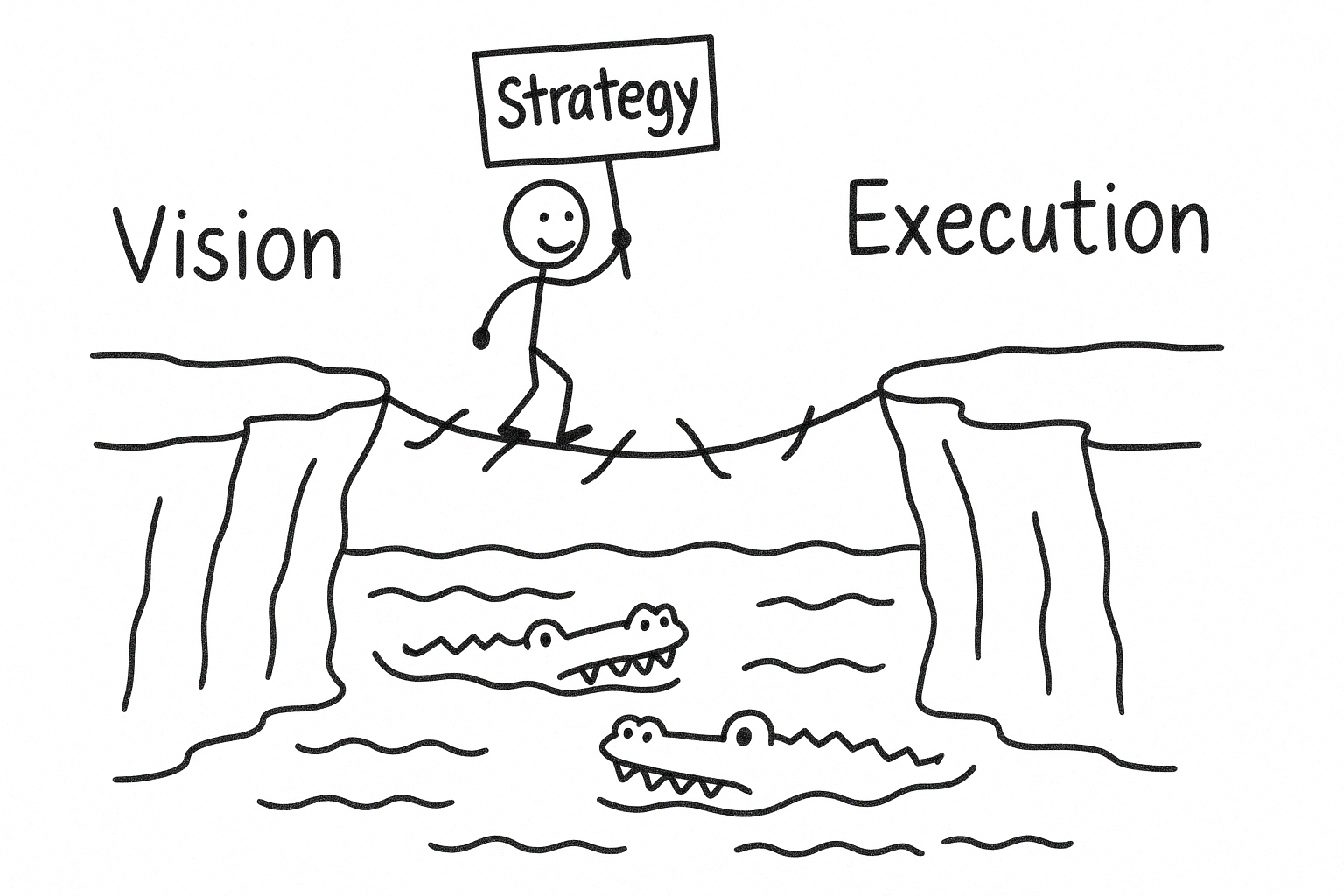
Strategy, far from being the bureaucratic nuisance it is often painted as, serves as the essential bridge between Vision and execution. It acts as the scaffolding that ensures each incremental effort compounds into sustainable differentiation rather than dissipating into disconnected efforts. Yet in the rush to deliver, strategy frequently becomes an inconvenient step, a luxury dismissed by leaders who prioritize pace over purpose. The true role of strategy is not to slow down innovation but to amplify impact by aligning each shipment with the organization’s broader goals.

Vision suffers the greatest neglect in this culture of immediacy. True Vision provides not only a north star but also an enduring framework for strategic coherence. When Vision is overlooked or undervalued, companies inevitably fragment into tactical chaos, mistaking activity for achievement. The paradox is clear: the very speed sought by a “Ship-It” culture is best achieved by clarifying Vision first, strategically aligning efforts second, and then relentlessly shipping toward meaningful outcomes.

No matter where your organization finds itself on the strategy journey, maintaining a balance between thoughtful planning and decisive action is critical. The most successful teams aren’t those who avoid missteps entirely but those who remain committed to progress, excited by the opportunity to continuously learn and refine their approach along the way.