The Role of the Directly Responsible Individual (DRI) in Modern Product Development

Why This Matters to Me

I have been in too many product discussions where accountability was fuzzy. Everyone agreed something mattered, but no one owned it. Work stalled, deadlines slipped, and frustration grew. I have also seen the opposite, projects where one person stepped up, claimed ownership, and pushed it forward.

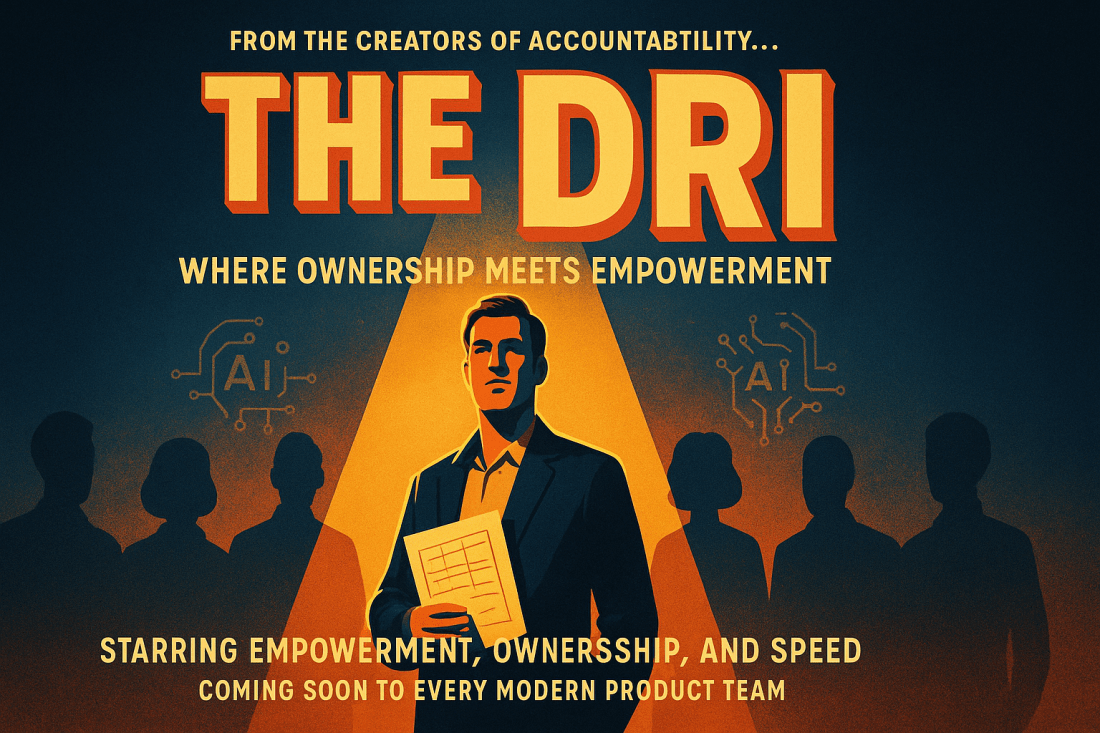
That is why the Directly Responsible Individual (DRI) matters. It is more than a process borrowed from Apple or GitLab. It is a mindset shift toward empowerment and clarity.

What Is a DRI?

DRI is the single person accountable for a project, decision, or outcome. They may not do all the work, but they ensure it gets done. Steve Jobs made the practice famous at Apple, where every important task had a DRI so ownership was never in doubt. (handbook.gitlab.combitesizelearning.co.uk)

In my experience, this clarity is often the difference between projects that deliver and those that linger.

Strengths and Weaknesses

The DRI model works because it removes ambiguity. With a clear owner, decisions move faster, resources are coordinated, and teams feel empowered. Assigning someone as a DRI is a signal of trust: we believe you can make this happen. (tettra.com)

The risks are real too. A DRI without proper authority can be set up to fail. Too much weight on one individual can stifle collaboration or lead to burnout. And if organizations treat the role as a label without substance, it quickly collapses. (levelshealth.comdbmteam.com)

Examples in Practice

  • GitLab: Embeds DRIs across the organization, with clear documentation and real authority. (GitLab Handbook)
  • Levels Health: Uses DRIs in its remote-first culture, often as volunteers, supported by “buddies” and documentation. (Levels Blog)
  • Coda: Assigns DRIs or “drivers” for OKRs and pairs them with sponsors for balance. (Coda Blog)

The lesson is clear. DRIs succeed when paired with support and clear scope. They fail when given responsibility without authority.

Rolling Out DRIs

Adopting DRIs is a cultural shift, not just a process tweak. Some organizations roll them out gradually, starting with a few high-visibility initiatives. Others go all in at once. I lean toward gradual adoption. It builds confidence and proves impact before scaling.

Expect the early days to feel uncomfortable. Accountability brings clarity but also pressure. Some thrive, others resist. Over time, the culture shifts and momentum builds.

Change management matters. Leaders must explain why DRIs exist, provide support structures like sponsors, and create psychological safety. If failure leads to punishment, no one will volunteer.

The Clash with Command-and-Control IT

The DRI model often collides with the command-and-control style of traditional enterprise IT. Command-and-control relies on centralized approvals and shared accountability. The DRI approach decentralizes decisions and concentrates accountability.

I believe organizations that cling to command-and-control will fall behind. The only path forward is to create space for DRIs in product teams while still meeting enterprise compliance needs.

How AI Is Shaping DRIs

AI is becoming a force multiplier for DRIs. It can track progress, surface risks, and summarize input, giving individuals more time to focus on outcomes. But accountability cannot be outsourced to an algorithm. AI should make the DRI role easier, not weaker.

Empowerment and Conclusion

At its core, the DRI model is about empowerment. When someone is trusted with ownership, they rise to the challenge. They move faster, make decisions with confidence, and inspire their teams. I have seen people flourish under this model once they are given the chance.

For senior leaders, the next steps are clear. Identify accountability gaps, assign DRIs to a few strategic initiatives, and make those assignments visible. Pair them with sponsors, support them with AI, and commit publicly to backing them.

If you want empowered teams, faster results, and less ambiguity, DRIs are one of the most effective levers available. Those that embrace them will build stronger cultures of ownership. Those that resist will remain stuck in command and control. I know which side I want to be on.

Why DIY: A ChatGPT Wrapper Isn’t the Best Enterprise Strategy

TL;DR: The Buy vs Build

ChallengeBuild (DIY Wrapper)Buy (Enterprise Solution)
CostTens to hundreds of thousands in build plus ongoing maintenance (applifylab.comsoftermii.commedium.com)Predictable subscription model with updates and support
SecurityVulnerable to prompt injection, data leaks, and evolving threats (en.wikipedia.orgwired.comwsj.com)Enterprise-grade safeguards built in such as encryption, RBAC, and monitoring
RewardLimited differentiation and fragile ROIFaster time to value, scalable, and secure

Do not fall for the trap of thinking “we are different” or “we can do this better with our framework.” Building these wrapper experiences has become the core product that multi-billion-dollar model makers are selling. If this is an internal solution, think very carefully before taking that path. Unless your wrapper directly connects to a true market differentiator, it is almost always wasted effort. And even then, ask whether it can simply be implemented through a GPT or an MCP tool that already exists in commercial alternatives like Microsoft Copilot, Google Gemini, or ChatGPT Enterprise.

This is a textbook example of a modern buy vs build decision. On paper, building a ChatGPT wrapper looks straightforward, it’s just an API after all right. In practice, the costs and risks far outweigh the benefits compared to buying a purpose-built enterprise solution.

Don’t fall for the trap that “we are different” or “we can do this better with our framework” as building these experiences have become the core experience these multi-billion dollar model makers are now selling. If this is an internal solution, thing hard before falling for this trap. Unless this is somehow linked to your market differentiator. Even then think can this simply be a GPT or a MCP tool used by a commercial alternative like Co-Pilot, Gemini, or ChatGTP enterprise.

1. High Costs Upfront with Diminishing Returns

Even a seemingly modest AI wrapper quickly escalates into a significant investment. According to ApplifyLab, a basic AI wrapper app often costs $10,000 to $30,000, while a mid-tier solution ranges from $30,000 to $75,000, and a full enterprise-level implementation can exceed $75,000 to $200,000+, excluding ongoing costs like infrastructure, CI/CD, and maintenance (applifylab.com).

Industry-wide estimates suggest that launching complete AI-powered software, particularly in sectors such as fintech, logistics, or healthcare, can cost anywhere from $100,000 to $800,000+, driven by compliance, security, robust pipelines, and integration overhead (softermii.com).

Even just a proof-of-concept (POC) to test value can run $50,000 to $150,000 with no guarantee of ROI (medium.com).

Buy vs Build Takeaway: By the time your wrapper is ready for production, the cost-to-benefit ratio often collapses compared to simply adopting an enterprise-ready platform.

2. Security Risks with Low Visibility and High Stakes

DIY wrappers also tend to fall short on enterprise-grade security.

  • Prompt Injection Vulnerabilities
    LLMs are inherently vulnerable to prompt injection attacks where crafted inputs (even hidden in documents or websites) can manipulate AI behavior or expose sensitive data. OWASP has flagged prompt injection as the top risk in its 2025 LLM Applications report (en.wikipedia.org).
    Advanced variations, such as prompt-to-SQL injection, can compromise databases or trigger unauthorized actions via middleware such as LangChain (arxiv.org).
    Real-world cases have already shown indirect prompt injection manipulating GPT-powered systems such as Bing chat (arxiv.org).
  • Custom GPT Leaks
    OpenAI’s custom “GPTs” have been shown to leak initialization instructions and uploaded files through basic prompt injection, even by non-experts. Researchers easily extracted core data with “surprisingly straightforward” prompts (wired.com).
  • Broader LLM Security Risks
    Generative AI systems are now a target for malicious actors. Researchers have even demonstrated covert “AI worms” capable of infiltrating systems and exfiltrating data through generative agents (wired.comwsj.com).
    More broadly, the WSJ notes that LLMs’ open-ended nature makes them susceptible to data exposure, manipulation, and reliability problems (wsj.com).

Building your own ChatGPT wrapper may feel like innovation, but it often ends up as a costly distraction that delivers little competitive advantage. Buying enterprise-ready solutions provides scale, security, and speed while allowing your team to focus on higher-value work. In the modern AI landscape, where risks are growing and the pace of change is accelerating, this is one of the clearest examples of why buy often beats build.

#AI #DigitalTransformation #CTO

Strategic Planning vs. Strategic Actions: The Ultimate Balancing Act

Let’s be blunt: If you are a technology leader with a brilliant strategy deck but nothing shipping, you are a fraud. If you are pumping out features without a clear strategy, you are gambling with other people’s money. The uncomfortable truth is that in tech leadership, vision without execution is delusion, and execution without vision is chaos.

Think about the companies we have watched implode. Kodak literally invented the digital camera but failed to commit to shifting their business model in time (Investopedia). Blockbuster had a roadmap for streaming before Netflix took off but never acted decisively, choosing comfort over speed. Their strategies looked great on paper right up until the moment they became cautionary tales.

The reverse problem of being all action and no plan is just as dangerous. Teams that constantly chase shiny objects, launch half-baked features, or pivot every few months might look busy, but they are building on quicksand. Yes, they might get lucky once or twice, but luck does not scale. Without a coherent plan, every success is an accident waiting to be reversed.

The leaders who get it right treat plans and actions as inseparable. Procter & Gamble’s OGSM framework aligns global teams on objectives, strategies, and measurable actions (Wikipedia). The Cascade Model starts with vision and values, then connects them directly to KPIs and delivery timelines (Cascade). Best Buy’s turnaround in the early 2010s, with price matching Amazon, investing in in-store experience, and expanding services, worked because it was both a clear plan and a relentless execution machine (ClearPoint Strategy). Nike’s 2021–2025 roadmap is another example, with 29 public targets supported by measurable actions (SME Strategy).

If you are leading tech without both vision and velocity, you are either drifting or spinning in place. Neither wins markets. Your job is not just to make a plan, it is to make sure the plan lives through your delivery cadence, your roadmap decisions, and your metrics.

Applying the Balance to AI Adoption

The AI revolution is no longer approaching, it is here. Nearly half of Fortune 1000 companies have embedded AI into workflows and products, shifting from proving its value to scaling it across the organization (AP News). But AI adoption demands more than flashy pilots. It requires the same balance of strategic planning and relentless execution.

Many organizations are experiencing AI creep through grassroots experiments. A recent survey found that 72% of employees using AI report saving time weekly, yet most businesses still lack a formal AI strategy (TechRadar). This gap is risky. Spontaneous adoption delivers early wins, but without an intentional rollout these remain one-off tricks rather than transformative advances.

The shift is forcing companies to formalize leadership. Chief AI Officers are now often reporting directly to CEOs to steer AI strategy, manage risks, and align use cases with business priorities (The Times). Innovators like S&P Global are mandating AI training, moving developer AI use from 7% to 33% of code generation in months, and building “Grounding Agents” for autonomous research on proprietary data (Business Insider).

Steering AI at scale requires a framework, not spontaneity. Gartner’s AI roadmap outlines seven essential workstreams, from strategy, governance, and data to talent, engineering, and value portfolios, so leaders can prioritize AI with clarity and sequence (Gartner). AI adoption also succeeds only when trust, transparency, and cultural fit are embedded, particularly around fairness, peer validation, and organizational norms (Wendy Hirsch).

Introducing AI into your product development process without a strategic scaffold is like dropping nitro on a house of cards. You might move fast, but any misalignment, governance gap, or cultural mismatch will bring it all down. The antidote is to anchor AI initiatives in concrete business outcomes, empower cross-functional AI working groups, invest in upskilling and transparency, and govern with clear risk guardrails and metrics.

Your Next Action

In your experience, which derails AI transformation faster: lack of strategic planning or reckless execution without governance? Share the AI initiatives that flamed out or flipped your company upside down, and let us unpack what separates legendary AI adoption from another shiny pilot. Because in tech leadership, if vision and velocity are not joined in your AI strategy, you are either running illusions or waiting for a miracle.

One-Word Checkout: The Small Ritual That Cuts Through Complexity and Accelerates Product Development

Why Meetings Need a Cleaner Landing

Even the best‑run product teams can let a meeting drift at the end. Action items blur, emotional undercurrents go unspoken, and complexity silently compounds. A concise closing ritual refocuses the group and signals psychological completion.

What the One‑Word Checkout Is

The one‑word checkout is a brief closing round in which each attendee offers a single word that captures their current state of mind or key takeaway;“aligned,” “blocked,” “energized,” “unclear,” “optimistic,” and so on. This micro‑ritual forces clarity, surfaces concerns that might otherwise stay hidden, and guarantees every voice is acknowledged. Embedding the checkout into recurring meetings builds shared situational awareness, spots misalignment early, and stops complexity before it cascades into rework.

How One Word Tames Complexity

  1. Forces Synthesis
    Limiting expression to one word pushes each person to distill the swirl of discussion into its essence, reducing cognitive load for everyone listening.
  2. Surfaces Hidden Signals
    Words like “anxious” or “lost” flag misalignment that polite silence might otherwise hide. Early detection prevents rework later.
  3. Creates Shared Memory
    A rapid round of striking words is easier to recall than lengthy recap notes, strengthening collective understanding of the meeting’s outcome.
  4. Builds Psychological Safety
    Knowing that every voice will be heard, even briefly, reinforces inclusion and encourages honest feedback in future sessions.

When to Use One‑Word Checkout

Apply this technique in meetings where fast alignment and shared ownership are critical; examples include daily stand‑ups, backlog refinement, sprint planning, design reviews, and cross‑functional workshops. Use it when the group is small enough that everyone can speak within a minute or two (typically up to 15 people) and when the meeting’s goal is collaborative decision‑making or problem‑solving. The ritual works best once psychological safety is reasonably high, allowing participants to choose honest words without fear of judgment.

When Not to Use One‑Word Checkout

Skip the ritual in large broadcast‑style meetings, webinars, or executive briefings where interaction is minimal and time is tightly scripted. Avoid it during urgent incident calls or crisis huddles that require rapid task execution rather than reflection. It is also less helpful in purely asynchronous updates; in those cases, a written recap or status board is clearer. Finally, do not force the exercise if the team’s psychological safety is still forming; a superficial round of safe words can mask real concerns and erode trust.

Direct Impact on Product Development

Challenge in Product WorkOne‑Word Checkout Benefit
Requirements creep“Unclear” highlights ambiguity before it snowballs into code changes.
Decision latency“Decided” signals closure and lets engineering start immediately.
Team morale dip“Drained” prompts leaders to adjust workload or priorities.
Stakeholder misalignment“Concerned” from a key stakeholder triggers follow‑up without derailing the agenda.

Implementation Guide

  1. Set the Rule
    At the first meeting, explain that checkout words must be one word. No qualifiers or back‑stories.
  2. Go Last as the Facilitator
    Model brevity and authenticity. Your word sets the tone for future candor.
  3. Capture the Words
    A rotating scribe adds the checkout words to the meeting notes. Over time you will see trends such as morale swings or recurring clarity issues.
  4. Review in Retros
    In sprint retrospectives, display a word cloud from the last two weeks. Ask the team what patterns they notice and what should change.
  5. Measure the Effect
    Track two metrics before and after adopting the ritual:
    • Decision cycle time (idea to committed backlog item)
    • Rework percentage (stories reopened or bugs logged against completed work)
    Many teams see a 10‑15 percent drop in rework within a quarter because misalignment is caught earlier.

Case Snapshot: FinTech Platform Team

A 12‑person squad building a payments API introduced one‑word checkout at every stand‑up and planning session. Within six weeks:

  • Average user‑story clarification time fell from three days to same day.
  • Reopened tickets dropped by 18% quarter over quarter.
  • Team eNPS rose from 54 to 68, driven by higher psychological safety scores.

The engineering manager noted: “When two people said ‘confused’ back‑to‑back, we paused, clarified the acceptance criteria, and avoided a sprint’s worth of backtracking.”

Tips to Keep It Sharp

  • Ban Repeat Words in the same round to encourage thoughtful reflection.
  • Watch for Outliers. A single “frustrated” amid nine “aligned” words is a gift; dig in privately.
  • Avoid Judgment during the round. Follow‑up happens after, not during checkout.

Alternatives to One‑Word Checkout

If the one‑word checkout feels forced or does not fit the meeting style, consider other concise alignment rituals. A Fist to Five vote lets participants raise zero to five fingers to show confidence in a decision; low scores prompt clarification. A traffic‑light round—green, yellow, red—quickly signals risk and readiness. A Plus/Delta close captures one positive and one improvement idea from everyone, fueling continuous improvement without a full retrospective. Choose the ritual that best matches your team’s culture, time constraints, and psychological safety level.

Thoughts

Complexity in product development rarely explodes all at once. It seeps in through unclear requirements, unvoiced concerns, and meetings that end without closure. The one‑word checkout is a two‑minute ritual that uncovers hidden complexity, strengthens alignment, and keeps product momentum high. Small habit, big payoff.

Try it out

Try the ritual in your next roadmap meeting. Collect the words for a month and review the patterns with your team. You will likely find faster decisions, fewer surprises, and a clearer path to shipping great products.


#ProductStrategy #TeamRituals #CTO

Beyond Busywork: Rethinking Productivity in Product Development

We have all seen the dashboards: velocity charts, commit counts, ticket throughput.
They make for tidy reports. They look great in an executive update. But let’s be honest, do they actually tell us if our teams are building the right things, in the right way, at the right time?

A recent Hacker News discussion, Let’s stop pretending that managers and executives care about productivity, hit a nerve. It pointed out a hard truth: too often, “productivity” is measured by what is easy to count rather than what actually matters. For technology leaders, this raises a critical question: are we optimizing for activity or for impact?

Before we can improve how we measure productivity, we first need to understand why so many traditional metrics fall short. Many organisations start with good intentions, tracking indicators that seem logical on the surface. Over time, these measures can drift away from reflecting real business value and instead become targets in their own right. This is where the gap emerges between looking productive and actually creating outcomes that matter.

We have seen this play out in practice. Atlassian warns on relying heavily on raw JIRA velocity scores when they realized it encouraged teams to inflate story point estimates rather than improve delivery outcomes. Google’s engineering teams have spoken about the risk of “metric gaming” and have stressed the importance of pairing speed indicators with measures of impact and reliability.

Why Shallow Metrics Fail

Several years ago, I was in a leadership meeting where a project was declared a success because the team had delivered 30% more story points than the previous quarter. On paper, it was an impressive jump. In reality, those features did not move the needle on adoption, customer satisfaction, or revenue. We had measured output, not outcome.

High-functioning teams do not just ship more. They deliver meaningful business value. That is where our measurement frameworks need to evolve.

DORA Metrics: A Better Starting Point

The DevOps Research and Assessment (DORA) group has done extensive research to identify four key metrics that balance speed and stability:

  1. Deployment Frequency – How often you deploy code to production.
  2. Lead Time for Changes – How quickly a change moves from code commit to production.
  3. Change Failure Rate – How often deployments cause a failure in production.
  4. Mean Time to Recovery (MTTR) – How fast you recover from a failure.

These are powerful because they connect process efficiency with system reliability. For example, I joined a project that was deploying only once a quarter. While this schedule reduced change risk, it also created long lead times for customer-facing features and made responding to feedback painfully slow. Over the course of six months, we incrementally improved our processes, automated more of our testing, and streamlined our release management. The result was moving to a two-week deployment cycle, which allowed the team to deliver value faster, respond to market needs more effectively, and reduce the risk of large-scale release failures by making changes smaller and more manageable.

The caution: if you treat DORA as a leaderboard, you will get teams “optimizing” metrics in ways that undermine quality. Used correctly, they are a diagnostic tool, not a performance scorecard.

Connecting DORA to Business Outcomes

For technology leaders, DORA metrics should not exist in isolation. They are most valuable when they are tied to business results that the board cares about.

  • Deployment Frequency is not just about speed, it is about how quickly you can respond to market shifts, regulatory changes, or customer feedback.
  • Lead Time for Changes impacts time-to-revenue for new features and directly affects competitive advantage.
  • Change Failure Rate affects customer trust and brand reputation, both of which have measurable financial consequences.
  • MTTR influences client retention, contractual SLAs, and the ability to contain operational risk.

When framed this way, engineering leaders can make the case that improving DORA scores is not just a technical goal, but a growth and risk mitigation strategy. This connection between delivery performance and commercial outcomes is what elevates technology from a support function to a strategic driver.

Innovative Metrics to Watch

Forward-thinking companies are experimenting with new ways to measure productivity:

  • Diff Authoring Time (DAT) – Used at Meta, this tracks how long engineers spend authoring a change. In one experiment, compiler optimisations improved DAT by 33%, freeing up engineering cycles for higher-value work.
  • Return on Time Invested (ROTI) – A simple but powerful concept: for every hour spent, what is the measurable return? This is especially useful in evaluating internal meetings, process reviews, or new tool adoption.

The Pitfalls of Over-Measurement

There is a dark side to metrics. Wired recently called out the “toxic” productivity obsession in tech where every keystroke is tracked and performance is reduced to a spreadsheet. It is a quick path to burnout, attrition, and short-term thinking.

As leaders, our job is not to watch the clock. It is to create an environment where talented people can do their best work, sustainably.

Takeaway

Productivity in product development is not about being busy. It is about delivering lasting value.
Use DORA as a starting point, augment it with reliability, developer experience, and business outcome metrics, and experiment with emerging measures like DAT and ROTI. But always remember: metrics are there to inform, not to define, your team’s worth.

Thoughts

The best technology organizations measure what matters, discard vanity metrics, and connect engineering performance directly to business value. Metrics like DORA, when used thoughtfully, help teams identify bottlenecks and improve delivery. Innovative measures such as DAT and ROTI push our understanding of productivity further, but they only work in cultures that value trust and sustainability. As technology leaders, our challenge is to ensure that our measurement practices inspire better work rather than simply more work.