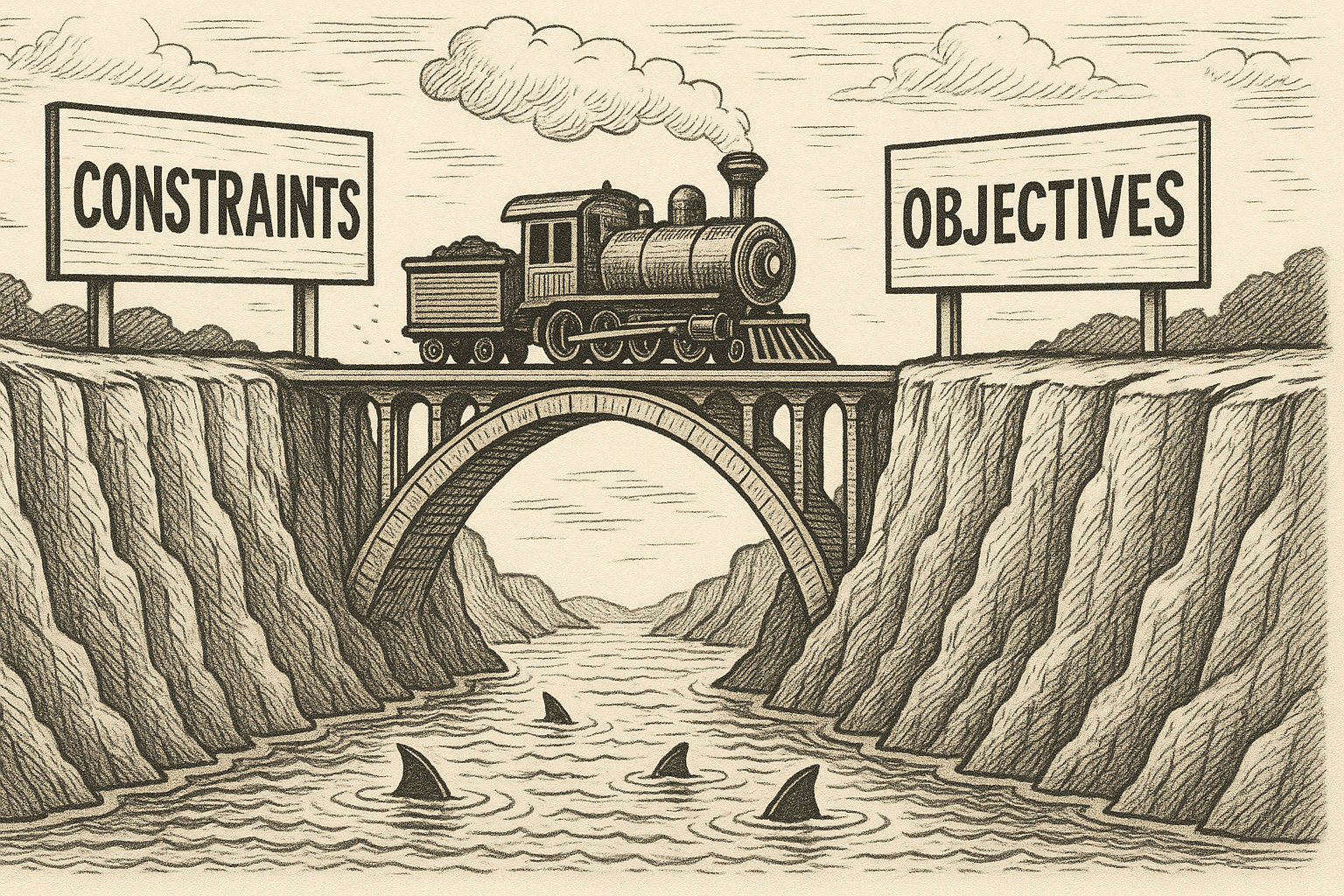
Bridging Constraints and Objectives with Data in Product Launches

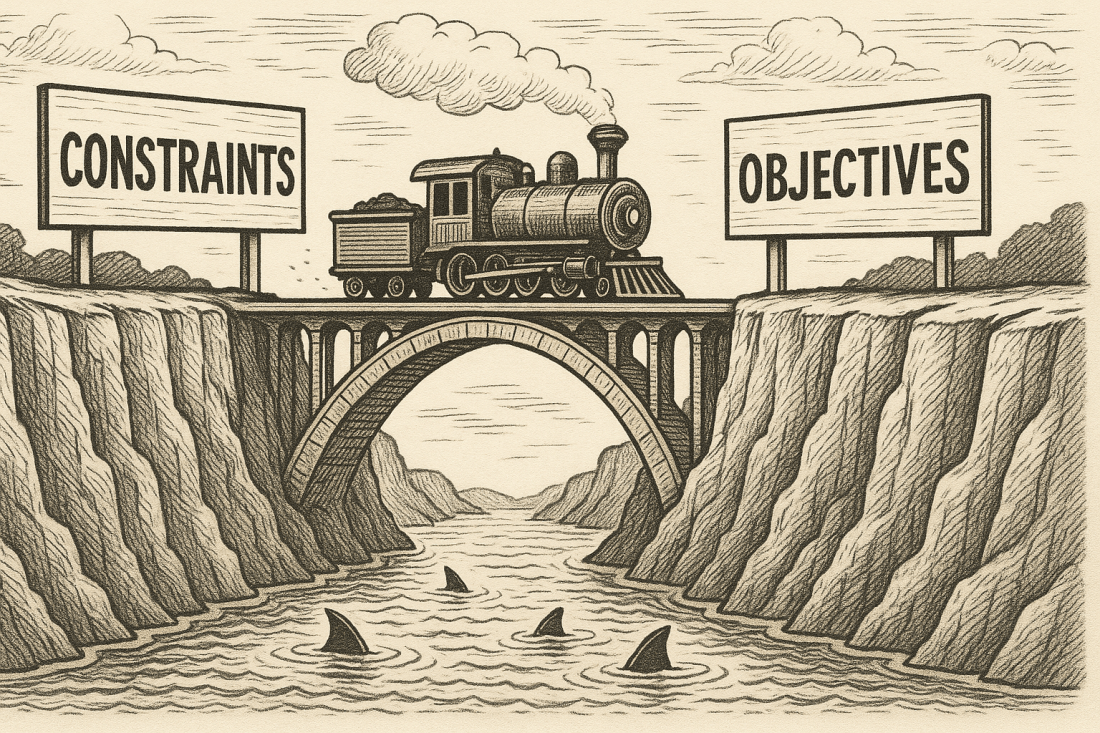
Launching a new product means navigating tension: bold objectives on one side, and real-world constraints on the other. You want to move fast, deliver value, and stand out in the market, but you’re held back by resource limits, compliance requirements, and fixed deadlines. The difference between vision and execution? It’s often how well you use data to connect the two.

Why Data is the Bridge

Data enables product leaders to:

  • Quantify what’s possible within given limits
  • Align stakeholders on the tradeoffs that matter
  • Validate market assumptions before committing to scale
  • Convert ambiguity into informed action

Used well, data doesn’t just guide, you de-risk your decisions with it.

1. Use Data to Define the Real Constraints

Most teams understand their high-level constraints: budget, time, people. But data can help you go deeper and quantify the impact of those constraints.

  • Burn rate models estimate how far your current budget takes you.
  • Headcount capacity planning identifies delivery bottlenecks.
  • Compliance risk scoring can uncover which features require the most red tape.

Then, tie constraints to revenue impact:

  • Revenue impact modeling shows what features or launches are delayed and how that delay affects potential earnings.
  • For example, if a delayed feature defers onboarding 1,000 users per month at a $50 average revenue/user, you can quantify that tradeoff: $50,000/month in deferred revenue.

Action tip: Frame constraint discussions around their revenue implications to drive smarter tradeoffs.

2. Translate Objectives into Measurable Signals

Ambitious goals like “win the mid-market” or “increase retention” need clear, data-backed definitions:

  • Use market sizing data to break down total addressable market (TAM), serviceable obtainable market (SOM), and key buyer personas.
  • Map strategic goals (e.g., “expand to EMEA”) to product KPIs (e.g., time-to-localization, conversion rates by region).
  • Use customer segmentation data to align objectives with where the most revenue or growth potential exists.

Action tip: Create a “data-to-objective map” that connects strategic goals to specific, quantifiable signals in your product analytics.

3. Use Data to Understand Market Fit Early

Product success hinges on whether it meets a real market need, and whether that market is worth entering.

  • Search trends, competitor pricing, and customer spend data can help validate demand before investing.
  • Use tools like Google Trends, LinkedIn job postings, or firmographic data to identify which markets are growing or underserved.
  • Analyze customer willingness-to-pay surveys and early funnel data (e.g., demo conversion rates) to refine positioning.

Action tip: Layer third-party data with internal early signals to triangulate real market opportunity before full launch.

4. Apply Data to Prioritize Tradeoffs Transparently

Every product decision requires a tradeoff. But data helps you make those tradeoffs visible, quantifiable, and less political.

  • Run feature impact simulations to model revenue uplift vs development time.
  • Use churn data to highlight which constraints (e.g., lack of functionality, latency, onboarding friction) are losing you customers.
  • Score roadmap options by business value per unit of effort to prioritize efficiently.

Action tip: Build a tradeoff matrix that pairs data with decision velocity, so leadership can move with confidence, not caution.

5. Align Stakeholders with Shared Data Visibility

Cross-functional stakeholders often have competing priorities. Data helps unify focus around outcomes, not opinions.

  • Build shared dashboards that track both constraint metrics (e.g., spend, velocity) and objective metrics (e.g., adoption, revenue).
  • Use visual storytelling to show the downstream effects of decisions, such as how one-month delays reduce first-year revenue projections by X%.

Action tip: Establish a shared “north star” metric that links product, revenue, and operational perspectives.

6. Use Feedback Loops to Navigate Uncertainty

Post-launch, data is your compass. Assumptions will shift, and your ability to adapt fast will determine your success.

  • Monitor early adoption and feature usage data to refine roadmap priorities.
  • Use voice of customer data to catch friction points before churn accelerates.
  • Track changes in market or competitor data to stay ahead of disruption.

Action tip: Treat every launch like an ongoing experiment, use data to validate, not just to report.

Thoughts

Taking a product to market is a balancing act. The most successful leaders aren’t just bold, they’re informed. They use data to quantify the real constraints, validate the market opportunity, and continuously weigh tradeoffs against business value.

If you want to move faster, align better, and launch smarter, ask yourself: Where can data help me bridge the gap between what I want to do and what I actually can do?

#ProductStrategy #CTO #CPO #CIO
Why Every Professional Services Firm Should Embrace Digital Products

The landscape for professional services firms is shifting faster than ever. Driven by client expectations for efficiency, personalization, and measurable value, digital transformation is no longer optional. It is a business imperative. Today’s clients are sophisticated buyers who expect more than traditional advisory or compliance services. They want solutions that are always-on, data-driven, and tailored to their needs.

Why Is Productization So Important for Services Firms?

Integrating digital products into a services business can be a true force multiplier.

  • Stronger Client Relationships: Digital products enable deeper, more sustained client engagement by delivering value between engagements and offering self-service capabilities.
  • Operational Scale: Products automate repeatable processes, freeing up expert capacity for higher-value work.
  • Differentiation: Well-designed digital products create unique value propositions that set firms apart in crowded markets.
  • Data-Driven Insights: By embedding products in service delivery, firms gain actionable insights into client behavior and emerging needs, which fuels both innovation and more relevant advice.

Impact on Firm Valuation

Digital products can fundamentally change a services firm’s valuation profile. Product revenue is valued higher than traditional services due to its recurring nature, higher margins, and scalability. Firms with a blend of services and software typically command stronger multiples in the market. Productization is not just a growth lever but a strategic asset for long-term value creation.

Three Strategic Paths to Productization

There is no one size fits all approach to productizing a services business. The optimal strategy depends on your firm’s client base, core capabilities, and vision for the future. Some firms start by embedding digital tools into their existing service model to increase efficiency and enhance client value. Others develop adjacent, standalone offerings that open up new revenue streams or extend their expertise into digital form. The most ambitious transform their entire service ecosystem into a connected digital platform, fundamentally changing their business model.

Below are three proven approaches to integrating digital products into a professional services business, each with distinct advantages and potential risks. Understanding these paths is critical for leaders seeking to future-proof their firm and unlock new levels of value for both clients and shareholders.

1. Embedded Productization

Approach:
Embed digital tools such as dashboards, workflow automation, or client portals directly into existing service workflows. These tools streamline delivery, automate manual tasks, and enhance transparency.

Benefits:

  • Accelerates adoption by integrating seamlessly with ongoing client work.
  • Drives operational efficiency, reducing cost-to-serve.
  • Differentiates the firm by providing clients with tangible value-adds.

Risks:

  • Clients may perceive these as incremental improvements rather than standalone value.
  • Teams accustomed to legacy ways of working may resist change.
  • Tools built primarily for internal use may be harder to scale or monetize externally.

Example:
A tax advisory firm integrates an automated client document intake portal within its compliance process, reducing manual effort and error rates.
EY Canvas – EY’s audit workflow platform

2. Adjacent Digital Offerings

Approach:
Develop standalone digital products that leverage your domain expertise but operate independently from your core services. Examples include compliance automation platforms, benchmarking dashboards, or self-guided planning tools.

Benefits:

  • Creates new, scalable revenue streams via subscriptions or licenses.
  • Deepens client relationships by offering continuous, proactive value.
  • Opens the door to new client segments and geographies.

Risks:

  • Requires new skills in product management, digital marketing, and customer success.
  • Can cannibalize advisory revenues if not positioned correctly.
  • Risk of missing product-market fit without robust user research.

Example:
A law firm launches a SaaS platform that helps clients track and manage regulatory filings, offered as a subscription service.
PwC’s “ProEdge” upskilling platform

3. Platform Play

Approach:
Build or acquire an integrated digital platform that connects multiple services, client data, and even third-party solutions. The platform becomes the firm’s operating system for client delivery, engagement, and innovation.

Benefits:

  • Positions the firm as an ecosystem orchestrator, not just a service provider.
  • Aggregates data for analytics, benchmarking, and AI-driven insights.
  • Drives higher valuation multiples due to recurring revenue and network effects.

Risks:

  • Requires high upfront investment and longer time to realize returns.
  • Demands a major shift in culture, mindset, and operating model.
  • Platform adoption can be challenging if clients are fragmented across technologies.

Example:
A major HR consultancy launches a cloud-based talent management platform that integrates assessment, onboarding, training, and performance management. This platform serves both enterprise clients and their employees through a single interface.
Mercer’s “Mercer | Mettl” Talent Assessment Platform

Conclusion

For professional services firms, integrating digital products is not just about keeping up. It is about future-proofing the business and strengthening the value delivered to clients. The right product strategy can unlock new revenue streams, create defensible differentiation, and increase your firm’s valuation. The path you choose—whether embedded tools, adjacent offerings, or a full platform—should align with your firm’s vision and client base. Leaders who invest in productization today will be tomorrow’s market leaders.

How is your organization approaching digital transformation?

The AI Agent Revolution: How Product Management Will Transform

AI is rapidly reshaping every discipline, but its impact on Product Management may be one of the most profound and underestimated shifts happening today. The rise of autonomous AI Agents is not just a tool change. It represents a fundamental evolution in how products are envisioned, built, and scaled.

The Current State: AI Agents as Accelerators

Today, AI Agents are already augmenting Product Managers (PMs) in several key ways:

  • Market & User Research: Tools like ChatGPT and Claude can quickly synthesize user feedback, summarize competitive research, and even generate personas from large datasets.
  • Roadmapping & Prioritization: AI-driven solutions such as Productboard’s AI Assist analyze customer requests, trend data, and engineering capacity to recommend feature prioritization.
  • Experimentation & Analysis: PMs are using AI Agents to automate A/B test design and result interpretation. For example, Amplitude’s AI tools surface actionable insights from product usage data that would take human analysts days to uncover.
  • Documentation & Communication: Agents are writing release notes, synthesizing meeting transcripts, and even drafting stakeholder emails. This reduces busywork and gives PMs back valuable time.

Example in Practice:
At Microsoft, PM teams are using Copilot to automate status reporting, aggregate feedback from Azure DevOps, and provide intelligent next-step suggestions all within the workflow. This allows PMs to spend more time with users and less time on repetitive updates.

Historical Parallels: From Waterfall Product Management to Agile, and Now AI

To fully appreciate where we are headed, it is important to look back at how product management has evolved. Traditionally, the product management process mirrored the Waterfall methodology of software development. It was linear, rigid, and heavily reliant on upfront planning and documentation. Product managers would spend months gathering requirements, building detailed roadmaps, and defining release cycles, with limited ability to adapt quickly to market feedback or changing user needs. Progress was measured in milestone documents and phased handoffs, rather than in real-time impact.

The shift to Agile changed everything. Agile methodologies empowered PMs and teams to embrace iteration, rapid prototyping, and close feedback loops. The focus moved from static plans to continuous delivery, learning, and adaptation. This evolution unlocked greater speed, innovation, and customer alignment.

Now, with the arrival of AI Agents, we are on the brink of another revolution. Just as Agile replaced Waterfall, AI is poised to move product management beyond even Agile’s rapid cycles. We are entering an environment where autonomous agents learn, iterate, and act in real time, allowing PMs to focus on the highest-value strategic decisions.

What’s Changing: From Assistant to Autonomous Product Agent

We are at an inflection point where AI Agents will move from being helpers to actual doers. The next wave of agents will be able to:

  • Proactively Identify Opportunities: Instead of waiting for PMs to define problems, agents will monitor usage, NPS, and market shifts to surface new product bets.
  • Draft and Validate Solutions: Agents will suggest wireframes, create PRDs, and even run early prototype tests with real users using digital twins and simulation.
  • Own Tactical Execution: Routine backlog grooming, user story mapping, and sprint planning will become automated. This will allow PMs to focus on vision and business outcomes.
  • Close the Loop with Engineering & Design: With multi-agent collaboration (see OpenAI’s GPTs and Google’s Gemini), AI agents will interact directly with design and engineering tools. They will push changes, create tickets, and track dependencies with minimal human intervention.

Emerging Example:
Startups like Adept and LlamaIndex are building agent frameworks that enable AI to take action across tools. This includes pulling analytics, updating Jira, and even creating Figma prototypes autonomously. Motional uses AI product agents to run simulations for autonomous vehicle feature testing, shortening cycles from weeks to hours.

The Next Frontier: AI-Powered Market Research

As product management embraces AI, one of the most promising developments is the use of AI agents for market research and user insights. According to a recent a16z analysis, AI tools are beginning to automate and transform the market research process. This shift enables PMs to understand customer needs at a scale and speed previously impossible.

Traditionally, market research involved time-consuming interviews, surveys, and manual data analysis. AI is now disrupting this model in several key ways:

  • Automated, Large-Scale Qualitative Research: AI can conduct thousands of simultaneous interviews, analyze sentiment, and summarize key themes across vast datasets in hours instead of weeks.
  • Deeper, Real-Time Consumer Insights: AI agents can tap into social media, review sites, and support channels, continuously surfacing new patterns and unmet needs as they emerge. This means PMs get early signals and can iterate faster.
  • Rapid Prototyping and Testing: The blog highlights how product teams can use generative AI to test product concepts, messaging, or UI designs with virtual users or real consumers at scale, getting statistically significant feedback almost instantly.

AI-powered market research, as highlighted by a16z, gives product managers faster, deeper insights for feature prioritization, user segmentation, and go-to-market decisions. PMs who leverage AI for continuous, automated market understanding will build more relevant products and outperform those using traditional methods.

The Future: Product Management as Orchestration

By 2030, product management will look very different:

  • The PM as an Orchestrator: The PM’s role will evolve into orchestrating swarms of specialized AI agents. Each will focus on a specific domain, such as research, delivery, or customer insights.
  • Faster, Smarter, More Iterative: Prototyping cycles will shrink from months to days. Products will launch with AI-managed experiments running in the wild, learning and adapting at a scale no human team could match.
  • New Skills Required: Success will depend on mastering AI orchestration, agent prompt engineering, and understanding the ethical and strategic implications of AI-driven product cycles.
  • Radical Collaboration: With autonomous agents handling the “what” and “how,” PMs will double down on the “why.” Their focus will shift to customer empathy, market positioning, and strategic bets.

Quote from Marty Cagan, SVPG:

“The next era of product creation will be led by those who can harness AI to not just accelerate, but fundamentally reimagine the product development process.”
(SVPG: The Era of the Product Creator)

References & Further Reading

Final Thoughts

AI agents are here, and they are quickly moving from simply augmenting product management to fundamentally transforming it. The best PMs will embrace this shift, not as a threat, but as a once in a generation opportunity to build better products, faster, and with more impact than ever before.

How are you preparing for the era of AI-augmented product management?