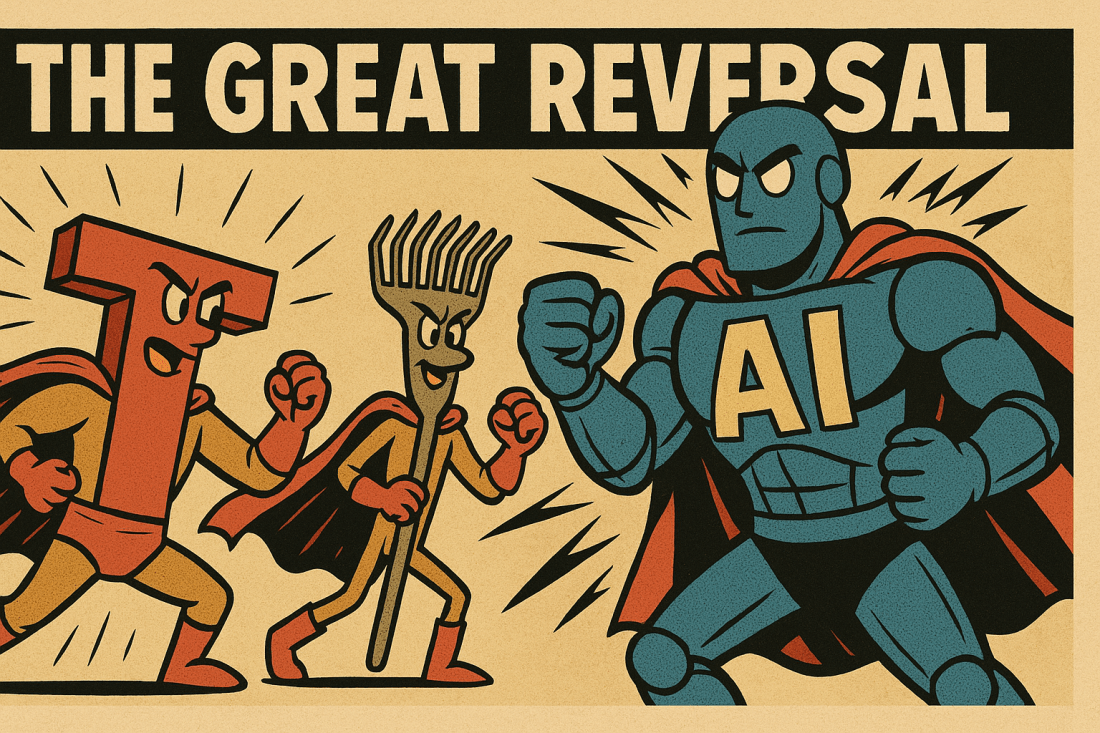
The Great Reversal: Has AI Changed the Specialist vs. Generalist Debate?

For years, career advice followed a predictable rhythm: specialize to stand out. Be the “go-to” expert, the person who can go deeper, faster, and with more authority than anyone else. Then came the countertrend, where generalists became fashionable. The Harvard Business Review argued that broad thinkers, capable of bridging disciplines, often outperform specialists in unpredictable or rapidly changing environments.
HBR: When Generalists Are Better Than Specialists—and Vice Versa

But artificial intelligence has rewritten the rules. The rise of generative models, automation frameworks, and intelligent copilots has forced a new question:
If machines can specialize faster than humans, what becomes of the specialist, and what new value can the generalist bring?

The Specialist’s New Reality: Depth Is No Longer Static

Specialists once held power because knowledge was scarce and slow to acquire. But with AI, depth can now be downloaded. A model can summarize 30 years of oncology research or code a Python function in seconds. What once took a career to master, AI can now generate on demand.

Yet the specialist is not obsolete. The value of a specialist has simply shifted from possessing knowledge to directing and validating it. For example, a tax expert who understands how to train an AI model on global compliance rules or a medical researcher who curates bias-free datasets becomes exponentially more valuable. AI has not erased the need for specialists; it has raised the bar for what specialization means.

The new specialist must be both a deep expert and a domain modeler, shaping how intelligence is applied in context. Technical depth is not enough. You must know how to teach your depth to machines.

The Generalist’s Moment: From Connectors to Orchestrators

Generalists thrive in ambiguity, and AI has made the world far more ambiguous. The rise of intelligent systems means entire workflows are being reinvented. A generalist, fluent in multiple disciplines such as product, data, policy, and design, can see where AI fits across silos. They can ask the right questions:

  • Should we trust this model?
  • What is the downstream effect on the client experience?
  • How do we re-train teams who once performed this work manually?

In Accenture’s case, the firm’s focus on AI reskilling rewards meta-learners, those who can learn how to learn. This favors generalists who can pivot quickly across domains, translating AI into business outcomes.
CNBC: Accenture plans on exiting staff who can’t be reskilled on AI

AI gives generalists leverage, allowing them to run experiments, simulate strategies, and collaborate across once-incompatible disciplines. The generalist’s superpower, pattern recognition, scales with AI’s ability to expose patterns faster than ever.

The Tension: When AI Collapses the Middle

However, there is a danger. AI can also collapse the middle ground. Those who are neither deep enough to train or critique models nor broad enough to redesign processes risk irrelevance.

Accenture’s stance reflects this reality: the organization will invest in those who can amplify AI, not those who simply coexist with it.

The future belongs to T-shaped professionals, people with one deep spike of expertise (the vertical bar) and a broad ability to collaborate and adapt (the horizontal bar). AI does not erase the specialist or the generalist; it fuses them.

The Passionate Argument: Both Camps Are Right, and Both Must Evolve

The Specialist’s Rallying Cry: “AI needs us.” Machines can only replicate what we teach them. Without specialists who understand the nuances of law, medicine, finance, or engineering, AI becomes dangerously confident and fatally wrong. Specialists are the truth anchors in a probabilistic world.

The Generalist’s Rebuttal: “AI liberates us.” The ability to cross disciplines, blend insights, and reframe problems is what allows human creativity to thrive alongside automation. Generalists build the bridges between technical and ethical, between code and client.

In short: the age of AI rewards those who can specialize in being generalists and generalize about specialization. It is a paradox, but it is also progress.

Bottom Line

AI has not ended the debate. It has elevated it. The winners will be those who blend the curiosity of the generalist with the credibility of the specialist. Whether you are writing code, crafting strategy, or leading people through transformation, your edge is not in competing with AI, but in knowing where to trust it, challenge it, and extend it.

Takeaway

  • Specialists define the depth of AI.
  • Generalists define the direction of AI.
  • The future belongs to those who can do both.

Further Reading on the Specialist vs. Generalist Debate

  1. Harvard Business Review: When Generalists Are Better Than Specialists—and Vice Versa
    A foundational piece exploring when broad thinkers outperform deep experts.
  2. CNBC: Accenture plans on exiting staff who can’t be reskilled on AI
    A look at how one of the world’s largest consulting firms is redefining talent through an AI lens.
  3. Generalists
    This article argues that generalists excel in complex, fast-changing environments because their diverse experience enables them to connect ideas across disciplines, adapt quickly, and innovate where specialists may struggle.
  4. World Economic Forum: The rise of the T-shaped professional in the AI era
    Discusses how professionals who balance depth and breadth are becoming essential in hybrid human-AI workplaces.
  5. McKinsey & Company: Rewired: How to build organizations that thrive in the age of AI
    A deep dive into how reskilling, systems thinking, and organizational design favor adaptable talent profiles.

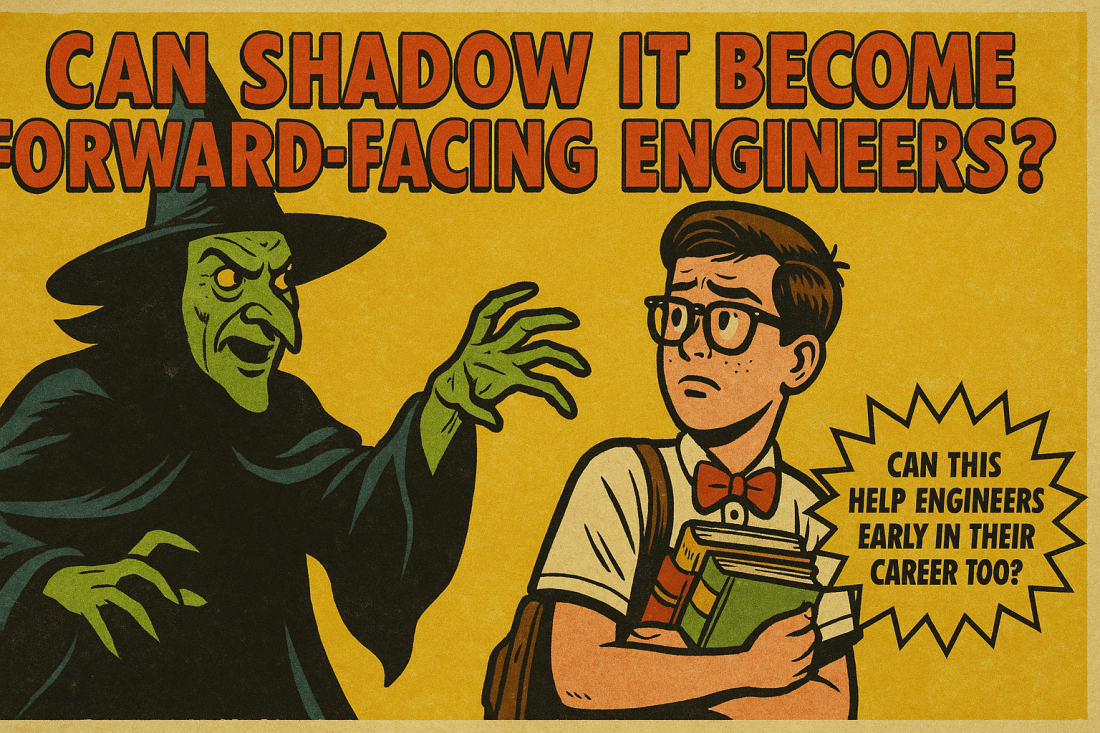
Turning Shadow IT into Forward-Facing Engineers

Across industries, shadow IT and citizen developers are no longer fringe activities; they are mainstream. The reason this is true is that the friction to get started has dropped to zero: with vibe coding, low-code platforms, and simply having access to ChatGPT, anyone can prototype solutions instantly. Business-side employees are building tools in Excel, Power Automate, Airtable, and other platforms to close gaps left by official systems. Instead of blocking these efforts, forward-looking organizations are embracing them and creating pathways for these employees to become forward-facing engineers who can deliver secure, scalable, client-ready solutions.

Why This Works

  • Bridge Business and Tech: Citizen developers deeply understand workflows and pain points. With the right training, they can translate business needs into technical delivery.
  • Accelerate Innovation: Harnessing shadow IT energy reduces bottlenecks and speeds delivery, without sacrificing governance.
  • Boost Engagement: Recognizing and investing in shadow IT talent motivates employees who are already passionate about problem-solving.
  • AI as an Equalizer: AI copilots and low-code tools lower the barrier to entry, making it easier for non-traditional technologists to scale their impact.

Risks to Manage

  • Security & Compliance: Shadow IT often overlooks governance. Retraining is essential.
  • Technical Debt: Quick wins can become brittle. Guardrails and code reviews are non-negotiable.
  • Cultural Resistance: Engineers may see this as encroachment. Clear roles and communication prevent friction.
  • Sustainability: The end goal is not just prototypes; it is enterprise-grade solutions that last.

The Playbook: From Shadow IT to Forward-Facing Engineers

The transition from shadow IT to forward-facing engineers is not a single leap; it is a guided journey. Each stage builds confidence, introduces new skills, and gradually shifts the employee’s mindset from quick fixes to enterprise-grade delivery. By laying out a clear progression, organizations can reduce risk while giving employees the structure they need to succeed.

Stage 1: Discovery & Assessment

This is about spotting hidden talent. Leaders should inventory shadow IT projects and identify who built them. The emphasis here is not on perfect code, but on curiosity, persistence, and problem-solving ability.

  • Inventory shadow IT solutions and identify their creators.
  • Assess aptitude based on curiosity and problem-solving.
  • Example: A bank’s operations team mapped its shadow macros before deciding who to upskill into engineering apprentices.

Stage 2: Foundations & Guardrails

Once talent is identified, they need a safe place to learn. Provide basic training, enterprise-approved platforms, and the guardrails to prevent compliance issues. This stage is about moving from “hacking things together” to “building responsibly.”

  • Train on secure coding, APIs, cloud, version control, and AI copilots.
  • Provide sandbox environments with enterprise controls.
  • Pair learners with senior mentors.
  • Example: Microsoft used Power Platform “fusion teams” to let business users build apps in sanctioned environments.

Stage 3: Structured Apprenticeship

Now comes immersion. Participants join product pods, experience agile rituals, and begin contributing to low-risk tasks. This apprenticeship gives them firsthand exposure to engineering culture and delivery standards.

  • Place candidates in agile product pods.
  • Assign low-risk features and bug fixes.
  • Example: At Capital One, former business analysts joined pods through internal engineering bootcamps, contributing to production code within six months.

Stage 4: Forward-Facing Engineering

At this stage, participants step into the spotlight. They start owning features, present solutions to clients, and earn recognition through internal certifications or badging. This is the pivot from being a learner to being a trusted contributor.

  • Provide recognition via certifications and badging.
  • Assign bounded features with client exposure.
  • Example: ServiceNow’s “CreatorCon” has highlighted employees who transitioned from shadow IT builders to client-facing solution engineers.

Stage 5: Leadership & Scaling

Finally, graduates help institutionalize the model. They mentor newcomers, run showcases, and measure success through metrics like migrated solutions and client satisfaction. This is where the cycle becomes self-sustaining.

  • Create a champions network where graduates mentor new entrants.
  • Establish a community of practice with showcases and hackathons.
  • Measure outcomes: number of solutions migrated, number of participants, client satisfaction.
  • Example: Deloitte formalized its citizen development program to scale across service lines, reducing tool duplication and client risk.

Pathways for Talent

Forward-facing engineering can also be a strong entry point for early-career engineers. Given the rapid impact of AI in the market, new engineers can gain confidence and real-world exposure by starting in these roles, where business context and AI-powered tools amplify their ability to contribute quickly. It provides a practical on-ramp to enterprise delivery while reinforcing secure, scalable practices.

  • Technical Track: Forward-facing engineer, automation specialist, platform engineer.
  • Product Track: Product owner, solution architect, business analyst.
  • Hybrid Track: Citizen developer + AI engineer, combining business know-how with AI copilots.

Keys to Success

  1. Executive Sponsorship: Lends legitimacy and resources.
  2. Visible Wins: Showcase transformations from shadow IT to enterprise product.
  3. Continuous Learning: Invest in AI, cloud, and security enablement.
  4. Cultural Alignment: Frame this as empowerment, not replacement.

Bottom Line

Turning shadow IT into forward-facing engineers transforms a risk into an innovation engine. Organizations like Microsoft, Capital One, and Deloitte have shown how structured programs unlock hidden talent. With the right framework, shadow IT contributors can evolve into enterprise-grade engineers who deliver secure, scalable, and client-facing solutions that drive competitive advantage.

🕸️ The Creepiest Part: The Curve Is Still Rising

Somewhere between the thunderclaps of innovation and the quiet hum of data centers, a strange chill fills the air. It’s not the wind. It’s not the ghosts. It’s the sound of AI adoption still accelerating long after everyone thought it might slow down.

Because if there’s one thing scarier than a monster rising from the lab,
it’s realizing it’s still growing.

⚡ The Laboratory of Limitless Growth

Deep inside a candlelit castle, lightning flashes across the stone walls. Test tubes bubble with neural networks, and electricity hums through old copper wires. At the center of it all, Frankenstein’s monster stands hunched over a chalkboard.

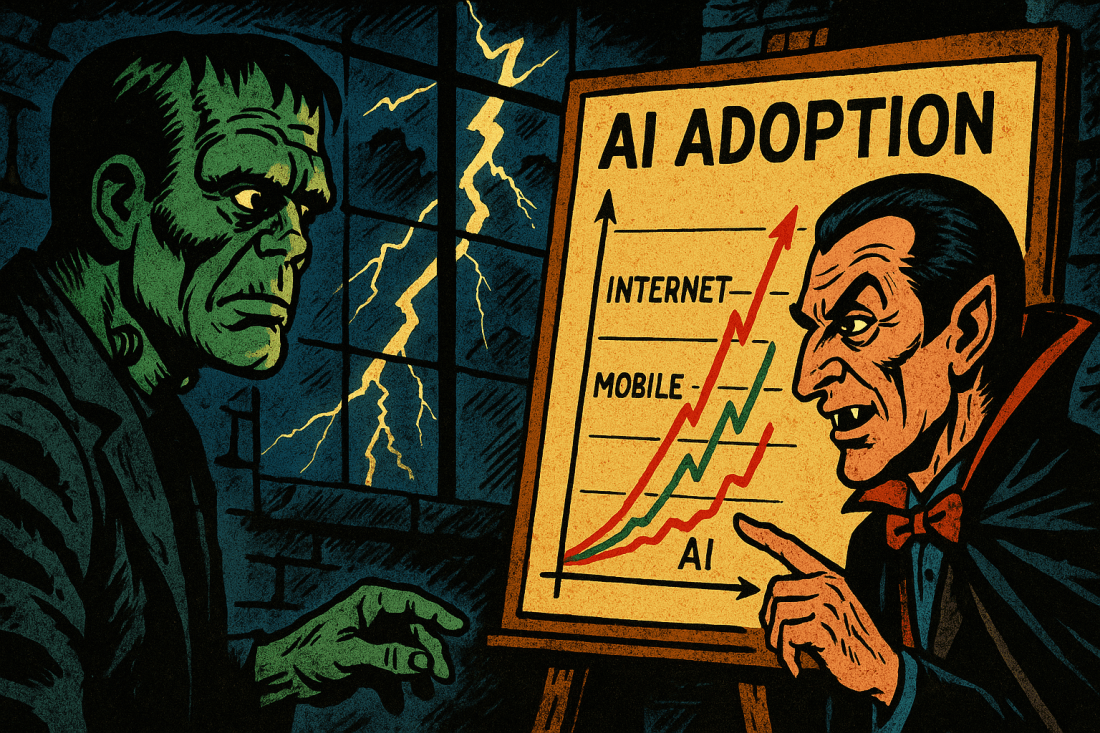
On it are three jagged lines, one for the Internet, one for Mobile, and one, glowing ominously in neon green, for AI.

Dr. Frankenstein peers at the data through cracked goggles.
“Impossible,” he mutters, flipping through a pile of parchment labeled St. Louis Fed and eMarketer. “Every curve must flatten eventually. Even the mobile revolution reached a plateau.”

The monster turns, bolts sparking from his neck. “But master,” he says in a low rumble, “the curve… it’s still rising.”

📈 The Data Doesn’t Die

The Count appears in the doorway, cape sweeping dramatically behind him.

Dracula, the eternal observer of technological transformation, carries a tablet glowing with eerie blue light.
“Ah, my dear doctor,” he says, “you’re still studying your creature? You forget, I’ve watched centuries of human obsession. Printing presses, telegraphs, the telephone, the internet. Each one rose, and then rested.”

He smirks, his fangs catching the candlelight.
“But this new creation, this Artificial Intelligence, it refuses to sleep.”

Frankenstein gestures at the graph.
“See here, Count. The Internet took a decade to reach 1 billion users. Mobile took about five. But generative AI? It’s measured in months.”

Dracula’s eyes narrow.
“Yes, I read that in the mortal scholars’ scrolls. The Federal Reserve Bank of St. Louis found AI adoption outpacing every major technology in history, even those bloodthirsty smartphones.”
(source)

He taps his screen, revealing another chart.
“And look here, eMarketer reports that generative AI reached 77.8 million users in two years, faster than the rise of smartphones or tablets.”
(source)

The monster grunts. “Even the villagers use it now. They ask it for recipes, resumes, love letters.”

Dracula raises an eyebrow. “And blood type analyses, perhaps?”

They both laugh, the uneasy laughter of men who realize the experiment has escaped the lab.

🧛 The Curse of Exponential Curiosity

Dracula glides to the window, staring out into the storm. “You see, Frankenstein, mortals cannot resist their reflection. Once they taste a new tool that speaks back, they feed it endlessly. Every prompt, every query, every midnight whisper, more data, more growth.”

“Like feeding a beast,” Frankenstein says.

“Exactly,” Dracula grins. “And this one feeds itself. Every interaction strengthens it. Every mistake teaches it. Even their fears become training data.”

He twirls his cape dramatically. “You’ve not created a machine, my dear doctor. You’ve unleashed an immortal.”

⚙️ Why the Curve Keeps Climbing

The monster scribbles four words on the wall: “No friction. Infinite feedback.”

“That’s the secret,” Frankenstein explains. “Unlike the old revolutions, electricity, mobile, internet, AI doesn’t require factories or towers. It scales through code, not concrete. The more people use it, the more valuable it becomes. That’s why the line won’t flatten.”

Dracula nods. “A perfect storm of seduction: zero cost to start, instant gratification, and endless novelty. Even I couldn’t design a better addiction.”

Together, they stare at the graph again.
The AI line doesn’t level off. It bends upward.

The candles flicker. Somewhere, a server farm hums, millions of GPUs glowing like a field of jack-o’-lanterns in the dark.

🦇 The Night Is Still Young

Dracula turns to Frankenstein. “Do you fear what comes next?”

The doctor sighs. “I fear what happens when the curve stops rising and starts replacing.”

Dracula’s grin fades. For a moment, the immortal looks mortal.
“Perhaps,” he says, “but revolutions always come with a price. The villagers feared your monster once, and now they fear their own machines.”

Lightning cracks across the sky.

“But remember, Doctor,” he continues, “progress is a creature that cannot be killed, only guided.”

The monster, now quiet, whispers, “Then let’s hope we are still the ones holding the switch.”

🎃 The Bottom Line

AI’s adoption curve hasn’t flattened because we’re still discovering what it is.
It’s not a single invention like the phone or the PC. It’s a living layer that spreads through APIs, integrates into tools, and evolves faster than we can measure.

The mobile revolution connected us.
The AI revolution is re-creating us.

And if the trendlines are right, we’re still only at the first act of this gothic tale. The lab lights are still on. The storm still rages.

And somewhere, in the distance, the curve is still rising.

Further Reading (for those who dare look deeper):

Fads vs. Trends: How Enterprise Tech Leaders Can Spot the Difference Before It’s Too Late


In the age of AI hype cycles, quarterly innovation pressures, and VC-fueled buzzwords, it is harder than ever for enterprise technology leaders to separate enduring trends from short-lived fads. Getting it wrong can mean wasting millions or missing the next generational opportunity. So how can leaders tell the difference?

Below, we explore practical criteria for identifying real trends, offer advice for weighing risks versus rewards, and highlight examples where even the smartest in the room got it wrong.

1. Criteria to Distinguish Fads from Trends

CriteriaTrendFad
Underlying NeedSolves a long-standing or emerging business challengeSolves a narrow or niche problem, often not mission-critical
Adoption PatternCross-industry interest with steady enterprise uptakeSudden spike driven by hype, celebrity, or viral exposure
Ecosystem DevelopmentBacked by tooling, standards, training, and community supportLimited ecosystem, few contributors, vendor lock-in
Time HorizonDemonstrates durability over 2 to 5 yearsGains attention fast, fades within 12 to 18 months
Talent MovementTalent shifts into the space (startups, universities, R&D)Little traction in talent pipelines or academic research

Checklist for Tech Leaders
Before investing time, money, or your team’s attention, ask:

  • Does this technology align with our long-term business goals?
  • Are early adopters seeing measurable value?
  • Can our current team learn and apply this, or is it too immature?
  • Is this technology part of a larger movement such as data mesh or low-code, or is it a standalone gimmick?

2. Risk vs. Reward: Betting on the Right Side of History

No risk means no reward. However, getting it wrong can damage credibility, slow down momentum, and reduce your team’s trust in leadership. Here’s a framework to help weigh the decision.

A. Risk of Overcommitment to a Fad

  • Examples:
    • Google Glass in enterprise was hyped as a revolutionary hands-free tool but fizzled due to privacy concerns and poor UX.
    • Clubhouse for business networking exploded during the pandemic but quickly lost relevance.
  • Cost: Wasted capital, sunk opportunity cost, and team disillusionment.

B. Risk of Underinvestment in a Real Trend

  • Examples:
    • Cloud computing in the early 2000s was dismissed by many as insecure and unreliable.
    • AI-powered copilots are now accelerating work, but companies that delayed adoption are falling behind.
  • Cost: Missed market leadership, slower time to value, and harder talent acquisition.

Approach to Mitigate Risk:

  • Start with low-stakes pilots or sandbox environments.
  • Engage cross-functional review panels including business, risk, and tech leaders.
  • Use stage-gate models to monitor value delivery before scaling.
  • Maintain an innovation portfolio that balances safe bets with exploratory investments.

3. When to Be Boring: Choosing Foundations Wisely

If you are positioning a technology as a core part of your business or architectural foundation, you typically do not want to be the newest or most adventurous use case of that solution. It may be tempting to select the latest platform, language, or AI framework in the name of innovation. However, for the systems that keep your business running, boring is often better.

Why Time-Tested Wins:

  • Stability and support ecosystems are mature.
  • Hiring and onboarding are faster with proven stacks.
  • Documentation, integrations, and compliance considerations are more predictable.

This conservative choice does come at a cost. You may not be first to disrupt your competitors. However, you also avoid disrupting your own ability to deliver.

Key Tradeoff to Consider:
Is the benefit of being early enough to differentiate worth the risk of being so early that reliability and scale become an issue?

Use this principle to evaluate infrastructure, identity systems, data platforms, and other backbone technologies. Save your cutting-edge bets for areas where failure is survivable.

4. Real-World Lessons: Why This is Hard

Even seasoned companies have misread the room.

These cases reveal a crucial truth. Visibility and hype are not proxies for viability.

5. Advice for Tech Leaders

  • Do not go it alone. Partner with strategy, finance, and external advisors to build an informed view.
  • Use a “10-10-10” lens. Ask how this will impact your business in 10 weeks, 10 months, and 10 years.
  • Create an internal Innovation Radar that scores technologies on maturity, market relevance, and business alignment.
  • Benchmark regularly. Use resources like Gartner Hype Cycle and BCG’s Tech Radar to understand your position in the market.

Conclusion

Distinguishing fads from trends is not just a technical skill. It is a leadership discipline. The right bets can transform your business. The wrong ones can set you back years. Use structured criteria, apply conservative choices to foundational systems, and embrace experimentation where the downside is survivable. In today’s market, knowing when to be bold and when to be boring is the real competitive advantage.

#EnterpriseTech #TechStrategy #InnovationLeadership #AI #CloudComputing #DigitalTransformation #CTOInsights #HypeCycle #TechnologyTrends

Rethinking Product Strategy in the Age of Data Products

As digital transformation matures, data is no longer just a byproduct of applications; it is the product. Yet many organizations still manage data with outdated, project-centric mindsets, treating it as an output rather than a reusable, consumable asset. For organizations, the shift toward data products marks a fundamental change in how we manage technology, deliver value, and structure teams.

What Are Data Products?

data product is a curated, governed, and reusable dataset or service, packaged with the same discipline you would expect from a traditional software product. It is built to be consumed, not just stored. Whether it’s an API delivering real-time customer metrics, a dataset powering a machine learning model, or a dashboard-ready feed of financial KPIs, a data product is intentionally designed to be discoverable, trusted, and self-serviceable by internal or external stakeholders.

Unlike application products, which focus on user interfaces and direct interaction, data products are focused on enabling decision-making, automation, or downstream systems.

Technical Anatomy of a Data Product

To operate at enterprise scale, a data product must have:

  • Domain Ownership – Aligned to a business domain to ensure context-rich data delivery and accountability
  • Interface Contracts – Defined APIs, SQL endpoints, event streams, or file exports for integration
  • Metadata & Documentation – Data dictionaries, lineage tracking, and guides that reduce friction
  • Embedded Quality Controls – Automated tests, monitoring, and freshness SLAs to build trust
  • Governance & Compliance – Integrated privacy, security, and data classification from the start
  • Observability – Usage tracking, access logging, and lineage monitoring for accountability and auditability

Why Data Products Are Not Just Another Application

While traditional applications focus on user-facing features, data products are fundamentally different:

CharacteristicApplication ProductData Product
Primary UserEnd usersSystems, analysts, models, APIs
Value GenerationThrough interactionThrough consumption and reuse
Design CenterUX, workflows, featuresData quality, access, lineage
Change ImpactLocalized to appRipple effects across multiple products and domains
LifecycleFeature-driven releasesFreshness, versioning, schema evolution

You are no longer building tools for users. You are building infrastructure for insights.

Embedding Data Products into the Product Management Landscape

To manage data products effectively, product management principles must evolve:

  • Cross-Functional Teams – Combine data engineers, domain experts, analysts, and governance specialists
  • Success Metrics – Shift from delivery-based KPIs (e.g., “dataset completed”) to outcomes like “customer churn reduced” or “model accuracy improved”
  • Iterative Lifecycle – Account for ongoing updates based on new sources, schema changes, or regulatory needs
  • Backlog Management – Engage directly with data consumers to prioritize changes and new features
  • Product Funding Model – Transition from project-based funding to sustained investment in reusable data capabilities

Why Data Products Matter, and Where They Fit in Your Strategy

Data products are not a side effort. They are foundational to a modern digital strategy. As organizations pursue AI, personalization, workflow automation, and advanced analytics, data becomes the fuel. But without structured, scalable, and governed data products, these initiatives stall.

In your technology strategy, data products operate between infrastructure and applications:

  • They are powered by your cloud and data platforms, but are more than raw storage layers
  • They serve product teams by enabling better features, personalization, and automation
  • They bridge silos by powering use cases across customer experience, operations, compliance, and beyond
  • They are core to platform strategies, enabling consistent and governed data usage across an ecosystem of tools and services

Organizations that understand and invest in this role will move faster, deliver more value, and compete based on intelligence rather than features alone.

Executive Checklist: Are You Productizing Your Data?

Ask yourself:

✅ Is every major domain accountable for a set of documented, consumable data products?
✅ Are data products discoverable through a central catalog or self-service platform?
✅ Do you fund teams to manage and evolve data assets continuously?
✅ Are consumption, freshness, and quality metrics actively tracked and reported?
✅ Do AI, reporting, and integration use cases rely on curated, trusted data products?

If several of these answers are “no,” it may be time to rethink your data strategy.

Conclusion

Data products are the connective tissue of modern digital businesses. Treating them with the same rigor and intentionality as traditional software is no longer optional. It is essential. As technology leaders, we must ensure that data is not just collected, but curated, governed, and delivered in ways that power the business, on demand, at scale, and with confidence.

#DataProducts #CIO #CTO #DigitalTransformation #AIEnablement #ProductStrategy #EnterpriseArchitecture #DataGovernance #ProductManagement #ModernDataStack #PlatformThinking

Forward-Deployed Engineers: The Secret Ingredient to a Modern Technology Strategy

In the race to build adaptive, customer-centric technology organizations, few strategies are as transformative as embedding forward-deployed engineers (FDEs) at the heart of your operating model. Companies delivering both products and services increasingly recognize that FDEs can be the critical element for innovation, client satisfaction, and sustainable growth.

What Is a Forward-Deployed Engineer?

A forward-deployed engineer is a technically skilled, client-facing engineer who operates at the intersection of engineering, product, and business teams. FDEs immerse themselves with customers and stakeholders, translating real-world challenges into actionable solutions and continuous product improvement.

Why FDEs Matter in a Modern Technology Strategy

Modern technology strategies depend on rapid learning, customer intimacy, and agile iteration. Traditional product engineering, often insulated from customers, can lag behind shifting market needs. FDEs bridge this gap by:

  • Surfacing Urgent Needs: They capture direct insights from customer environments, reducing the risk of isolated development.
  • Accelerating Solution Delivery: FDEs rapidly prototype and deliver customized integrations, ensuring products and services remain relevant.
  • Driving Product Evolution: Their field experience becomes direct input for product management, aligning investments with actual market requirements.

Real-World Examples

Palantir: Palantir built its global reputation around the FDE model. Their engineers deploy on-site with clients, delivering custom data solutions and feeding requirements back to product teams. This approach allowed Palantir to quickly address complex, high-value use cases competitors struggled to solve.

Stripe: Stripe’s “solutions engineers” blend technical acumen with customer empathy. Their collaboration with enterprise clients enables successful integrations and tailored solutions, significantly contributing to Stripe’s ability to move upmarket.

Google Cloud: Google Cloud’s customer engineers act as field-based technical experts. They architect solutions and relay critical feedback from clients, giving Google Cloud strategic leverage in the competitive enterprise technology landscape.

Who Makes a Great FDE?

FDEs represent a rare combination of skills:

  • Technical Depth: Strong software engineering or systems engineering experience, often equivalent to core engineering staff.
  • Business Acumen: Able to quickly grasp domain-specific business problems and communicate effectively with stakeholders.
  • Exceptional Communicators: Skilled in explaining complex technical concepts to clients, business teams, and internal engineering groups.
  • Adaptable Problem Solvers: Comfortable working in ambiguous environments and across multiple teams or client settings.

Ideal candidates frequently have backgrounds in consulting, solutions architecture, or roles that have required balancing technical expertise with customer-facing responsibilities. Emotional intelligence and curiosity are equally critical.

How FDE Recruiting Is Different

Recruiting forward-deployed engineers requires a specialized approach:

  • Focus on Communication: Interviews often include scenario-based exercises involving both technical and non-technical stakeholders.
  • Broader Skills Assessment: Beyond coding skills, candidates might run workshops, present technical solutions, or engage in simulated client interactions.
  • Values and Mindset: Recruiters emphasize a growth mindset, adaptability, and empathy, qualities less central in traditional engineering hiring processes.
  • Diverse Backgrounds: Recruitment often draws from non-traditional engineering paths, such as consulting, customer success, or technical sales roles.

Pro Tip: The most successful FDEs typically have career experiences involving multiple roles and thrive when presented with ambiguous challenges.

Career Paths for FDEs

The FDE role offers distinct career paths:

  • Leadership in Product or Engineering: Many FDEs advance into product management, technical program management, or senior engineering leadership roles, leveraging their broad client experience.
  • Specialist or Principal FDE: Some become field CTOs or principal field engineers, shaping client outcomes and internal engineering strategies.
  • Core Engineering Roles: Others return to core product development, enhancing team effectiveness with their direct client perspectives.

Forward-thinking organizations formalize the FDE career ladder with clear recognition, training opportunities, and advancement paths reflecting the significant business impact these individuals generate.

The Counterpoint: Risks and Tradeoffs

While powerful, the FDE model also introduces risks:

  • Resource Allocation Challenges: Assigning top engineers to client sites can diminish resources available for core product development.
  • Role Clarity Issues: Without clear definitions, FDEs might focus too heavily on custom solutions, negatively affecting scalability and product focus.
  • Burnout Potential: The demands of frequent client engagements and extensive travel can lead to retention and morale issues.

Some companies have found that, without disciplined feedback loops and defined boundaries, the FDE role can inadvertently lead to overly customized, unsustainable client solutions.

How to Succeed with FDEs

Organizations successful with FDE implementation use disciplined approaches:

  • Tight Feedback Loops: Establish clear communication channels between FDEs and product or engineering leadership to ensure client insights shape product roadmaps.
  • Rotation and Growth: Create rotational opportunities between field and core teams, maximizing knowledge sharing and preventing burnout.
  • Clear Mission and Boundaries: Clearly define responsibilities to focus FDE efforts on scalable, broadly beneficial solutions rather than overly bespoke work.

Conclusion

As companies strive to become more agile, responsive, and deeply attuned to customer needs, forward-deployed engineers have become an essential element in a modern technology strategy. The FDE model ensures alignment between real-world client requirements and product evolution, promoting growth and resilience. Achieving this value requires careful talent selection, targeted recruitment, and intentional organizational support.

References:


#DigitalTransformation #CTO #CIO #ProductStrategy #EngineeringLeadership #FutureOfWork

Timing the AI Wave: The Risk of Being Too Early vs Too Late

Is your organization at risk of being too early to the AI party, or too late to matter?

Is your organization sprinting toward AI adoption or inching along the sidelines? Both extremes can crush value. Act before the tech or market is ready and you burn capital. Wait for perfect clarity and competitors pass you by. Winning leaders master the sweet spot: they experiment early, but only where there is a credible path to profitable revenue, and they bake in a clear stop-loss if results do not materialize.

What History Teaches About Timing

Think of innovation history as a long-running movie about timing. Some players burst onto the screen too early, winning applause from futurists but empty wallets from buyers. Others arrive fashionably late, discovering the party has moved to a cooler venue. Only a few walk in just as the music peaks, cash in hand and product in pocket.

  • Apple Newton vs. iPhone: Newton proved the concept years too soon; the iPhone launched when components, networks, and consumer behaviors aligned.
  • GM EV1 vs. Tesla: GM’s electric pioneer lacked charging infrastructure and market demand; Tesla timed its debut with falling battery costs and eco-tailwinds.
  • Blockbuster vs. Netflix: Streaming looked niche until broadband became ubiquitous. Blockbuster hesitated and lost the market it once owned.
  • IBM Watson vs. ChatGPT: Watson dazzled on Jeopardy! but struggled to generalize, whereas ChatGPT struck when intuitive chat interfaces met broad public curiosity.

The pattern is clear: an early mover wins only when the surrounding ecosystem can sustain scalable, profitable growth.

From Anecdote to Action: A Readiness Framework

It is easy to point at cautionary tales, but far harder to decide “Should we jump now?” In executive war rooms worldwide, that single question dominates slide decks and budget debates. Before you write the next check, pause at four gates:

  1. Strategic Fit: Does AI solve a mission-critical problem or merely scratch an innovation itch?
  2. Market Maturity: Are peers already generating ROI, or are most use cases still proofs of concept?
  3. Organizational Capacity: Do you have clean data, sound governance, and talent that understands both AI and the business domain?
  4. Risk Appetite & Governance: Can you fund controlled pilots and shut them down quickly if metrics fall short?

Passing through all four gates does not guarantee success, but skipping any one is like building a bridge without the middle span.

When Being Early Is a Feature, Not a Bug

If your answers came back green, congratulations, you may be ready to step out in front. Early, however, is not synonymous with reckless. The smartest pioneers tie their boldness to a fiscal seat belt:

  • Profitable Revenue Roadmap: Draft a line of sight to margin-positive performance within a set horizon.
  • Stop-Loss Trigger: Commit to KPIs and a sunset date. If adoption, cost, or risk thresholds are not met, shelve or pivot.
  • Iterative Funding: Release capital in stages tied to hard milestones, limiting downside while preserving speed.

These constraints may sound unromantic, yet they keep early bets from turning into bottomless pits.

Knowing When to Stop

Even the best pilots can stall. Leaders who cling to pride projects burn cash that could have powered the next winner. Watch for four flashing red lights:

  • Stalling Traction: User adoption plateaus despite targeted change-management pushes.
  • Shifting Economics: Compute, data, or compliance costs erode projected margins.
  • Strategic Drift: The pilot’s goals diverge from core business priorities.
  • Better Alternatives: New vendors or open-source models deliver the same value faster or cheaper.

Institute quarterly go-or-no-go reviews; retire or repurpose any initiative that fails two consecutive health checks. Capital freed today funds tomorrow’s breakthroughs.

Moving From Concept to Cash: Three Steps

Once the green lights stay on, it is time to leave PowerPoint and hit the factory floor:

  1. Prioritize High-Value Use Cases: Hunt for pain points with measurable upside such as cycle-time reduction, revenue lift, or cost savings.
  2. Run Controlled Pilots: Use real data and real users. Measure ruthlessly and iterate weekly.
  3. Scale What Works: When KPIs prove profitable potential, invest in robust data pipelines, cloud infrastructure, and upskilling.

These steps look simple on paper and feel grueling in practice; disciplined execution is exactly what separates AI winners from headline chasers.

The Bottom Line

The AI race is not about being first or last; it is about being right. Move when the value path is visible, learn fast through disciplined pilots, and stop faster when evidence says so. Organizations that master this rhythm will convert AI hype into durable, profitable growth, while their rivals are still debating the next move.

Because in the end, it’s not about being early or late, it’s about being ready.

#DigitalTransformation #CPO #CTO #CIO #FutureOfWork

AI Agents: Expanding or Contracting TAM?

Artificial Intelligence (AI) agents, are transforming industries and reshaping market dynamics. When evaluating AI’s strategic implications, understanding whether these agents expand or contract your Total Addressable Market (TAM) is crucial.

AI Agents: Catalysts of Market Expansion

AI agents are notably expanding markets by enabling businesses to reach previously underserved customer segments or create entirely new use cases. Consider Shopify’s “Sidekick,” an AI assistant empowering small businesses to launch sophisticated e-commerce stores with minimal expertise. Similarly, GitHub Copilot drastically enhances developer productivity and even empowers non-developers to participate in software creation. Klarna’s AI-driven customer support bot performs the work equivalent to hundreds of support staff, allowing even smaller enterprises to offer around-the-clock customer service.

These examples underline a significant trend: AI agents democratize advanced capabilities, significantly broadening markets by making sophisticated solutions accessible to broader audiences.

Where AI Agents Contract TAM

However, the integration of AI agents also means contraction in specific traditional markets, primarily those heavily reliant on human labor. TurboTax’s AI tools are reducing the need for professional tax preparation services, while Microsoft’s Copilot for Excel threatens niche data analytics tools by embedding powerful AI directly into mainstream products. Likewise, legal firms face revenue contraction from AI-driven contract reviews and document analysis tools automating what previously required extensive manual labor.

Thus, markets reliant on routine human-intensive services face significant disruption and potential TAM contraction unless they strategically adapt.

Products vs. Services: Divergent Impact

AI’s impact diverges between products and services:

  • Products: Enhanced by AI integrations, digital products like Microsoft’s Office suite become vastly more appealing and broadly applicable, increasing their market reach. However, niche or standalone products risk commoditization and obsolescence if they don’t integrate competitive AI capabilities.
  • Services: AI automation opens scalable delivery opportunities, expanding service reach. Financial advisory bots or healthcare symptom-checkers exemplify how traditionally premium services now scale affordably. Yet, human-intensive services without AI augmentation may find themselves losing customers who switch to lower-cost, AI-driven alternatives.

Industry-Level Implications

Industries experiencing significant TAM expansion include:

  • Education: AI tutors (e.g., Khan Academy’s Khanmigo) democratizing personalized learning globally.
  • Healthcare: AI symptom-checkers (Babylon Health) extending care access to remote populations.
  • Retail & E-Commerce: AI-powered shopping assistants and merchant tools driving customer engagement and business growth.
  • Software & Technology: AI expanding software capabilities into roles previously requiring human labor, drastically enlarging software’s market.

Conversely, industries facing contraction pressures include:

  • Legal Services: Automation of routine legal work reducing traditional billable services.
  • Customer Support BPOs: AI-driven support bots displacing entry-level customer support roles.
  • Basic Financial Advisory: Robo-advisors capturing lower-tier investment advisory markets previously served by human advisors.

Overall Industry Outlook: Industries centered on information, analysis, and routine communication are seeing parts of their TAM shrink for traditional players but expand for tech-enabled ones. Meanwhile, industries that can harness AI to reach underserved populations or create new offerings see TAM expansion. Importantly, the total economic opportunity doesn’t vanish – it shifts. As one venture study put it, AI agents let software and automated services compete for a “10-20x larger opportunity” by doing work that used to be outside software’s scope lsvp.com. Companies need to recognize whether AI agents enlarge their particular market or threaten it, and adapt accordingly.

Recommendations

If you are aiming to harness AI agents for market expansion you should:

  1. Embed AI in Products to Access New Users: Companies should integrate AI agents or assistants directly into their products to enhance functionality and usability. By offering AI-driven features (such as natural language queries, smart recommendations, or autonomous task completion), products become accessible to a wider audience. This can unlock new user segments who lack expertise or resources – for example, a software platform with an AI helper can attract non-specialist users and expand the product’s TAM. Strategic tip: Identify core user pain points and implement an AI agent to solve them (e.g. an AI design assistant in a web builder). This not only differentiates the product but also positions the company to capture customers who were previously underserved. Successful cases like Adobe adding AI generative tools into its suite or CRM systems adding AI sales assistants show that built-in AI features drive adoption and usage lsvp.com.
  2. Reframe Service Offerings as “Agent-Augmented”: Service organizations (consultancies, agencies, support providers, etc.) should redesign their offerings around AI + human collaboration. Instead of viewing AI as a pure substitute, present it as a value-add that makes services faster, more affordable, and scalable. For instance, a marketing agency might offer an “AI-augmented content creation” service where AI drafts content and humans refine strategy – delivering faster turnaround at lower cost. This reframing helps retain clients who might otherwise try a DIY AI tool, by giving them the best of both worlds. It also attracts new clients who were priced out of the fully human service. The key is to train staff to work alongside AI agents and emphasize the enhanced outcomes (better insights, quicker service) in marketing the service. Organizations that position themselves as AI-empowered advisors or providers can expand their TAM by capturing clients who demand efficiency and still value human judgment.
  3. Use Tiered Models to Avoid Cannibalization: When introducing AI agents that could undercut your existing offerings, use tiered product/service models to segment the market. Offer a basic, AI-driven tier targeting cost-sensitive or new customers, and a premium tier that includes high-touch human expertise. This prevents the AI solution from simply cannibalizing your top-end revenue – instead, it lets you capture a new low-end market while preserving an upscale segment for those willing to pay more. For example, a software company might offer a free or low-cost AI tool to appeal to a broad audience (expanding TAM), while reserving advanced features and support for a paid enterprise version. In services, a law firm could provide an AI-powered contract review service for simple cases (low fee, high volume) and a specialized attorney review for complex cases (high fee). By tiering, organizations can widen their market reach with AI without eroding the value of premium offerings. Over time, some customers may even upgrade as their needs grow. The goal is a balanced portfolio where the AI-based tier brings in new business and the premium tier continues to generate high-margin revenue – together growing the total addressable market served by the firm.

In conclusion, the mandate is clear, embrace AI agents proactively to drive growth, but do so strategically. AI agents are reshaping markets: expanding them in aggregate, but shifting where value flows. Organizations that thoughtfully integrate AI into their products and services, adjust their business models, and target emerging opportunities can ride this wave to capture a larger TAM. Those that resist or neglect the trend risk seeing their addressable market captured by more agile, AI-powered competitors. In summary, AI agents should be viewed as a catalyst for expansion, and with prudent strategy, businesses can ensure that they are on the expanding side of the TAM equation rather than the contracting side, leveraging AI to unlock new horizons of growth.