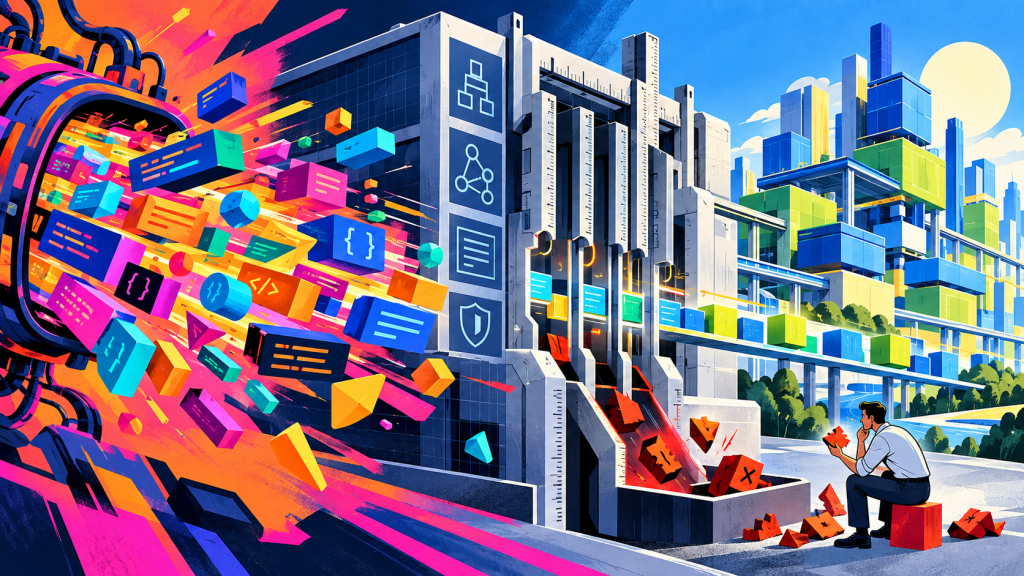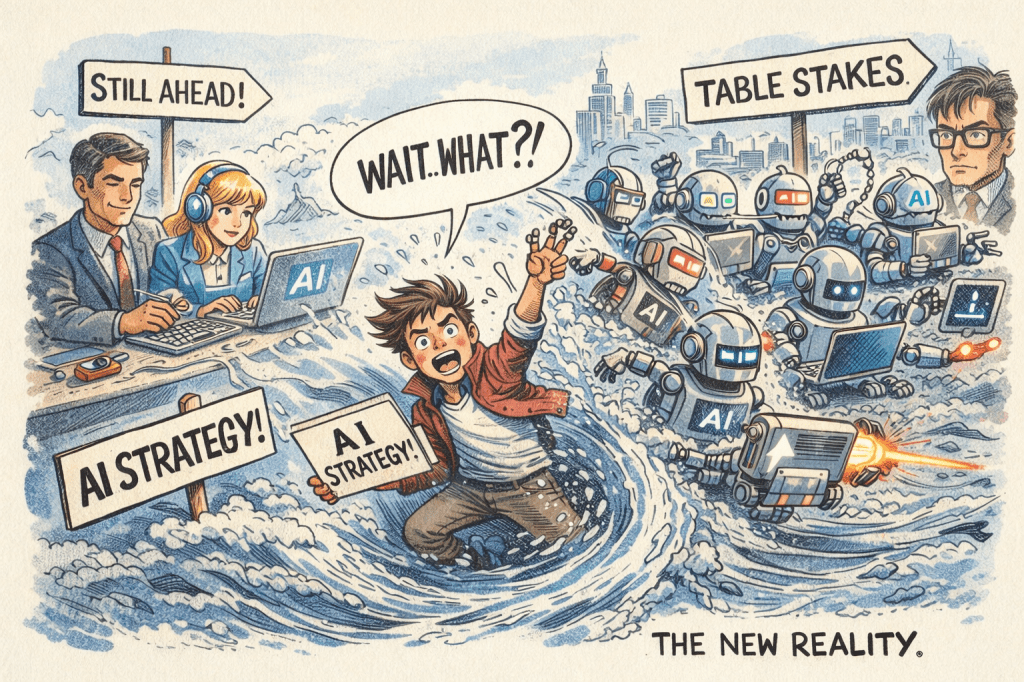
For years, leaders could win the room by saying, “We’re investing in AI.” It sounded like vision. It implied momentum. It created cover for experimentation.
In 2026, it sounds like you are simply showing up.
AI has crossed the same boundary cloud crossed a decade ago. It is no longer a differentiator that you use it. It is infrastructure. If you build products and your teams are not using AI to write, research, design, test, support, and ship, you are not making a philosophical choice. You are choosing slower learning.
The data is already telling us that the baseline moved. Microsoft and LinkedIn reported that 75% of knowledge workers use AI at work, and many are bringing their own tools when companies lag behind. (Source) McKinsey reported that 65% of respondents said their organizations were regularly using generative AI in early 2024, and that number continued rising in later surveys. (McKinsey & Company) Stanford’s AI Index reported that 78% of organizations used AI in 2024, up from 55% the year prior. (Stanford HAI)
That is what “expected” looks like.
“We Use AI” Is Now Like Saying “We Use Email”
When Shopify’s CEO told employees that AI usage is a baseline expectation and that teams should demonstrate they explored AI before asking for more headcount, he was not pitching a moonshot. He was describing a new professional norm. (Marketing AI Institute) Duolingo’s “AI-first” shift, including changes in how work is staffed and evaluated, landed with similar force for the same reason: it framed AI as default behavior, not a side project. (The Verge)
You can dislike the tone. You cannot ignore the signal. This is what happens when a capability becomes cheap enough, good enough, and widely available enough that opting out is no longer neutral.
Customers Are Being Trained to Expect AI Everywhere
The market is also conditioning your users. Atlassian made AI capabilities generally available across Jira, Confluence, and Jira Service Management, embedding AI into the daily machinery of teams. (Atlassian) Salesforce moved Einstein Copilot into general availability and wrapped it with adoption tooling because enterprise buyers demand more than a chatbot. (Salesforce) Notion has positioned AI inside the workspace itself, pushing toward an “AI where the work happens” model rather than a separate destination. (Notion)
So when a product leader says, “Should we add AI,” they are already late. The real question is whether AI becomes a thin UI gimmick or a compounding system that changes outcomes.
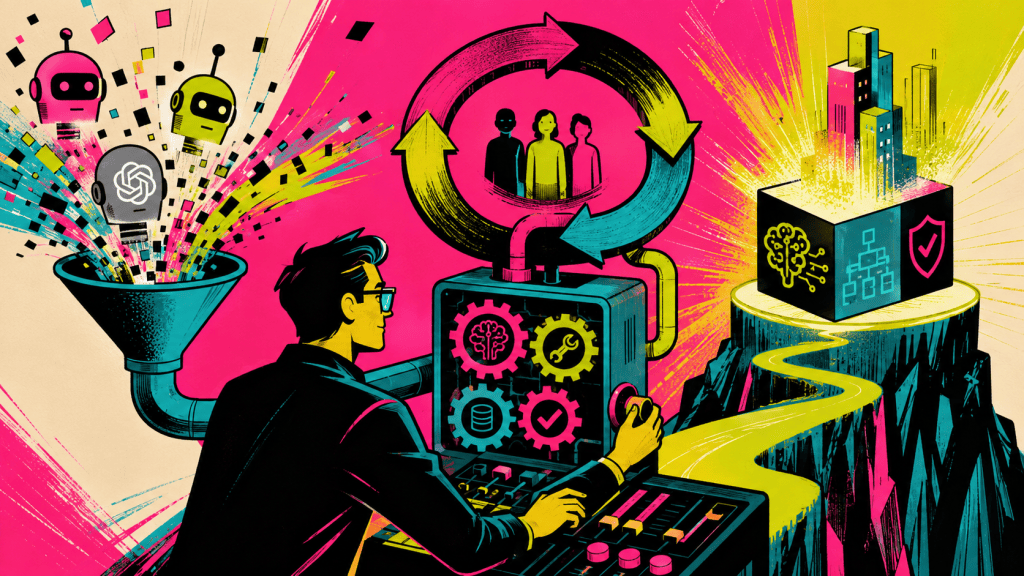
The Competitive Edge Is Not Access to a Model. It Is the Operating System You Build Around It.
Most teams still treat AI as decoration. They add a text box. They ship a “summarize” button. They demo it once. Then they quietly discover that adoption is uneven, quality is inconsistent, and trust is fragile.
Strategic advantage comes from redesigning the workflow, not bolting on a feature. It comes from moving AI upstream into the messy parts of work, where it reduces friction and makes progress feel inevitable. When AI pre-fills the annoying steps, flags missing inputs before users hit a wall, or routes exceptions to humans with the full context attached, it stops being a novelty and starts being leverage.
That leverage is real, but it is not automatic. Controlled research on GitHub Copilot found developers completed a defined task materially faster with the tool. (arXiv) At the same time, more recent research has shown the opposite outcome in some contexts, where experienced developers slowed down because they spent time verifying and correcting suggestions. (Reuters)
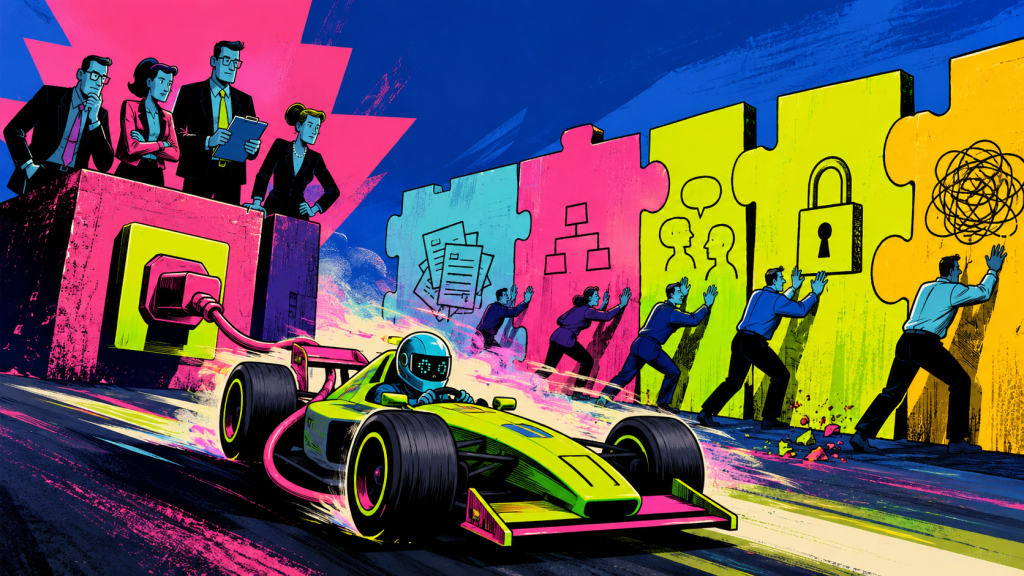
This is the point many exec teams miss. AI does not guarantee speed. It changes the shape of work. If you do not build evaluation, guardrails, and feedback loops, you will either ship unreliable output or burn time cleaning up after it.
The Klarna Lesson: Efficiency Headlines Are Easy. Quality Systems Are Hard.
Klarna’s own 2024 announcement about its AI assistant highlighted dramatic workload coverage and faster resolution times. (Klarna) That narrative later evolved as the company and the broader industry confronted a familiar reality: routine issues can be automated, but sensitive, complex, and high-stakes cases still demand skilled humans. (Bloomberg)
The lesson is not that AI failed. The lesson is that AI without a quality system is simply a new way to create failure, often faster and at scale.
Trust Is Now Product Work, Not Legal Cleanup
If you want to see where real product leadership shows up, watch what happens when trust is challenged. Adobe had to publicly clarify its terms and commitments, including statements about customer content ownership and how generative AI training data is handled, because the market will not accept hand-wavy assurances. (Adobe Blog)
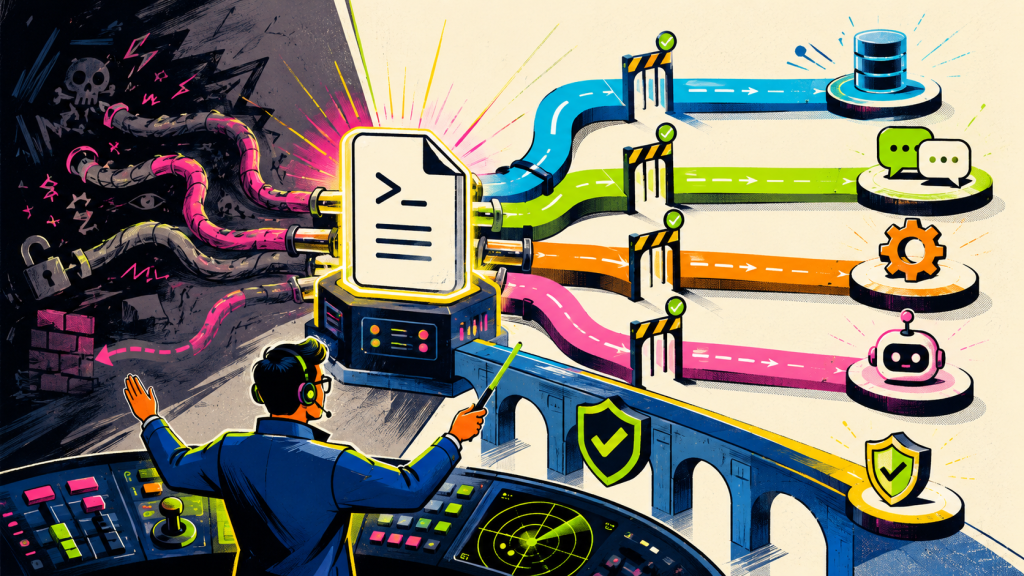
This is where strategy actually lives. Not in whether you “have AI,” but in whether your AI is governed, auditable, permissioned, and designed with explicit failure modes. Buyers do not want magic. They want control.
What “Strategic AI” Actually Means in 2026
If simply using AI is expected, then strategy becomes your ability to make AI compound. In practice, that means you treat AI as an operating model upgrade.
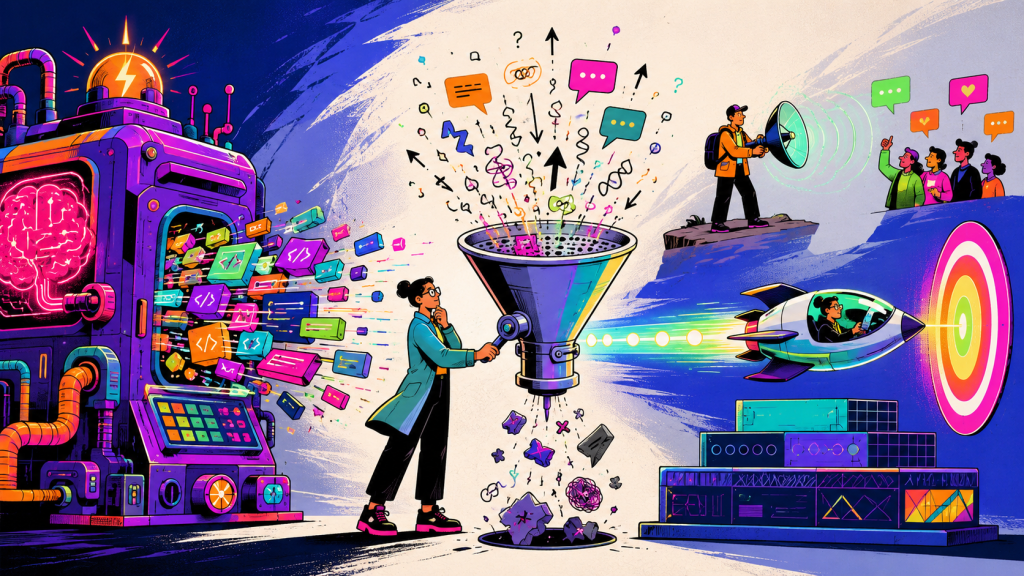
You build AI into the way work flows, not as an overlay. You instrument the moments where users accept, reject, and correct output so you can learn faster than competitors. You create an evaluation harness early so quality is measured continuously rather than debated in anecdotes. You design cost and latency as product constraints, because economics determines where intelligence belongs and how often you can deliver it.
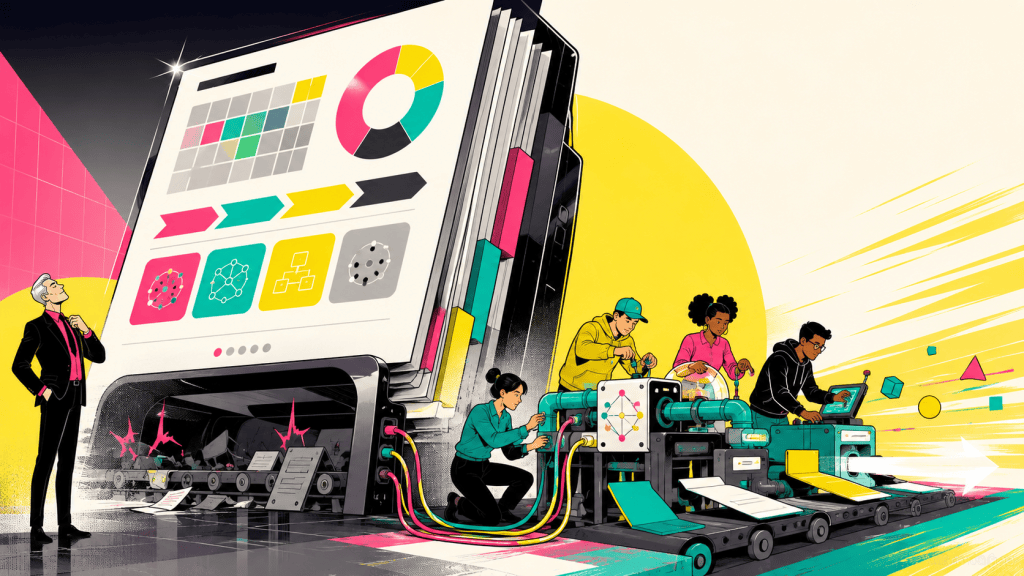
Most importantly, you pick a small number of high-leverage workflows and make them unmistakably better, then expand outward. That is how you turn “everyone has AI” into “only we deliver outcomes like this.”
The Bottom Line
AI is no longer your strategy. It is your starting line.
The organizations that win from here will not be the ones that announce adoption. They will be the ones that operationalize AI into compounding advantage: faster learning cycles, workflow redesign, measurable quality, and trust engineered into the product.
If you are still debating whether AI belongs in your product and your team, your competitors are already debating something else: what they will learn this quarter that you will not.