Most product leaders have been trained to worship information. More data. More dashboards. More customer calls. More synthesis. It feels responsible, and sometimes it is. But if you have ever sat in a roadmap review where everyone has the same facts and still ends up with three mutually exclusive “obvious” answers, you already know the truth.
Judgment is not just knowledge. Judgment is knowledge plus taste.
Knowledge is what you can collect. Taste is what you can consistently choose.
In 2026, knowledge is getting cheap. AI is making “good enough” analysis available on demand. That shifts the value of leadership away from who can gather information, and toward who can decide what matters, what to ignore, what to trade off, and what to ship.
Taste is not aesthetic fluff. It is the internal compass that lets you turn messy reality into clean decisions.
Why taste is suddenly a leadership superpower
When software was hard to build, the bottleneck was execution. When software becomes easier to build, the bottleneck becomes selection.
That is the core point behind Paul Graham’s long-running argument that taste is a maker’s advantage: the ability to recognize what is good and then to produce it consistently. (Paul Graham)
Julie Zhuo makes the modern version of the same claim: as AI increases the supply of “outputs,” taste becomes the differentiator because it is tied to risk, narrative, and the willingness to back a bet before the world agrees. (lg.substack.com)
And you can see it in how high-performing companies talk about decision-making culture. Netflix’s culture memo is effectively a public bet that judgment scales better than process, with policies designed to force teams to exercise discernment rather than hide behind rules. (jobs.netflix.com)
So what is taste, operationally?
Taste is pattern recognition shaped by scars and exposure. It is your ability to say, “This solution is clever but wrong for our user,” or “This feature will age badly,” or “This UI looks clean but the workflow is hostile.” It is the thing that makes two leaders look at the same evidence and reach different conclusions, then one of them is right in hindsight more often than chance would allow.
The executive moments where judgment actually shows up
Taste is easiest to talk about in design, but product executives experience it everywhere. A few familiar situations:
1) The “two good options” trap
You have two plausible strategies. Both have data. Both have customer quotes. Both have revenue models. The room wants a spreadsheet answer.
This is where taste matters, because taste is your ability to value second-order effects: what the decision does to your operating model, your credibility, your brand promise, and the next three product cycles. Data rarely captures that cleanly.
2) The roadmap that is technically correct and strategically dead
Every item is defensible. None of it is memorable.
This is a taste failure masquerading as a prioritization exercise. You can ship a year of “reasonable” work and still lose because you never created a point of view.
Paul Graham describes good design as simple, timeless, and even slightly strange. That “strange” part is what makes a product feel inevitable later, even if it felt risky early. (Paul Graham)
3) The metrics that are accurate and misleading
Your dashboards say things are fine. Your gut says the product is calcifying.
Taste shows up as the ability to notice what the metrics are not measuring. Netflix explicitly tries to avoid “dummy-proofing” the organization because it leads to process creep and slower adaptation. That is a taste position about how systems fail at scale. (jobs.netflix.com)
4) The “design is how it works” argument, but for everything
At some point you realize that your product is not the UI, it is the end-to-end experience: onboarding, workflows, defaults, failure modes, support, and trust.
Steve Jobs’ framing that design is “how it works” is fundamentally a statement about taste applied to function, not just aesthetics. (Daring Fireball)
That mindset is product leadership: you are designing decisions, not screens.
A simple model: Knowledge sets the menu, taste picks the meal
Here is the practical way I think about it.
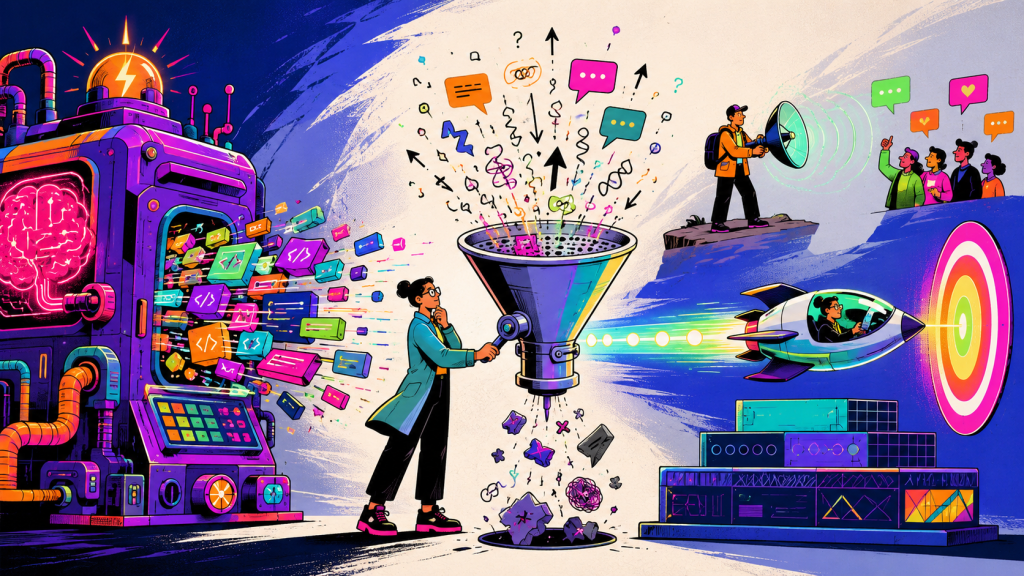
Knowledge expands your option set. Taste collapses it.
Knowledge says: “Here are 10 things we could do.”
Taste says: “We are doing these 2, and here is why they fit who we are.”
If you are leading product and engineering, your job is not to produce options. Your job is to remove options responsibly.
Taste is the filter that makes subtraction feel confident instead of arbitrary.
What “good taste” looks like in product leadership
You can spot it in behaviors, not vibes:
- They have a point of view before the meeting. They show up with a draft decision and invite critique, rather than crowdsourcing direction.
- They can articulate what they are optimizing for. Not just “growth,” but a specific tradeoff, like “time-to-value beats customization for this segment.”
- They protect coherence. They notice when a feature violates the product’s mental model, even if it helps a metric.
- They use constraints as a design tool. Headcount, latency budgets, pricing simplicity, and support load become part of the product shape, not annoyances.
- They are consistent. Not rigid, but legible. Teams can predict what they will say yes to.
This is why Netflix writes culture in a way that forces judgment. If you can replace leaders with rules, you will eventually replace taste with compliance. (jobs.netflix.com)
How to build taste without becoming a snob
Taste is learnable, but it is not learned from frameworks alone. It is learned from exposure, feedback, and honest postmortems.
A few practices that work in real product orgs:
- Run decision reviews, not status reviews.
Once a week, pick one meaningful decision and dissect it. What did we know? What did we assume? What did we value? What did we ignore? This builds shared taste, not just shared context. - Expose your team to great work, then name what makes it great.
Paul Graham’s essays are useful here because they force you to describe quality concretely rather than spiritually. (Paul Graham) - Make critique a craft, not a conflict.
Critique is how taste transfers. The goal is not to win, it is to sharpen the shared definition of “good.” - Use AI to amplify knowledge, then demand human taste.
Let AI generate options, drafts, experiments, and analysis. Then hold the line that selection is still a leadership responsibility. Zhuo’s point is not that AI kills taste, it is that AI makes taste the scarce resource. (lg.substack.com)
The uncomfortable truth
If judgment is knowledge plus taste, then a lot of leadership failure is explainable.
Some leaders have knowledge and no taste. They become committees.
Some leaders have taste and no knowledge. They become gamblers.
The leaders you want have both, and they know which one they are missing in the moment.
In a world where information is abundant, your advantage is not being the smartest person in the room. Your advantage is being the person whose decisions age well.
That is taste. That is judgment. And it is the job.