Every line of code is a future obligation. It must be understood, secured, tested, upgraded, observed, explained, and eventually retired. In the pre-agentic world, the human cost of writing code created a natural brake on software growth. In the agentic world, that brake is gone.
That is the promise and the danger. Google has said that 75% of its new code is now AI-generated and approved by engineers, while Amazon reported that Amazon Q Developer helped migrate tens of thousands of production applications from Java 8 or 11 to Java 17, representing more than 4,500 years of development work saved and $260 million in annual cost savings. These are not toy examples. They show that AI-assisted engineering can move real enterprise systems at a speed that would have looked impossible a few years ago. (Fast Company)
The uncomfortable question is what happens when output grows faster than understanding. DORA’s 2026 generative AI report found that a 25% increase in AI adoption was associated with a 1.5% decrease in delivery throughput and a 7.2% decrease in delivery stability, largely because faster code generation can create larger batch sizes that are harder to review and more destabilizing to systems. Thoughtworks has also warned that agentic coding can create larger change sets, rising duplication, reduced refactoring, and complacency with AI-generated code. (dora.dev)
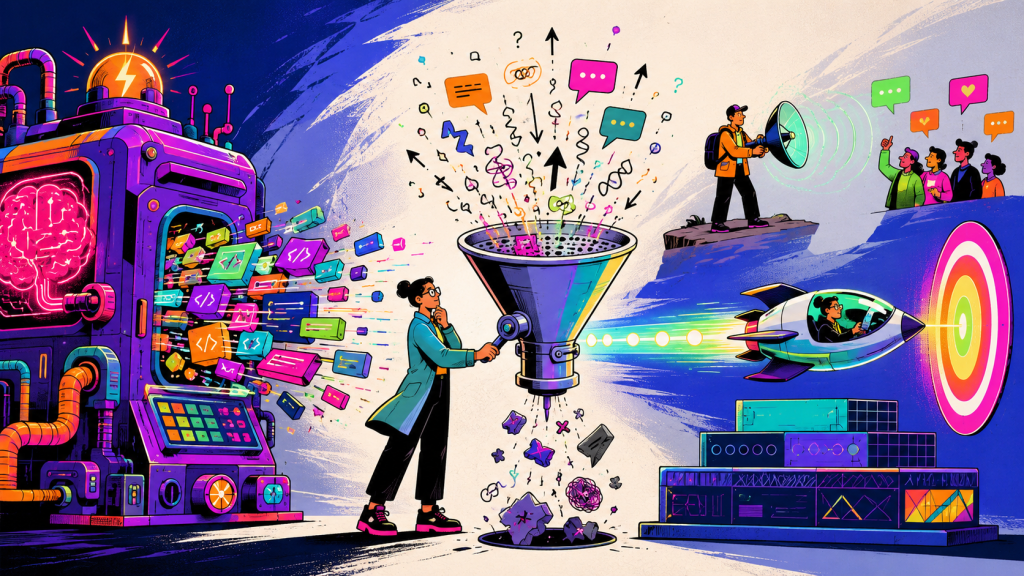
This is the new architecture problem. It is not whether AI can write code. It can. The problem is whether the organization can absorb that code without turning its product estate into a landfill of plausible, compiling, locally correct, strategically incoherent software.
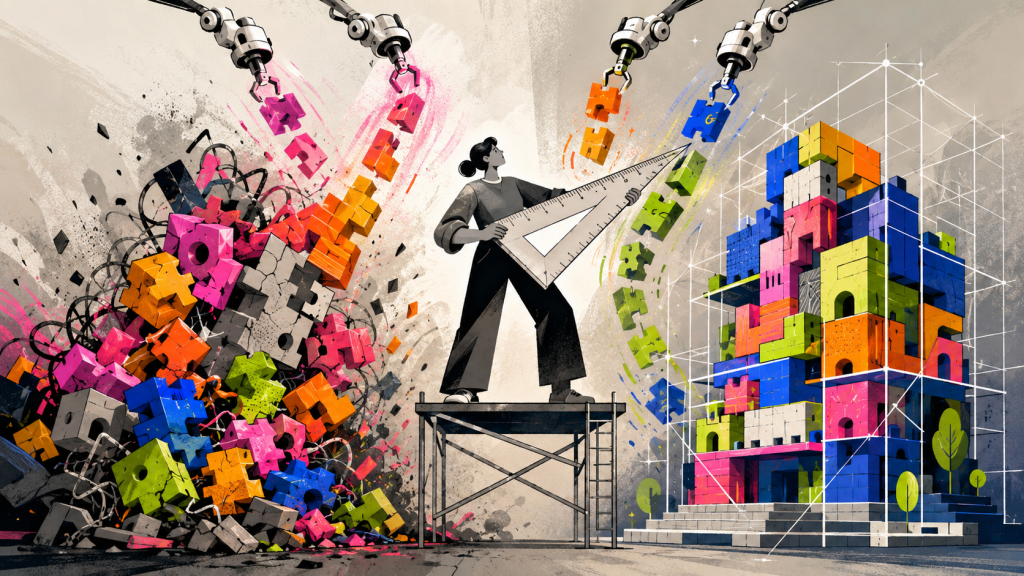
Architectural hygiene is the discipline that prevents speed from becoming entropy. It is the daily care of boundaries, patterns, interfaces, dependencies, observability, security, and ownership. It is not a quarterly architecture review, and it is not a beautiful diagram in Confluence. It is the muscle memory that keeps teams from solving the same problem in eight different ways because eight different agents were prompted by eight different engineers under delivery pressure.
This matters because agentic engineering does not merely accelerate implementation. It accelerates liability creation. Veracode’s 2025 GenAI code security work found that 45% of AI-generated code samples failed security tests and introduced OWASP Top 10 vulnerabilities, and its 2026 update found security pass rates still stuck around 55% even as syntax correctness exceeded 95%. That gap between “it works” and “it is safe, maintainable, and fit for the enterprise” is where future outages, audit findings, and modernization costs are born. (Veracode)
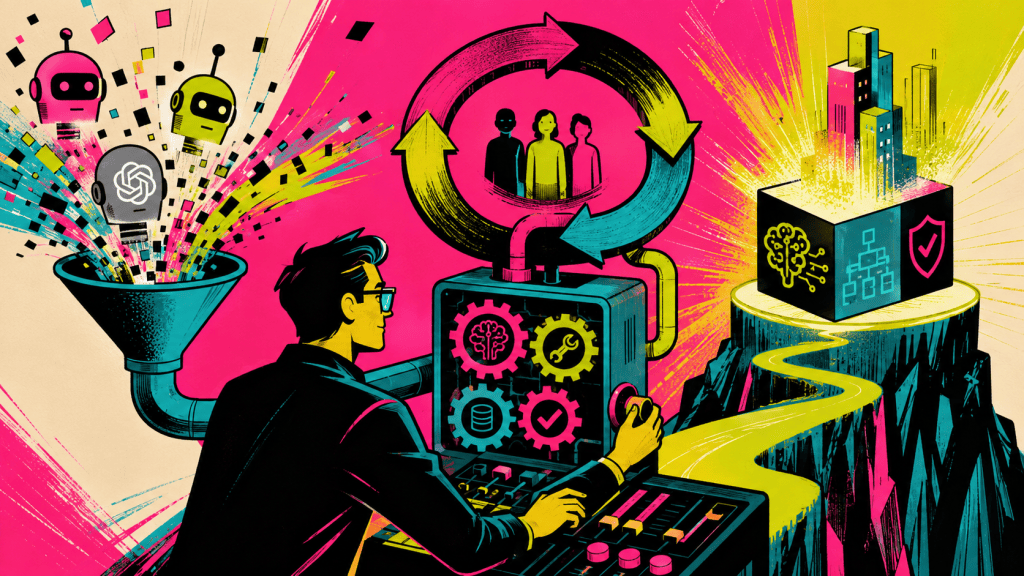
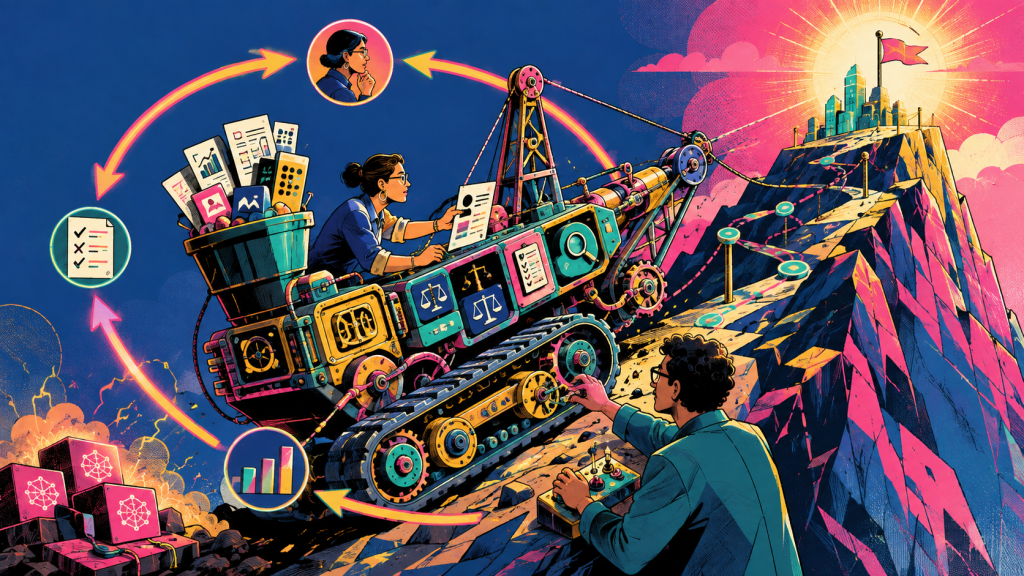
The right conclusion is not to slow down AI adoption. The right conclusion is to make architecture operational. Claude.md files, skill files, coding-agent instructions, and prompt libraries are useful, but they are not an operating model. They are the outer layer of guidance, not the governance spine of the engineering organization.
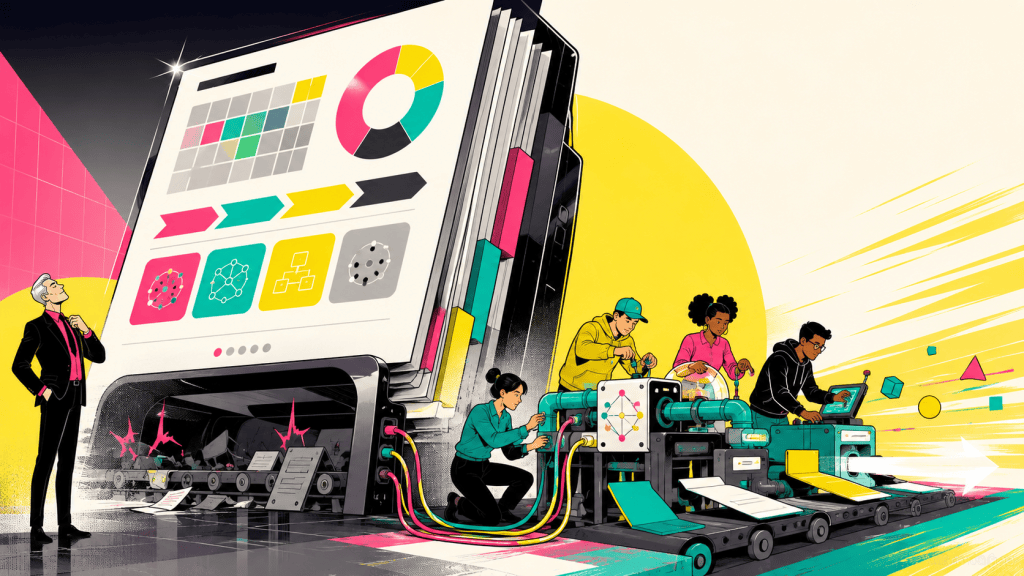
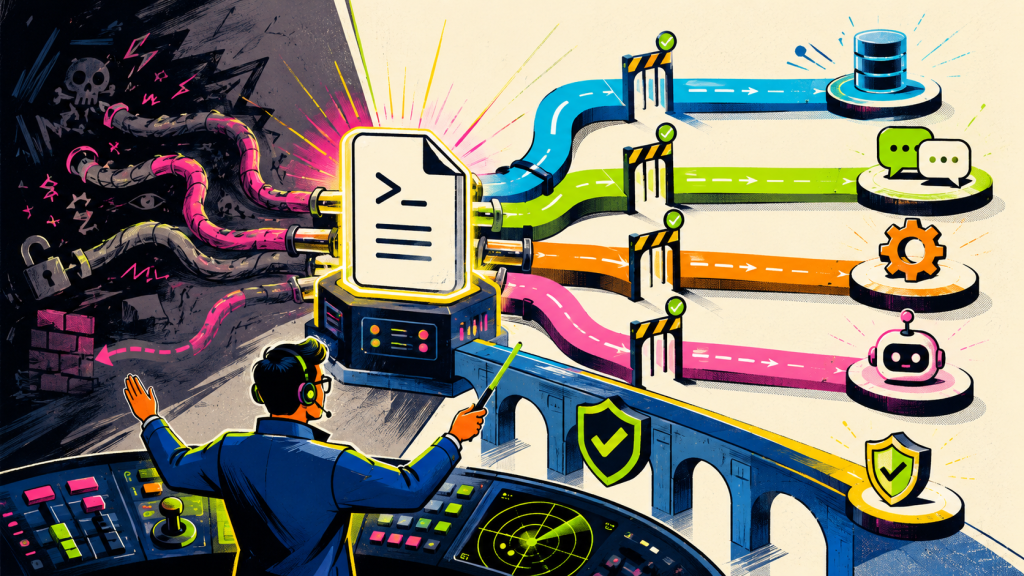
The deeper work is more structural. Teams need opinionated paved roads for common capabilities, including authentication, authorization, logging, workflow, data access, eventing, APIs, UI patterns, and deployment. They need architecture decision records that explain why patterns exist, not just what pattern to copy. They need service catalogs that show ownership, dependencies, runtime health, and lifecycle status. They need policy-as-code, contract tests, dependency rules, static analysis, security scanning, and architecture fitness functions embedded directly into delivery pipelines.
Fitness functions are especially important because they move architecture from persuasion to feedback. Thoughtworks describes fitness function-driven development as a way to provide continuous feedback for architectural conformance while development is happening, rather than after the fact. In an agentic model, that is essential. If AI can generate code continuously, architecture has to inspect continuously. (Thoughtworks)
The role of architecture therefore changes. The architect is no longer the person who blesses designs from a distance. The architect becomes the designer of constraints, the curator of patterns, the builder of guardrails, and the teacher of judgment. Strong architects will spend less time policing individual pull requests and more time shaping the system in which those pull requests are produced.
Responsibility cannot sit in a central ivory tower. In an agentic engineering model, architectural consistency has to be owned at multiple levels. The CTO owns the architectural doctrine and the economic trade-offs. Principal and staff engineers own the reusable patterns and technical quality bars. Platform teams own the paved roads and automation. Product engineering teams own local design choices within those constraints. Product leaders own the discipline of not turning every customer request into bespoke software. Security, SRE, and data leaders own the non-negotiables that must be encoded into the path to production.
The next generation of technology and product leaders will not be differentiated by whether they “use AI.” Everyone will use AI. The differentiation will be whether they can scale AI-assisted delivery without losing architectural coherence, engineering judgment, and product leverage.
The best technology executives will know how to ask different questions. Not “how many lines did we generate?” but “how much durable capability did we create?” Not “how fast did the agent complete the ticket?” but “did the change reinforce or weaken the architecture?” Not “can we ship this?” but “will we still understand this six months from now?”
This also changes how organizations should evaluate AI productivity. A GitHub Copilot field experiment across Microsoft and Accenture found suggestive productivity gains in pull requests per week, while a 2025 METR randomized controlled trial with experienced open-source developers found that AI tools slowed completion time by 19% in mature codebases the developers already knew well. The lesson is not that one study is right and the other is wrong. The lesson is that AI value depends heavily on context, codebase shape, task type, review discipline, and organizational maturity. (An MIT Exploration of Generative AI)
That is why architecture has to become part of the AI adoption strategy, not a downstream cleanup function. If the codebase is modular, observable, well-tested, and full of clear domain language, agents perform better and humans can review faster. Thoughtworks makes this point directly: AI-friendly code design looks a lot like good human-friendly design, with expressive naming, modularity, abstractions, and DRY principles helping both humans and agents manage context. (Thoughtworks)
The worst outcome is not that AI writes bad code. The worst outcome is that AI writes acceptable code in unacceptable volume. That is how organizations create AI slop at enterprise scale: not through one catastrophic mistake, but through thousands of small inconsistencies that each look reasonable in isolation.
Agentic engineering raises the premium on architecture because it raises the cost of ambiguity. If your patterns are unclear, agents will improvise. If your boundaries are weak, agents will blur them. If your standards live in tribal memory, agents will not know them. If your review process is optimized for human-sized change sets, agents will overwhelm it.
The companies that win will not be the ones that generate the most code. They will be the ones that convert AI speed into sustainable business capability. That requires architectural hygiene as a first-class executive discipline: visible, funded, measured, automated, and owned.
The future of software leadership belongs to executives who understand that code is cheap, but coherence is priceless.