
A certain kind of AI leadership advice is becoming increasingly common. Move AI out from under the cautious CIO. Give every pilot a kill date. Manufacture scarcity so employees fight for access. Treat code as a commodity because agents can generate it almost for free.
Each idea contains a piece of truth. Together, they reveal a much more dangerous misunderstanding: that enterprise AI transformation is primarily a problem of picking the right tool, executive, incentive, or launch tactic.
It is not.
AI is not “just another tool” in terms of capability. The speed, accessibility, and increasingly autonomous nature of these systems are genuinely different. But inside an enterprise, AI is still a tool in the most important sense: it creates value only when trained people apply it to a real problem, inside a redesigned workflow, with clear ownership, appropriate controls, and a path to adoption at scale.
The technology has changed dramatically. The physics of transformation have not.
Experimentation is not transformation
The current AI market is full of prototypes. Some are useful, some are impressive, and many are difficult to connect to any meaningful change in the economics or performance of the business.
This has created an understandable push for stronger discipline. Organizations are being told to demand clearer hypotheses, better baselines, explicit measures of success, and more rigorous decisions about what deserves continued investment.
All of that is sensible. It is also incomplete.
The deeper problem is that many companies still treat experimentation and transformation as though they were the same activity. They are not.
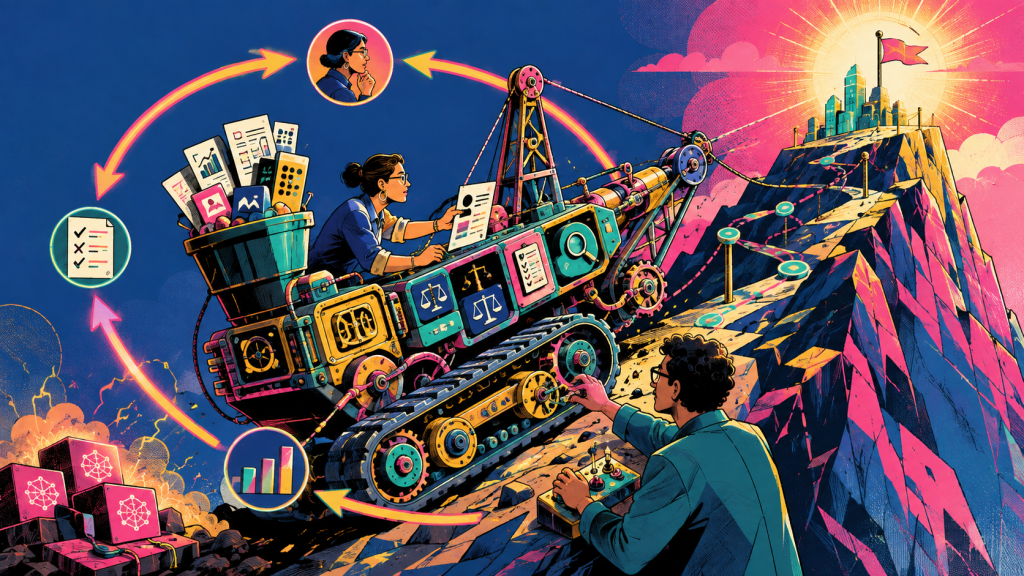
An experiment can prove that a model summarizes documents accurately, generates acceptable code, reduces handling time, or automates part of a workflow. Transformation begins only when the organization redesigns the surrounding system so that the capability becomes part of how work is actually performed.
Gartner expects more than 40% of agentic AI projects to be canceled by the end of 2027, citing cost, unclear value, and inadequate risk controls. The more important observation in Gartner’s analysis is that integrating agents into legacy environments is complex and that successful deployment may require workflows to be rethought from the ground up.
That distinction matters because the market is drowning in activity while still struggling with impact. McKinsey’s 2025 global survey found that 88% of respondents reported regular AI use in at least one business function, but only 39% reported enterprise-level EBIT impact. The strongest differentiator was not simply more experimentation. AI high performers were nearly three times as likely to have fundamentally redesigned workflows, and McKinsey identified workflow redesign as one of the strongest contributors to meaningful business impact.
This is the uncomfortable truth behind many AI programs. The prototype is not the difficult part anymore.
The difficult part is changing the surrounding process, assigning accountability, integrating with existing systems, changing roles, removing obsolete steps, training users, creating controls, and deciding what the organization will stop doing once the new capability exists.
A successful experiment proves possibility. A successful transformation changes the operating model.
Adoption has to be designed
Another recurring mistake is to treat adoption as a communications problem. Leaders assume that employees are not using AI because they have not seen enough demonstrations, attended enough training sessions, received enough executive encouragement, or been given sufficiently exciting access to the latest tools.
That diagnosis is usually too shallow.
People do not change durable work habits because a CEO sends an email or because a new application appears in the corporate portal. They change when the new way of working is clearly better, visibly supported, relevant to their role, reinforced by management, and embedded into the flow of real work.
IBM reported in 2026 that only 25% of workers regularly use AI as part of their jobs, even though 86% of CEOs believe their people are ready. More tellingly, 83% of CEOs said AI success depends more on people’s adoption than on the technology itself. (IBM)
That gap should concern every executive funding an AI transformation.
The problem is rarely that employees need more enthusiasm in the abstract. They need to know which tasks should change, which tools are trusted, what good output looks like, when human review is required, how performance expectations are evolving, and whether management genuinely supports abandoning familiar processes.
BCG’s research on AI capability building makes this point explicitly. Effective enablement moves from foundational understanding, to applied practice on real work, to embedded habits reinforced through role expectations, incentives, and support systems. BCG also found that only about 5% of companies were generating AI value at scale, while nearly 60% reported little or no impact.
That is why enterprise adoption cannot be reduced to license distribution or training completion.
The objective is not to get more people to open an AI application. The objective is to change how work gets done.
Engineering acceleration exposes the rest of the system
Software engineering is where the disconnect between AI capability and enterprise reality is becoming most visible.
There is no serious argument anymore that AI-assisted development is merely hype. Models can generate code, tests, documentation, migrations, interfaces, and entire working prototypes at a speed that would have been extraordinary only a few years ago. Agentic development environments are pushing that acceleration further by allowing systems to plan, implement, test, and iterate with increasing autonomy.
But faster generation does not remove the system around generation. It exposes it.
A July 2026 longitudinal study followed 802 developers and 196,212 pull requests inside an AI-forward company pursuing a “2x” engineering mandate. Per-capita throughput eventually reached 2.09 times the pre-mandate baseline. That is a remarkable result, although the authors appropriately caution that adoption was not randomly assigned. The more revealing finding was what happened elsewhere in the system: per-reviewer load roughly doubled, and automated review overtook human review. (arXiv)
This is what meaningful acceleration does. It changes the constraint.
Atlassian found a similar tension in its 2025 developer research. Almost all developers surveyed reported saving time with AI, and 68% said they saved more than ten hours a week. At the same time, 50% reported losing more than ten hours a week to organizational inefficiencies such as finding information, adopting technology, context switching, and cross-team friction. (Atlassian)
That should force a rethink of how technology leaders talk about AI productivity.
When implementation becomes faster, unclear product decisions become more expensive because teams can execute ambiguity at greater speed. Weak architecture becomes more dangerous because code volume can outpace coherence. Slow security processes become more visible because development arrives at the control point sooner. Poor documentation becomes a constraint because agents cannot reliably reason over information the organization never captured.
The engineering organization does not suddenly become simple because code can be produced faster.
In many cases, it becomes more demanding.
Google’s 2025 DORA research captures this well by describing AI as an amplifier of the existing organizational system. Strong systems can compound the benefit. Weak systems can compound the dysfunction.
That is a far more useful mental model than assuming every hour removed from coding automatically becomes an hour of enterprise value.
AI changes the economics of work, not the need to redesign it
The same principle applies well beyond software.
AI can absolutely transform service businesses, claims operations, finance processes, tax workflows, customer service, document-heavy industries, and administrative functions. In some cases it may remove labor constraints that historically limited growth. In others it may allow smaller teams to deliver levels of service that previously required much larger operating structures.
That opportunity is real.
What does not follow is that introducing AI automatically changes the economics of the business.
To create that change, the organization must identify which work disappears, which work changes, which decisions become automated, where humans remain accountable, how exceptions are handled, how quality is measured, and what happens to the roles and cost structures surrounding the old process.
There is compelling evidence that the tools work when context and operating design are right. A major field study of more than 5,000 customer-support agents found a 14% average productivity increase from generative AI, rising to 34% for novice and lower-skilled workers while producing little benefit for the most experienced workers. (NBER)
That is a powerful result, but the insight is more nuanced than “AI increases productivity.”
Outcomes depended on the worker, the task, the workflow, and the ability of the system to make expertise available at the moment of work. The technology created value because it operated inside a specific service environment with measurable tasks and a clear relationship between assistance and performance.
This is exactly the kind of detail that disappears when AI strategy becomes a collection of slogans.
The real advantage is what the enterprise does with speed
The companies that win will absolutely move faster. They will use agents to generate software, analyze documents, support employees, redesign products, automate decisions, and eliminate work that previously required large teams.
But speed is not transformation. Speed is pressure.
AI puts pressure on weak product discovery because teams can build the wrong thing faster. It puts pressure on poor architecture because technical output can accumulate faster than coherence. It puts pressure on management because employees need new expectations, new skills, and permission to change how work gets done. It puts pressure on executives because the distance between a strategic decision and an executable prototype is collapsing.
This is why some of the loudest AI advice feels strangely disconnected from enterprise reality. It focuses on changing the tool, changing the title, changing the launch tactic, or changing the pace of experimentation without confronting the harder question of what must change in the business itself.
The fundamentals are not glamorous. Someone still has to define the problem. Product leaders still have to decide what should be built. Engineers still have to design systems that can survive contact with production. Teams still need training. Incentives still shape behavior. Legacy systems still exist. Security still matters. Data quality still matters. Change management still matters.
AI does not make those disciplines obsolete.
It increases the cost of being bad at them because every weakness now compounds faster.
Do not confuse experimentation with transformation. Do not confuse access with adoption. Do not confuse generated output with delivered value. Do not confuse executive sponsorship with an operating model. And above all, do not confuse velocity with progress.
The models are new. The hard part is still getting an enterprise to change.



 bencoding