Satya Nadella’s most important AI argument is not about models. It is about whether your company retains the ability to learn.
Most enterprise AI strategies are still procurement strategies dressed up as transformation plans. They describe which copilots will be licensed, which models will be approved, how many pilots will be launched, and how much productivity management expects to extract.
They rarely answer the more important question: What will our organization know how to do better eighteen months from now because we deployed AI?
That is the challenge at the center of Satya Nadella’s June 14, 2026 post, “A frontier without an ecosystem is not stable.” Nadella argues that the defining asset of an AI-era company will not be access to a particular model. It will be the learning system that allows the company’s people, data, workflows, and AI capabilities to improve one another continuously.
This deserves far more attention than another announcement about model size, benchmark performance, or agent autonomy. Nadella is describing a new theory of the firm, and technology leaders need to translate it into an operating model before their next planning cycle locks them into eighteen more months of disconnected pilots.
The model is not the moat
Nadella divides the future enterprise into two forms of capital: human capital and token capital. Human capital includes judgment, relationships, pattern recognition, creativity, and the tacit expertise accumulated by people. Token capital is the AI capability a company develops from that expertise.
The phrase “token capital” can be misleading. It does not mean the number of tokens a company purchases from a model provider. It means the reusable intelligence created when an organization turns its own experience into context, evaluations, workflows, tools, decision rules, and eventually models that perform better because they have learned how that specific company works.
This distinction matters because most companies currently rent intelligence while giving away the learning opportunity.
They call a model, receive an answer, show the answer to an employee, and move on. The next interaction begins almost exactly where the previous one started. The model provider may improve, but the enterprise itself has not necessarily become any smarter.
Nadella’s argument is that companies must own the loop between human judgment and machine performance. A general-purpose model should be replaceable without the company losing the expertise it has accumulated. The durable asset is the environment around the model: the workflows, private evaluations, traces, tools, knowledge, feedback, and outcome data that make the system effective inside one organization.
That is a much harder strategy than buying an enterprise chatbot. It is also far more defensible.
Most companies are building AI usage, not AI capital
Enterprise adoption statistics increasingly hide the real problem. McKinsey reported that 88 percent of surveyed organizations were using AI in at least one business function, yet nearly two-thirds had not begun scaling it across the enterprise. Only 39% reported any enterprise-level EBIT impact, and most of those attributed less than 5 percent of EBIT to AI.
The gap exists because access is not transformation. A company can have thousands of licensed users, millions of model calls, and dozens of pilots without creating anything that compounds.
Deloitte’s 2026 enterprise AI research tells a similar story. Worker access to AI increased substantially during 2025, but only 34 percent of organizations reported that they were genuinely reimagining the business. Deloitte also identified the skills gap as the largest barrier to integration, while only one in five companies had a mature governance model for autonomous agents.
This is what happens when adoption is measured through seat counts and demonstrations. Activity goes up, but institutional capability remains flat.
The important metric is not how often employees use AI. It is how frequently the organization converts an interaction into a better process, a stronger evaluation, a clearer decision rule, a more useful tool, or a new piece of reusable knowledge.
That is the difference between consuming intelligence and accumulating it.
What a learning loop actually contains
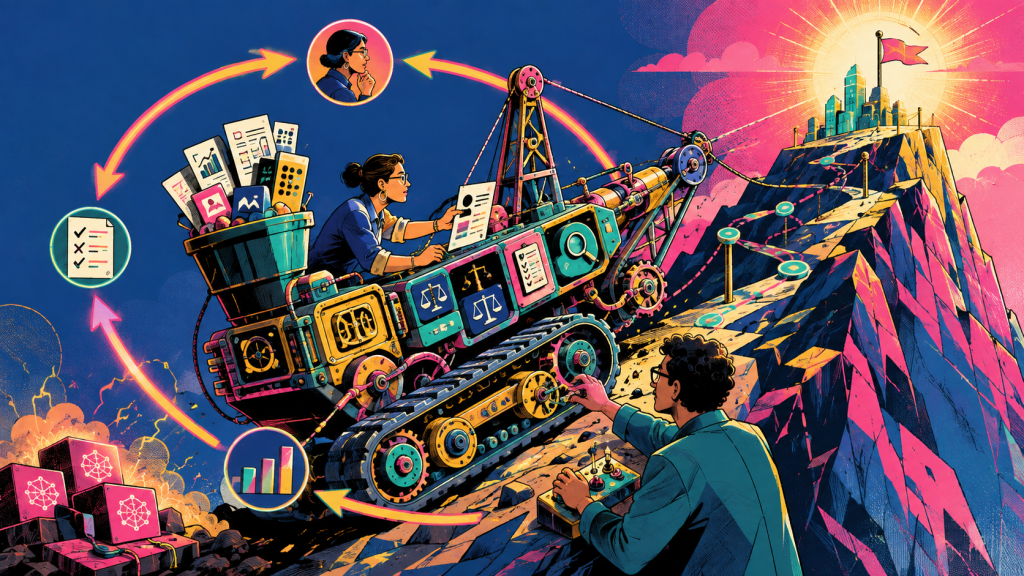
The concept can sound unnecessarily theoretical, but the mechanics are straightforward. A useful enterprise learning loop has five connected parts.
First, it begins with a real workflow. Not a generic assistant and not an open-ended innovation sandbox, but a recurring piece of work with a meaningful business outcome. Examples include reviewing an immigration case, preparing an underwriting recommendation, diagnosing a software incident, responding to a client inquiry, validating a contract, or generating a product specification.
Second, the system captures the path taken through the work. This includes the original request, the context retrieved, the tools called, the decisions made, the output produced, the employee’s corrections, and the eventual business outcome.
Third, the organization defines what good means. Private evaluations should measure the qualities that actually matter to the company: accuracy, compliance, completeness, commercial judgment, client impact, cycle time, cost, or risk. Public benchmarks cannot tell you whether an output meets your operating standards.
Fourth, people improve the system around the model. They refine instructions, context, tools, workflow steps, routing, knowledge sources, and escalation rules. Only after those elements are working should the company consider more expensive techniques such as fine-tuning or reinforcement learning.
Fifth, the improved version is tested against unseen examples and released only when it performs better. Every cycle should begin slightly higher up the hill than the previous one.
Microsoft describes this as a “hill-climbing machine.” Its technical interpretation includes a repeatable environment, an outcome rubric, production traces, and a mechanism for turning performance scores into improvements. Microsoft is also supporting OpenEnv, an emerging protocol intended to make reinforcement-learning environments portable across models, trainers, and runtimes.
OpenEnv may or may not become the dominant standard. The architectural principle is more important than the protocol: the model should be swappable, but the learning environment should belong to the enterprise.
This is already visible in real companies
Morgan Stanley offers one of the clearest examples of this approach. It did not begin by releasing a general chatbot and hoping employees found useful applications. It created an evaluation framework for each use case, had advisors and prompt engineers grade responses, expanded those evaluations as new failure modes emerged, and ran daily regression testing against representative questions.
That foundation helped Morgan Stanley expand its assistant from answering approximately 7,000 questions to working across a corpus of 100,000 documents. OpenAI reports that more than 98 percent of Morgan Stanley advisor teams now actively use the assistant. The important lesson is not the model choice. It is that adoption followed confidence, and confidence came from a company-specific evaluation loop.
Forcura, a healthcare technology company, followed a similar pattern on a smaller scale. It launched an AI referral-summary capability in less than 90 days, used a human-feedback loop to maintain accuracy, worked directly with pilot clients on issues, and retained the flexibility to move among models available through Amazon Bedrock. This allowed a relatively constrained team to focus on its workflow and customer value rather than building foundational AI infrastructure.
Microsoft is applying the same logic at a much larger scale. The company says its tuned model for Excel can match the performance of a larger general model while operating at up to one-tenth of the cost. Microsoft and Mayo Clinic have also announced work on a healthcare model that will combine Mayo Clinic’s clinical expertise with Microsoft’s foundation technology, while ownership of the resulting healthcare model remains with Mayo Clinic. These are vendor-reported examples, but they illustrate where the economics are heading: domain adaptation can become more valuable than repeatedly buying the most expensive general intelligence available.
The pattern across these examples is consistent. Competitive value is not created by the model in isolation. It comes from combining a model with proprietary context, expert judgment, evaluations, workflow integration, and feedback.
Do not respond by creating a large AI laboratory
The instinctive executive response will be to create a centralized AI organization and begin recruiting machine-learning researchers. For most enterprises, that would be an expensive misreading of the opportunity.
You do not need a frontier-model team to build a learning loop. You need a small number of people who understand product engineering, domain workflows, evaluation, data, and operational change.
A constrained enterprise can begin with a product leader, a senior engineer, a data or platform engineer, a domain expert, and part-time participation from security and risk. The scarce resource is not necessarily machine-learning talent. It is the sustained attention of the people who understand what excellent work looks like.
Those experts cannot simply appear at the end of the process to approve an AI-generated answer. They need to define the rubric, identify difficult exceptions, explain why one answer is better than another, and help encode that judgment into the system.
This changes the role of expertise. The expert is no longer only the person who performs the work. The expert becomes the person who teaches the organization how to perform the work repeatedly at a higher level.
A practical strategy for a limited budget
The fastest way to waste an AI budget is to distribute it evenly across the enterprise. Every function receives a pilot, every executive gets a demonstration, and no workflow receives enough focus to become truly differentiated.
A constrained strategy should concentrate investment on one or two learning loops that have four characteristics. The workflow should occur frequently, carry meaningful economic or risk value, have access to knowledgeable reviewers, and produce an outcome that can be evaluated.
The initial investment should go into workflow integration, evaluation, context, and trace capture rather than custom model training. Most early performance gains will come from improving the system around the model: better context, clearer instructions, stronger tools, more reliable data, and smarter escalation.
Model selection should remain flexible. Use expensive frontier models where reasoning quality changes the outcome, and route simpler tasks to smaller or cheaper models. The enterprise should evaluate models using its own workload instead of assuming that a model leading a public benchmark will also lead on internal tasks.
Most importantly, do not attempt to capture every possible piece of employee feedback. Build deliberate feedback into the natural workflow. A correction to an AI-generated summary, an overridden recommendation, a rejected code change, or a revised client response can all become valuable signals when the system records why the change was made.
This approach respects both budget and talent constraints. It purchases general intelligence from the market while concentrating internal investment on the context and judgment competitors cannot easily buy.
The next eighteen months: a company plan
An eighteen-month plan should not be organized around increasingly impressive demonstrations. It should be organized around creating increasingly valuable learning assets.
Months 0 to 3: Choose the hill
The first quarter should establish where the company intends to compound knowledge.
Select one internal workflow and one customer-facing workflow. Document the current process, cost, cycle time, failure rate, handoffs, sources of expertise, and business outcome. Identify where experienced employees exercise judgment that is not captured in existing systems.
At the same time, define the first private evaluation set. Collect representative examples, including difficult cases and known failures. Ask domain experts to score the current human process and the first AI-assisted process using the same rubric.
The objective is not automation. It is to establish a measurable starting point.
Months 4 to 6: Build the harness
The second phase should turn the selected workflows into instrumented systems.
Capture prompts, context, retrieved documents, tool calls, outputs, corrections, latency, token use, and final outcomes. Version the prompts, tools, knowledge sources, and evaluations alongside the application code.
Introduce human review at the points where it produces the highest learning value. Avoid forcing experts to review every low-risk interaction, but require clear feedback when an output is materially changed, rejected, or escalated.
By the end of six months, the organization should be able to answer three questions with evidence: Is the system getting better? Why is it getting better? What did the last release improve or damage?
Months 7 to 12: Turn projects into a platform
Once two workflows are improving reliably, extract the reusable capabilities.
Create a shared evaluation service, trace store, model gateway, knowledge architecture, security pattern, and deployment process. Establish a small registry of approved agents, tools, datasets, owners, costs, and risk classifications.
This is where centralized investment becomes valuable. The central team should not own every use case. It should provide the paved road that allows product and operational teams to build learning loops without recreating the same infrastructure.
The company should also begin model competition during this phase. Run multiple models against the same private evaluations and route work based on quality, latency, and cost. Vendor relationships become far more balanced when the enterprise can demonstrate that its real intellectual property sits above the model layer.
Months 13 to 18: Change the operating model
The final phase should connect AI learning to how the company manages products, talent, and investment.
Product reviews should include evaluation performance alongside adoption, revenue, customer satisfaction, reliability, and cost. Engineering teams should treat agent instructions, tools, and evals as production assets. Domain leaders should be accountable for the quality standards encoded into their systems.
Procurement and legal teams should strengthen contractual protections around trace data, retention, model training, portability, and ownership of adapted capabilities. Architecture teams should regularly prove that critical workflows can move between models without losing their accumulated expertise.
At this point, the organization is no longer running an AI program. It is operating a company that learns through both people and machines.
Your personal eighteen-month plan matters just as much
Technology leaders also need to build their own hill-climbing machines. The market will soon distinguish between executives who can discuss AI and executives who have personally built the management system required to turn AI into enterprise value.
During the first three months, choose one workflow you personally own and redesign it with AI. It could be technology investment reviews, architecture decisions, executive communication, portfolio analysis, incident learning, or product discovery. Capture where AI helps, where it fails, and what context improves the outcome.
During months four through six, become fluent in evaluation rather than merely prompting. Learn how to create representative datasets, failure taxonomies, regression tests, human scoring rubrics, and cost-quality comparisons. An executive does not need to implement every component, but should be able to challenge a team that claims an agent is improving without producing evidence.
During months seven through twelve, lead a cross-functional workflow redesign. Bring together product, engineering, operations, data, security, and domain experts. This is where AI leadership becomes management craft rather than technical enthusiasm.
During months thirteen through eighteen, codify and communicate what you have learned. Produce an architecture, operating model, investment framework, governance approach, and measurable case study. Recruiters and boards will not be impressed for long by executives who say they sponsored AI adoption. They will look for leaders who can show how they converted institutional expertise into a capability that became more valuable over time.
The executive differentiator will not be familiarity with the latest model. It will be the ability to connect product thinking, software craftsmanship, enterprise architecture, talent development, financial discipline, and organizational change into one learning system.
The leadership decision underneath the technology
Nadella’s post is ultimately about ownership.
Every company will consume powerful models. Every company will have access to agents, copilots, and increasingly capable automation. Those capabilities will become cheaper, more abundant, and less differentiating.
The strategic decision is whether your organization uses those models to strengthen its own knowledge or merely transfers more of its work into someone else’s intelligence layer.
A company that owns its evaluations can define quality. A company that owns its workflow traces can understand how work is really performed. A company that owns its context and tools can change models. A company that develops its people alongside its systems can improve without hollowing out the expertise on which the business depends.
That is the practical importance of Nadella’s argument. The next competitive moat will not be built by selecting the winning model.
It will be built by becoming the organization that learns fastest, retains that learning, and turns every cycle of work into a slightly higher starting point for the next one.






 bencoding