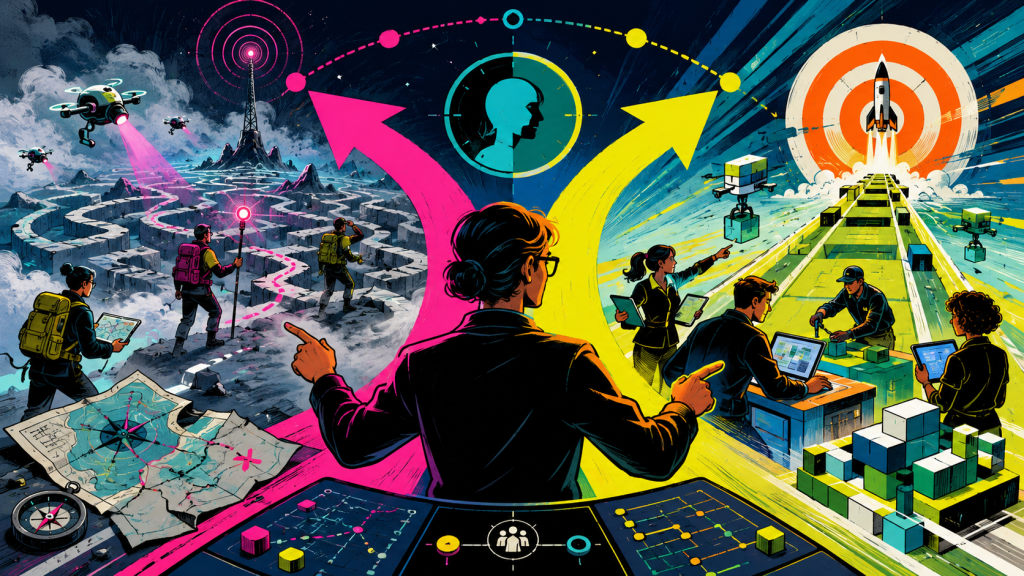
From Waterfall to Agile to Agents to Probabilistic Engineering
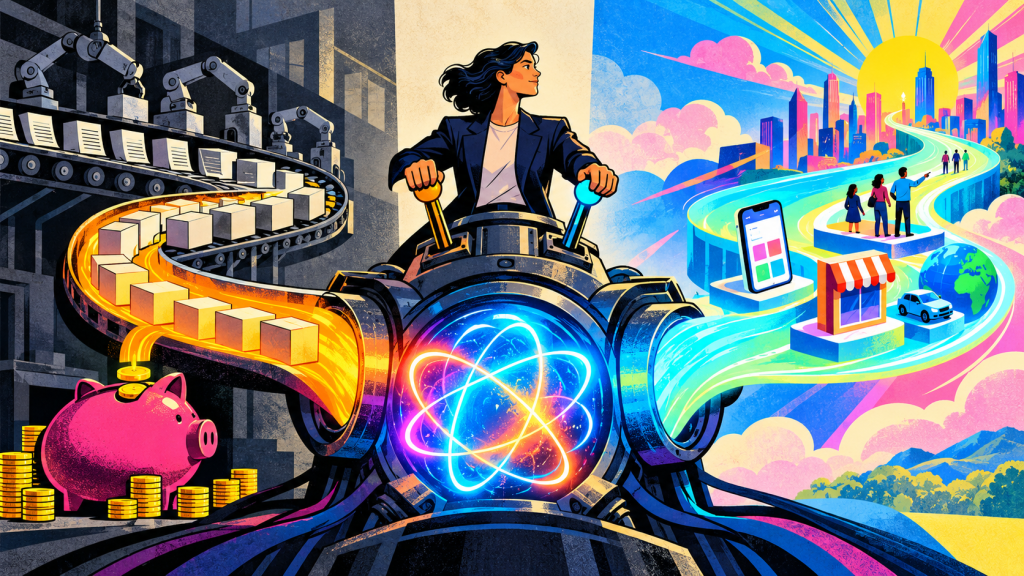
For fifty years, engineering methodologies organized humans. The next era of engineering architectures will organize different forms of intelligence. That changes what an engineering organization is, and it changes what a CEO should expect from the person who runs one.
Software engineering has spent most of its history trying to answer one question: how do we make building software more predictable? The answer has changed every decade. We standardized the process. Then we shortened it. Then we distributed the people. Then we automated the pipeline. Now we are automating the engineers themselves.
And just as the industry is getting comfortable with agentic engineering, another shift is arriving. A new class of models is introducing a different primitive: not generated code, not generated prose, but probabilistic decisions designed to sit directly inside software. That could be read as one more architecture trend. I think it is bigger than that, and I want to explain why by looking at where we have been.
1970–2000: Make Software Predictable
The early history of enterprise software was a coordination problem. Large systems required large teams, computing was expensive, releases were infrequent, and changing something late was extraordinarily costly. The natural response was planning: requirements, design, implementation, verification, deployment. Winston Royce’s 1970 paper is usually credited with what became Waterfall, though the history is more nuanced than the linear model we remember.
The organizational assumption was clear: reduce uncertainty before construction begins. The engineering organization came to look like an industrial production system. Architects designed, developers built, QA verified, operations deployed. Specialization reduced complexity, process created control, and documentation moved knowledge between specialists.
The scarce resource was engineering capacity, so organizations became very good at allocating it. Then the internet changed the economics.
1995–2010: Move the Work to the People
Software development went global. As communications infrastructure made programming a tradable service, offshoring accelerated through the 1990s, the Y2K cycle pushed it further, and companies steadily moved more sophisticated engineering offshore. The optimization was simple: if engineering capacity is scarce and expensive, distribute it. Offshore, nearshore, global delivery centers, follow-the-sun.
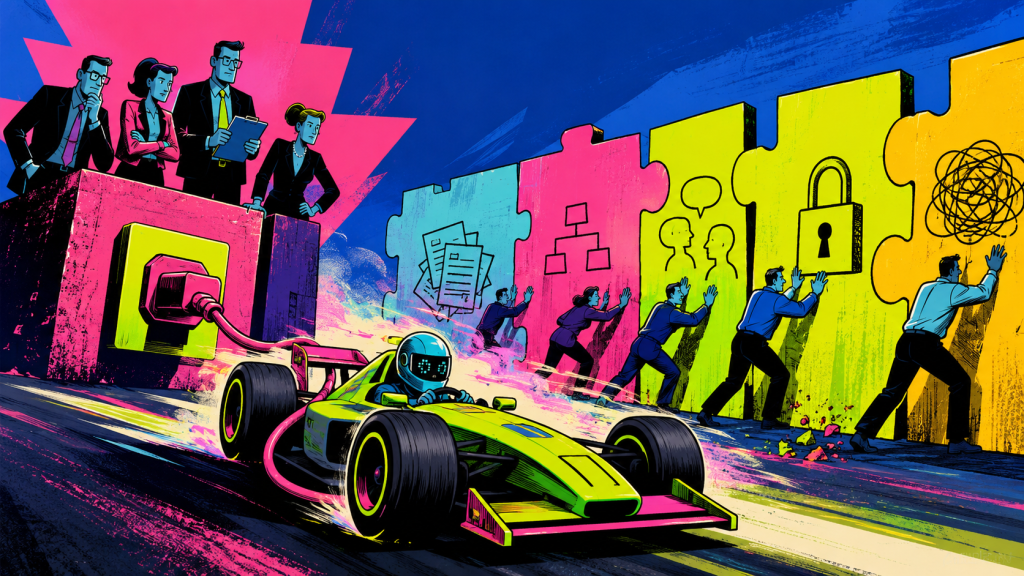
Follow-the-sun took the idea to its conclusion: teams in different time zones handing work to one another in a theoretical 24-hour development cycle. The research eventually confirmed what practitioners already felt. The speed advantage was real, and coordination and handoff costs could erase it.
Hold onto that lesson. It is about to matter again.
2001–2020: Make the Feedback Loop Faster
The Agile Manifesto arrived in 2001 with a different proposition. Working software over comprehensive documentation. Customer collaboration over contract negotiation. Responding to change over following a plan.
The important innovation was not standups, story points, or Jira. Agile reduced the distance between an assumption and the evidence that the assumption was wrong. Waterfall tried to eliminate uncertainty through planning. Agile accepted uncertainty and built faster mechanisms for responding to it.
DevOps, cloud, CI/CD, infrastructure as code, and automated testing then compressed the loop further. A change that once took months to reach production could move from commit to production in minutes. The unit of improvement kept shrinking: annual release, quarterly release, sprint, commit, deployment. The industry was steadily reducing the latency between intent and reality.
Then AI attacked that latency from another direction.
2022–2025: AI Enters the Development Loop
The first generation of generative AI mostly made individual engineers faster. Autocomplete, code generation, documentation, unit tests, refactoring, debugging. The developer still controlled the loop: think, prompt, generate, review, modify, commit. It was a more powerful IDE. Useful, but not a new operating model.
Agents changed that.
2025–2027: The Agentic Era
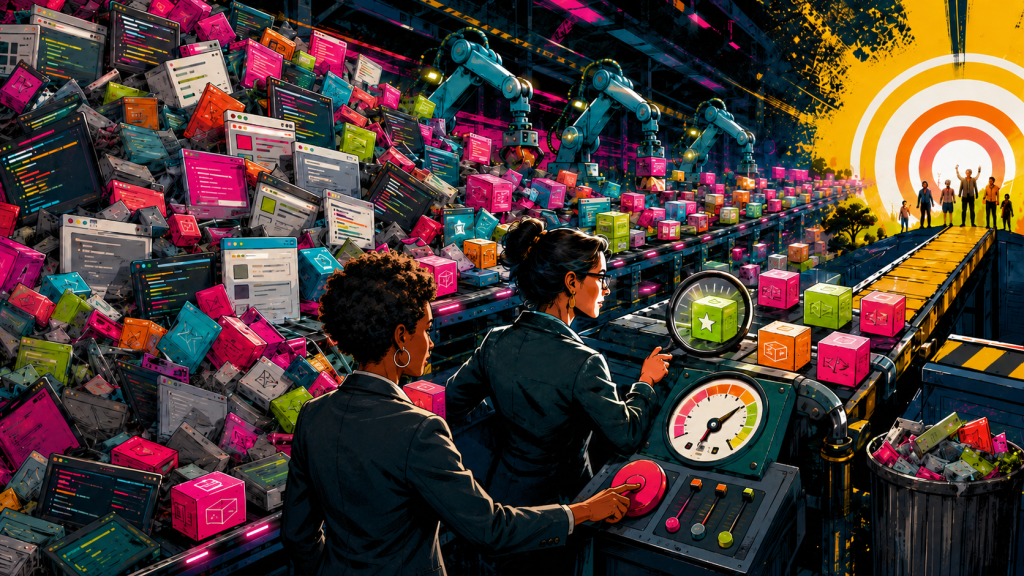
With coding agents, the unit of work shifts again. The engineer no longer requests every transformation. Instead: here is the problem, here is the repository, here are the constraints, solve it. The agent inspects the codebase, forms a plan, modifies multiple files, runs the tests, reads the failures, corrects itself, and prepares a pull request.
That is delegation, not assistance. The major labs now describe this shift the same way: knowledge work moving from individual interactions toward delegated, long-running tasks, with engineers orchestrating several agents in parallel and spending more of their time on architecture and system-level judgment.
I have watched this happen inside my own organization, and it changes something Agile never changed. Agile changed how humans coordinate work. Agents change who performs the work. When one engineer can supervise ten agents, the limiting factor is no longer typing speed or even headcount. It becomes: how effectively can we specify, constrain, observe, and verify machine-generated work?
That is why the discipline of building the harness around the agent, the context, constraints, feedback signals, and verification, is becoming as important as the model itself. The model matters. The system around the model may matter more.
2026–2028: Intelligence Becomes an Engineering Primitive
The newest shift is quieter and, I think, more consequential. Alongside ever-larger generative models, a class of decision models is emerging that answers a different question. Not “generate the answer,” but “given this state, which of these possibilities is most likely?” Unstructured state in, typed probabilistic decisions out: a classification, a score, a confidence, rather than an unrestricted string.
Consider a workflow deciding whether a transaction should proceed. Traditional software says:
if amount > 10000 requireReview()
An LLM-centric architecture effectively asks, in natural language, whether this transaction should be reviewed given everything we know. A probabilistic decision architecture looks like this:
risk = evaluate(transaction)if risk > 0.98 block()else if risk > 0.72 requireReview()else proceed()
The judgment is probabilistic. The policy is deterministic. The execution is deterministic.
That separation matters enormously for an enterprise. The model supplies the judgment; conventional software decides what happens next, and the thresholds, the escalation paths, and the irreversible actions remain in code that can be audited, tested, and explained to a regulator. This is the form in which AI judgment becomes safe to put inside systems that move money, approve claims, and route patients.
2028–2030: The Hybrid Stack
There is a temptation to believe AI eventually replaces conventional software. I think the opposite is more likely. AI will make deterministic software more important. The more probabilistic intelligence we introduce into a system, the more deterministic infrastructure we need around it.
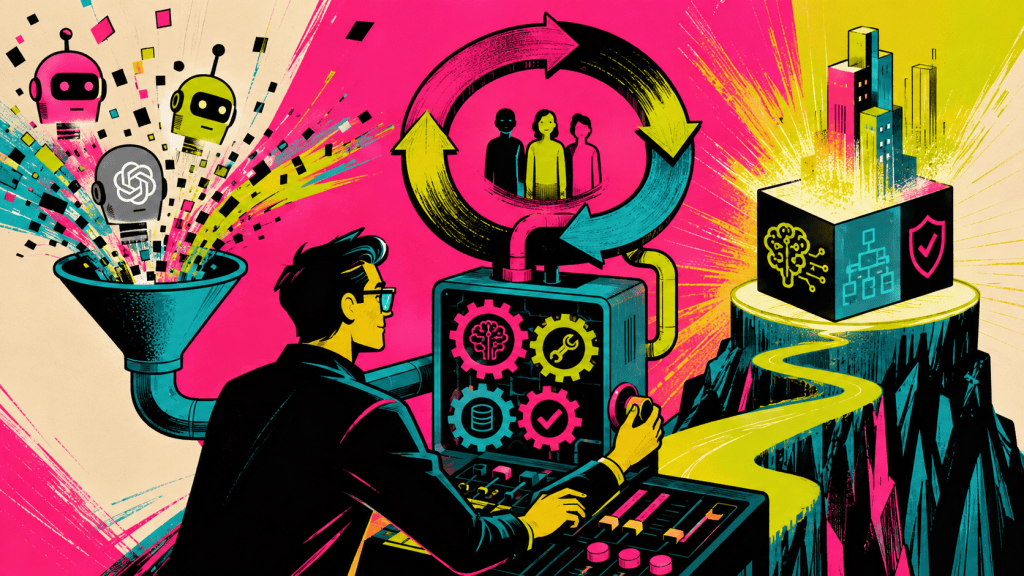
The emerging architecture has four layers, and each owns something different:
- Generative intelligence explores possibilities. LLMs design, reason, write code, synthesize, and work through ambiguous problems.
- Probabilistic intelligence makes bounded judgments. Decision models classify, score, rank, route, and estimate confidence.
- Deterministic software enforces reality. Code controls permissions, financial limits, data integrity, security boundaries, and irreversible actions.
- Humans own intent and accountability. People set objectives, tradeoffs, acceptable risk, and whether the system is producing the outcomes the organization wants.
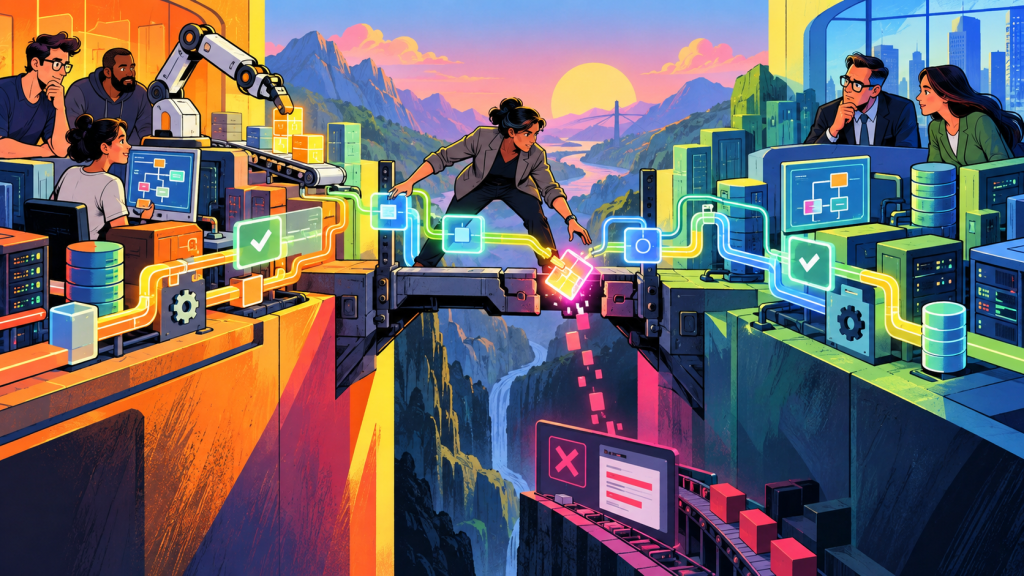
This is not deterministic versus probabilistic engineering. It is an architecture built from both, and deciding where each belongs is becoming the most important engineering skill in the organization.
2030–2035: Engineering Becomes the Design of Decision Systems
The engineering team of 2035 may look as different from today’s Agile squad as today’s cloud organization looks from a 1980s software department.
We will stop organizing primarily around developers producing code. Engineering organizations will design systems that produce, evaluate, and operate software: agents that generate and test, models that score risk, policy engines that decide what may proceed, and humans who intervene where uncertainty, consequence, or novelty crosses a defined threshold.
That is a much bigger transformation than faster coding, and it is the one boards should be planning for.
The Return of Determinism
There is an irony here. The AI era may produce a renaissance in deterministic engineering, not because probabilistic systems failed, but because they succeeded.
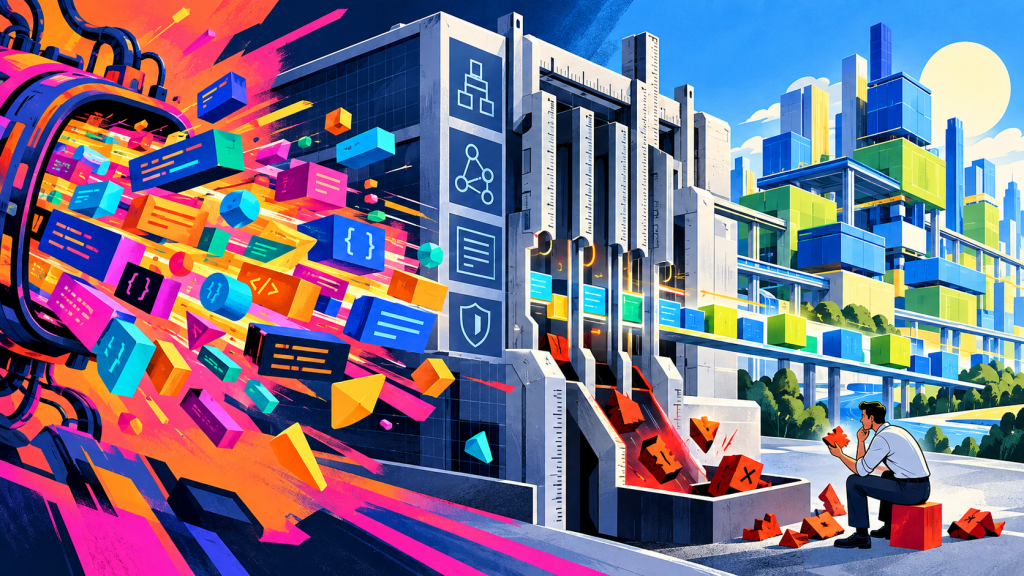
If an agent can produce a hundred times more code, the organization needs dramatically stronger mechanisms for deciding which code should exist. If agents operate continuously, testing must be continuous. If agents change systems autonomously, policy must be machine-readable. If probabilistic models make millions of decisions, confidence thresholds and escalation rules must be explicit. If software changes faster than humans can inspect it, verification cannot depend primarily on humans.
So the unglamorous parts of engineering become more valuable: types, contracts, schemas, tests, policy engines, static analysis, formal verification, permission boundaries, observability, evals, reproducible environments, rollback.
The more nondeterministic software creation becomes, the more deterministic the software factory around it must become. In my experience that is where the real investment is going, and it is the investment least visible to anyone outside engineering.
The Timeline
Seen across sixty years, the pattern is clear. Each era optimized a different scarce resource.
- 1970–2000, Process Engineering. Predictability through planning.
- 1995–2010, Global Engineering. Labor through geography and specialization.
- 2001–2020, Agile Engineering. Learning through shorter feedback loops.
- 2010–2025, DevOps Engineering. Delivery through automation.
- 2022–2026, AI-Assisted Engineering. Individual productivity.
- 2025–2028, Agentic Engineering. Cognitive work through delegation.
- 2026–2030, Probabilistic Engineering. Judgment embedded in software.
- 2028–2035, Hybrid Intelligence Engineering. Code, decisions, reasoning, agents, and humans orchestrated as one production system.
The dates overlap, and that is the point. Waterfall never fully disappeared when Agile arrived. Offshore engineering did not disappear with cloud. Agile did not disappear with DevOps. Traditional coding will not disappear because agents exist, LLMs will not disappear because decision models exist, and deterministic software will certainly not disappear because probabilistic software gets better. Each paradigm becomes another tool in the system.
The New Engineering Question
For decades, engineering leaders asked which methodology to use. Waterfall or Agile. Offshore or onshore. Platform teams or product teams.
The next generation will ask a different question: what form of intelligence should own this decision?
Should it be code? A probabilistic model? A generative model? Should an agent own the workflow, or should several compete? Can the result be verified deterministically? At what confidence does the system escalate? When must a human decide?
Those are architecture questions. Increasingly they are also organizational design questions, and they belong to the technology executive in the same way capital structure belongs to the CFO.
The Engineering Organization Becomes the Harness
Every previous generation of engineering management coordinated people. The next one coordinates people, agents, models, tools, and deterministic systems together.
The scarce resource will no longer be the ability to produce code. Code becomes abundant. So do analysis, experiments, and implementation alternatives. The scarce resource becomes the ability to build a system that chooses well among all of them. That requires architecture, context, constraints, evaluation, feedback, governance, and judgment.
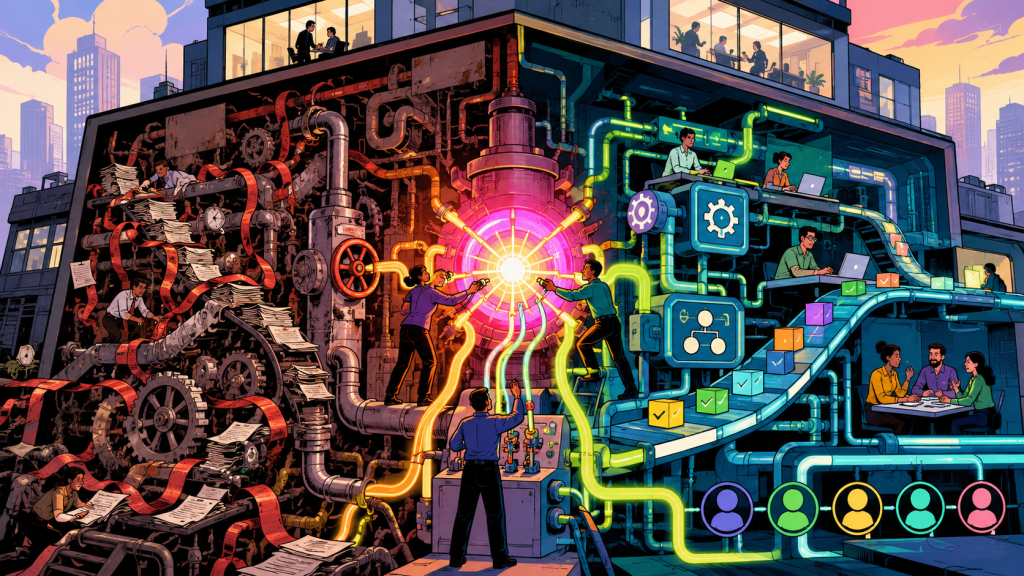
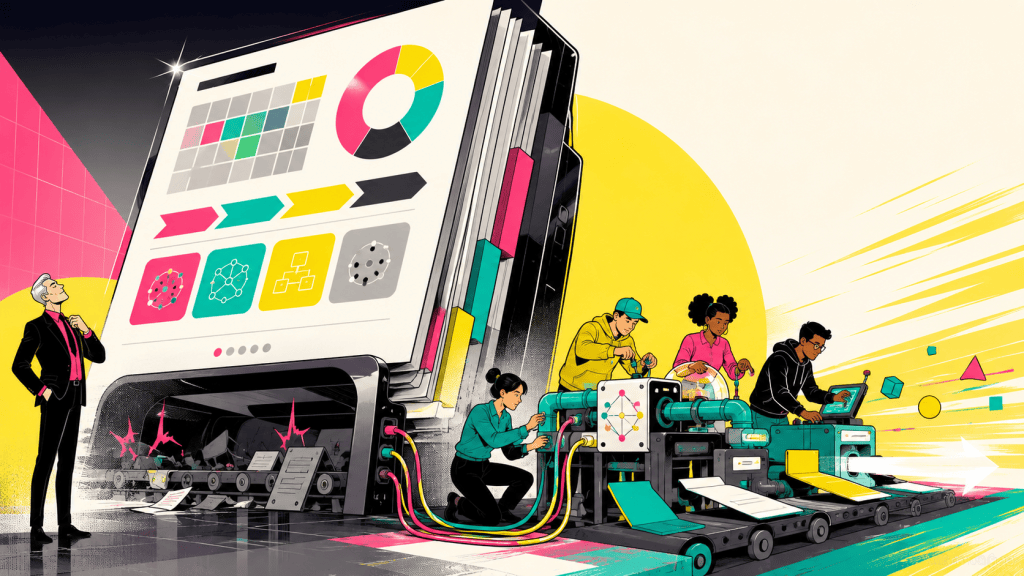
The engineering organization itself starts to resemble the agent harness. It provides context, defines boundaries, delegates work, observes outcomes, evaluates quality, feeds learning back, and decides where autonomy ends.
What This Means for the CEO
If you lead a company rather than an engineering organization, three things follow.
The profile of your technology leader is changing. The job is shifting from running a delivery organization to designing a decision system: deciding which judgments belong to code, which to models, which to agents, and which to people, and being accountable for the boundary. That is an architecture and governance role as much as a management one.
Your governance has to become machine-readable. Risk appetite, approval thresholds, and escalation rules that live in policy documents and committee minutes today will have to live in code and configuration tomorrow, because the systems acting on them will be moving faster than any committee.
The investment case will look unfamiliar. Much of the spend that makes this safe, the evals, policy engines, observability, and verification, produces no feature a customer can see. It is the factory, not the product. Leaders who fund only the visible AI will build the fast, fragile version of this future.
We spent fifty years making humans better at producing software. We may spend the next decade making software better at producing software.
The winners will not be the companies that replace deterministic engineering with probabilistic AI, and they will not be the companies that constrain AI until it behaves like yesterday’s software. They will be the organizations that understand where certainty matters, where uncertainty creates value, and how to engineer the boundary between the two.
The future of software engineering is not deterministic or probabilistic. It is the deliberate architecture of both.