After a decade of digital, cloud, agile, and data transformations, the problem is not AI. It is what we never learned.
Most enterprises are not transforming with AI. They are adopting it, and calling it transformation. Adoption changes the tools. Transformation changes how the business creates, delivers, and captures value. Confusing the two is how a company can put AI in front of every employee and still end the decade with the same operating model, the same economics, and the same competitive position.
Almost every major organization now has an AI transformation strategy. Remarkably few can describe what the business will look like when it is done. We have steering committees, centers of excellence, enterprise copilots, agentic roadmaps, and new executive titles. We measure adoption, training completion, use cases deployed, and hours supposedly recovered.
Ask a more basic question and the room gets quiet: what, exactly, is being transformed? The technology? How people work? The operating model? The customer experience? The economics? Those are different ambitions with different investments and different measures of success, and we put all of them under one convenient label.
I run engineering, the first function where AI agents started doing real work at real scale. That gives me an uncomfortably clear view of the gap between deploying AI and changing a business, and a strong opinion: we are repeating a mistake the last decade should already have taught us. The record is worth looking at honestly.
A Decade of Transformation, Scored
Over the past ten years enterprises ran six overlapping transformation waves. Each had a legitimate goal and many delivered real value. But when you score them on two separate questions, did the change get delivered and adopted? and does the business actually perform differently?, a pattern appears.
Ranked by the value they changed in the business, from most to least:

1. Shared services and ERP: painful to deliver, but it paid. Deloitte found more than half of shared services leaders achieving three or more of their objectives, even as Gartner predicts more than 70% of recent ERP initiatives will not fully meet their original goals. A narrow cost thesis that finance could measure and capture.
2. Agile: changed how teams work, not how the business funds them. BCG found 53% of companies became “truly agile” and hit their targets. The other 47% adopted the ceremonies without the performance.
3. Cloud: the most completely executed wave, with the biggest gap. Accenture found only 37% of enterprises achieving the full value they expected from cloud. The workloads moved; the economics often did not.
4. Data and analytics: platforms built, decisions slow to follow. Wavestone found 43% of firms reporting an established data culture in 2024, up from just 21% a year earlier.
5. Digital: excellent front ends on unchanged operations. BCG found 70% of digital transformations fell short of their objectives.
6. Intelligent automation (RPA): automated tasks inside broken processes. EY saw 30% to 50% of initial RPA projects fail. Brittle, and hard to scale.
The scores are my assessment, anchored on those figures. Reasonable people will move a dot or two. The pattern does not move.
Three lessons stand out.
First, every wave sits below the line. Each was better at changing a capability than at changing the enterprise. A cloud migration could succeed while the application portfolio stayed needlessly complex. Agile could double engineering velocity while business priorities were still funded once a year. Digital could ship a beautiful app on top of the same manual handoffs. The technology changed. The constraints stayed.
Second, the winners had the narrowest, most economic thesis. Shared services did not promise reinvention. It promised a lower cost to serve, with finance at the table to confirm it happened. Digital promised the most and captured the least.
Third, and most important for AI: the easier a technology is to adopt, the wider the gap. Cloud was the easiest wave to execute and has one of the largest gaps, because migrating a workload feels like progress whether or not anything about the business changed. Generative AI is the easiest technology to adopt that enterprises have ever seen. Every employee can use it on day one. That is precisely why it is on track to have the widest gap of all. Gartner’s September 2026 research found only 22% of organizations had scaled AI across multiple business units or adopted an AI-first approach, while 75% of functional leaders were targeting productivity.
The closest precedent for today’s copilot strategies is not cloud or digital. It is RPA, the worst performer on the list. Both automate tasks inside processes nobody redesigned.
The Chief Transformation Officer Paradox
The rise of the Chief Transformation Officer is a clue to what went wrong. By the middle of the last decade, it was clear that the CIO could modernize technology, the COO could improve operations, and the CFO could impose discipline, but nobody owned changing how the whole enterprise worked. By 2016, McKinsey was describing the Chief Transformation Officer as an executive empowered to drive enterprise-wide change and hold leaders accountable for outcomes.
The key distinction: a program office tracks whether initiatives are delivered; a transformation office has to prove the business performs differently. That is the gap in the chart, given an org chart box.
The uncomfortable part is that the role is both a remedy for organizational inertia and evidence of it. Strong transformation leadership is often essential. But if every technology cycle needs another extraordinary program and another office to force change through, the organization never learned how to change. The goal is not to run better transformations. It is to need fewer of them.
AI Is Different, Just Not for the Reasons We Keep Hearing
Previous waves mostly changed the infrastructure, channels, and information flows through which people did work. AI can now do parts of the cognitive work itself: interpret unstructured information, generate work products, reason over context, operate software, and carry out bounded sequences of actions. That reopens design questions every enterprise considered settled. Which activities need human attention? Where should decisions be made? Which handoffs exist only because information could not move on its own?
None of those questions gets answered because an employee received a copilot.
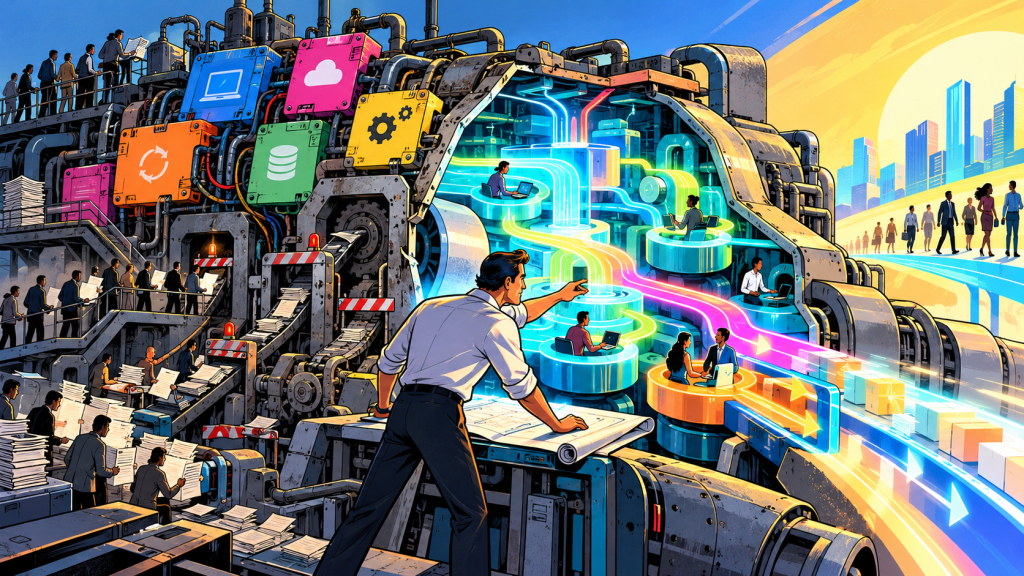
Take a professional services firm. AI cuts the time to review documents and draft a client deliverable from two hours to twenty minutes. Impressive. But the work still passes through five approval stages, waits in the same queues, and reaches the client in the same ten business days. If a deliverable spends ten days in flight and two hours of that is someone working on it, saving 100 minutes changes the client’s experience by almost nothing. In most knowledge work, the work is not the slow part. The waiting is.
Engineering learned this first. When agents made writing code dramatically faster, cycle time did not fall in proportion, because code was never most of the cycle. Reviews, environments, approvals, and coordination were. The teams that saw real gains redesigned the flow. They did not just buy the fastest agent.
Now picture the same firm redesigning the service end to end. AI interprets what comes in, flags missing requirements, prepares next actions, and coordinates routine steps across systems. Professionals focus on exceptions, judgment, relationships, and consequential decisions, with controls that preserve accountability and the ability to intervene. That version can change delivery time, capacity, cost to serve, and potentially the pricing model.
The difference between those two firms is not the sophistication of their AI. It is the ambition of their operating model redesign.
A Definition Executives Can Actually Use
AI transformation is the deliberate redesign of how an enterprise creates, delivers, and captures value, by changing its operating model, decision-making, workforce, and products around what AI can now do.
That definition separates three levels of ambition:
- Productivity. People do existing tasks faster or better. Capacity goes up; the structure is unchanged.
- Operating model redesign. Processes, decision rights, roles, and handoffs change. The business delivers outcomes with different economics, speed, or quality.
- Business reinvention. The company offers products, services, or commercial models that were not previously viable.
All three are legitimate, and a productivity gain with a measurable return is a perfectly good investment. The problem is announcing level three while funding level one. It is the same divide I described in Efficiency AI vs. Opportunity AI: one improves the business you have, the other changes what the business can become.
Time Saved Is Not Value Created
The most expensive assumption in enterprise AI is that time saved equals value created. It does not, not automatically, and in my experience not usually.
Five hours saved per employee per week is potential capacity. Its value depends on what happens next. Do we serve more customers without adding cost? Retire work that no longer needs to exist? Shorten turnaround enough to move retention? Launch something we could not offer before?
If nobody decides, the organization decides for you. Unclaimed capacity does not sit idle; it gets absorbed into more meetings, more polish on internal documents, more features nobody asked for. The hours were real. The value evaporated.
So AI value needs two numbers, not one:
Capacity Created × Capacity Captured = Economic Value
The first is what the technology makes possible. The second is a management decision. Most AI dashboards report the first and assume the second, and because they multiply, a spectacular productivity gain with a near-zero capture rate is worth close to nothing. Capture shows up in cost per transaction, throughput, cycle time, retention, revenue, and margin, not in adoption rates. Getting there forces decisions about staffing, incentives, and pricing, which is why technology and finance leaders need to work far more closely than most do today. BCG’s recent research makes the same point, placing workflow redesign, workforce change, and financial accountability at the center of AI value.
If the economic redesign is not in the plan on day one, it will not show up on day 365.
Two Years In: Stop Piloting, Start Redesigning
Most executive teams do not need a starting plan. They started two years ago. What they need is a course correction, because the typical enterprise AI program now looks exactly like the waves in the chart: broad adoption, a long list of use cases, and very little that has changed in the P&L.
Audit the portfolio honestly. Sort every AI investment into productivity, operating model redesign, or reinvention, and report the capacity captured, not just created. Most companies will find they are 80% to 90% productivity and cannot say where the freed capacity went.
Run the vendor-free test. Ask the executive team to explain the AI strategy without naming a model, vendor, copilot, or agent platform, describing only how the business will operate differently and why that matters commercially. It takes about ten minutes to learn whether you have a transformation strategy or a deployment roadmap.
Retire the use-case catalog. Redesign a few journeys. A list of three hundred use cases is evidence of activity, not strategy. Pick a small number of end-to-end journeys where redesign could materially move cost, revenue, or customer experience. Baseline elapsed time, not just effort, because the waiting is where the opportunity hides. Then ask how would we design this service if these capabilities had always existed? and do not assume today’s org boundaries or approval chains survive the answer.
Decide what to stop doing. Many approval steps, reconciliations, and coordination roles exist only because systems could not share context. Some safeguards are essential. But making every legacy activity faster while keeping all of them is the RPA mistake at a larger scale.
Give one business executive the outcome. Not sponsorship. Ownership, with the benefit on their scorecard and technology, finance, HR, and risk in support. The CEO sets the ambition, finance validates the economics, and the transformation office orchestrates across boundaries. If AI success belongs to one office, it does not belong to the business.
Kill what does not deliver, and change the rhythm. Treat the AI portfolio like any capital allocation, with economic hypotheses and measured results. And because the technology now moves faster than annual budgets and multi-year programs, revisit outcomes, investment, and workforce plans continuously. That rhythm, not any single program, is the capability that ends the cycle of extraordinary transformations.
Five Questions for the Board
- Can management describe our AI transformation without naming a single vendor or tool?
- What share of our AI investment is productivity, operating model redesign, and reinvention?
- Of the capacity AI has already created, how much have we captured, and where did it go?
- Which end-to-end journey works measurably differently today than it did a year ago?
- Who owns the outcome, and what have we stopped funding because it did not deliver?
The Real Transformation May Be Leadership
We are asking increasingly capable technology to operate inside management structures designed for a far less adaptable world. Functions optimize their own budgets. Workforce plans follow historical job definitions. Governance assumes work flows through predetermined human approval chains. Then we introduce AI and expect transformational results without touching any of it.
The hardest part of AI transformation is not deciding what machines can do. It is deciding what leaders are willing to change because of it.
A company can deploy AI to fifty thousand employees and transform nothing. A focused redesign of one high-value journey can be genuinely transformational if it durably changes how value is created and captured. The measure is not how much the technology changes. It is how much the enterprise changes because of it.
Six waves in ten years have shown us what happens when we confuse the two. The most valuable outcome of the AI era may not be a seventh transformation program. It may be enterprises that no longer need an extraordinary intervention every time the technology moves.
So the question for every CEO and board is no longer whether the organization is adopting AI. It is whether they are prepared to redesign the business around what AI now makes possible.
Because if the operating model, the economics, and the customer value proposition all stay the same, we have not transformed the enterprise.
We have simply given the old one better tools.