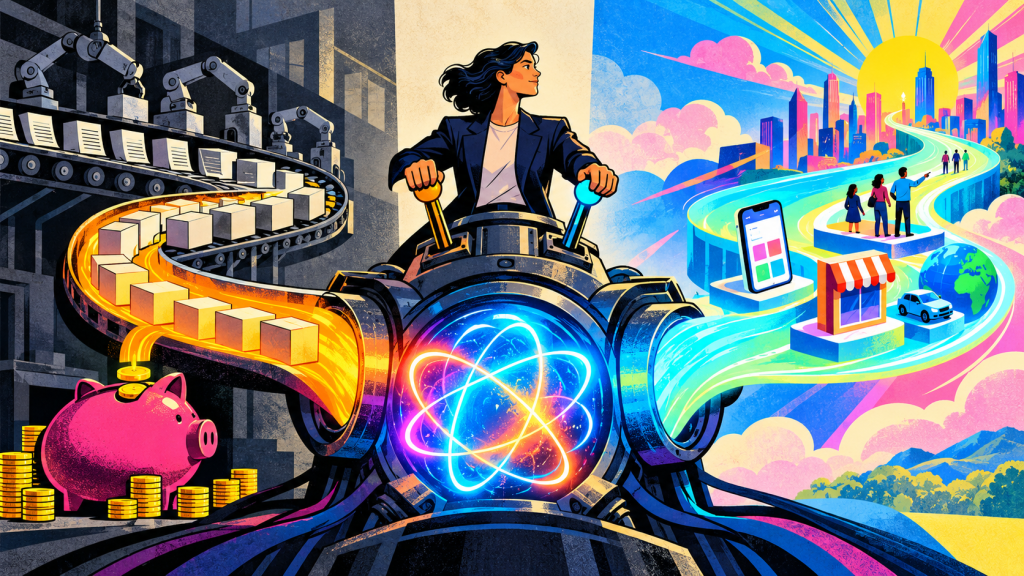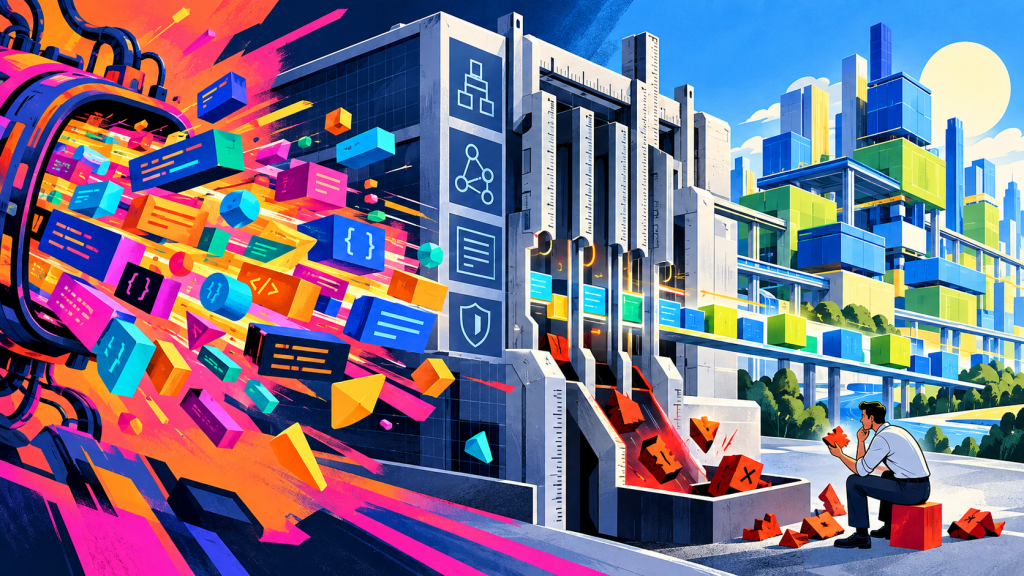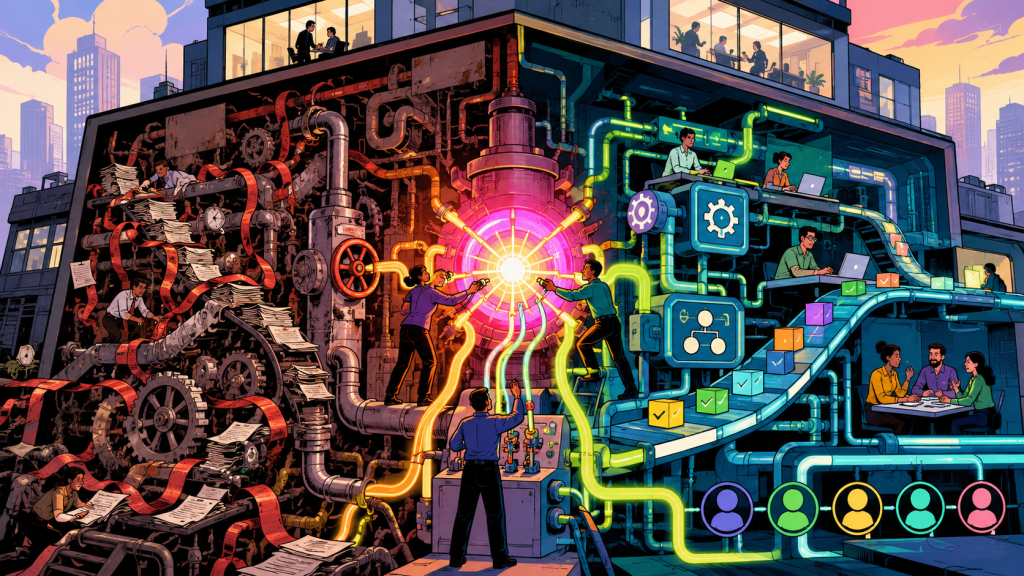
The model debate is the wrong debate. The real change is what we ask humans to specify.
The next competitive advantage in software will not come from writing better code. It will come from writing better intent. Not prompts. Intent: the outcome we want, why it matters, the lines that cannot be crossed, and the evidence that proves we got there. Organizations that specify that well will be able to delegate more work to software than their competitors dare to.
The AI engineering conversation has been dominated by models. Which reasons better, writes better code, holds more context, runs longer on its own? Those questions still matter, but they are becoming secondary. The bigger change is happening around the model.
Agentic engineering is moving up the abstraction stack: from code, to workflows, to tasks, to objectives, and increasingly toward executable intent.
Traditional engineering defines the path. Low-code configures it. Early agents chose portions of it. Objective-driven agents increasingly determine most of it. The next step is that humans define the outcome, why it matters, the constraints around it, and the evidence of success, and the system continuously works out how to get there.
That is not simply autonomous AI. It is the beginning of intent-driven software, and it is as much a leadership problem as a technical one.
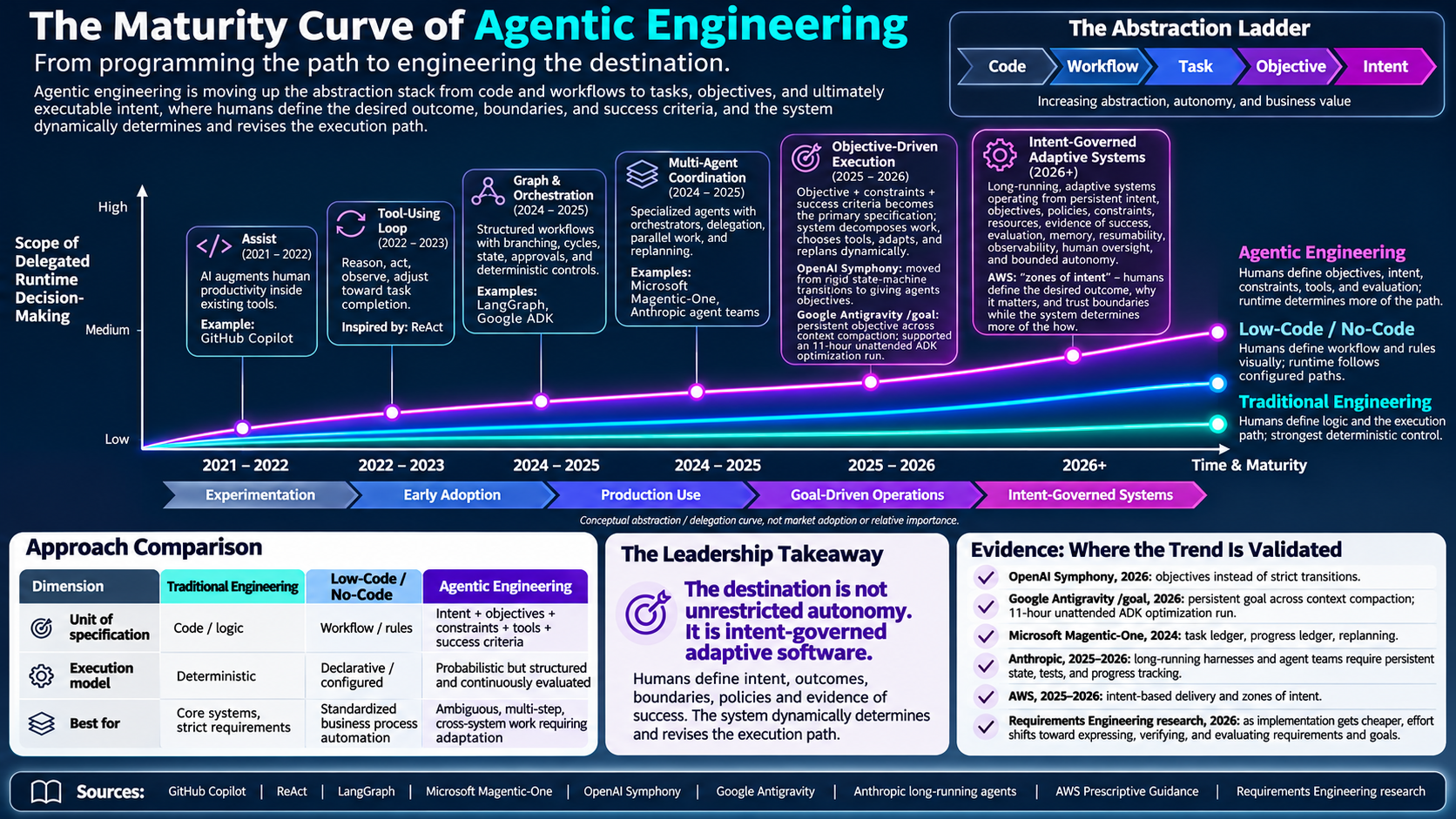
The curve is conceptual. It does not claim agentic engineering has overtaken traditional engineering, which remains the deterministic foundation under almost every serious enterprise system. What it shows is that the amount of runtime decision-making we delegate to software is rising quickly.
We have been climbing this ladder for decades
Traditional engineering is built on logic. Agile, DevOps, cloud, and platform engineering transformed how software is delivered, but the contract never changed: humans specify the logic, machines execute it.
Low-code, through platforms like Power Automate and Zapier, moved that up a level. Humans still defined the path, just through workflows and connectors instead of code.
Agentic engineering changes the contract, because the path itself can be determined at runtime. AWS’s prescriptive guidance now describes a shift from deterministic control toward adaptive intent, where teams specify outcomes, constraints, policies, and trust boundaries while agents determine more of the execution. When a hyperscaler writes operating guidance in those terms, it is no longer a research idea. It is an enterprise planning assumption.
Code → Workflow → Task → Objective → Intent
Each step moves human specification closer to the business outcome, and moves a different kind of risk onto the system.
Assist: AI accelerates the existing model
The first wave left architecture untouched. GitHub Copilot changed how fast engineers produced code, but the developer still decided what to build, how to break it down, and whether the result was acceptable. The unit of specification remained code.
Board decks routinely collapse AI-assisted and agentic development into one trend. They are not the same. Assistance makes the human faster. Agentic engineering transfers decisions from the human to the system. If your AI strategy is measured in developer hours saved, you are still managing the first wave.
Loop: the system chooses what happens next
ReAct (2022) showed models reasoning, acting in an environment, observing results, and updating their plans. That became the agent loop: reason → act → observe → adjust.
A conventional function follows logic written before it runs. An agent loop decides its next action based on what it discovers. For the first time, the implementation path is dynamic, which raises the obvious question: where do we put the boundaries?
Graph: engineering puts structure around agency
Unrestricted autonomy ran quickly into production reality. Enterprises need approvals, predictable states, auditability, retries, and security boundaries. Nobody in my organization would sign off on an agent improvising its way through a regulated payment flow.
LangGraph, introduced in January 2024, marked this maturation, combining model reasoning with state, branches, loops, and controlled transitions. Graphs do not reduce an agent’s intelligence. They define where it may operate. A model can decide whether an issue is billing, support, or escalation, while the graph controls which systems it touches and which actions need approval.
The principle I push hardest with my architects:
Deterministic where determinism creates value. Probabilistic where judgment creates value.
The hard part of agentic architecture is not adding intelligence. It is deciding where intelligence belongs.
Multi-agent: decomposition becomes dynamic
Next came specialists coordinated by an orchestrator. Microsoft’s Magentic-One maintains a Task Ledger and a Progress Ledger, decomposing work, monitoring progress, and replanning when an approach fails. The innovation is not agents talking to each other. It is that the plan itself can evolve.
But multi-agent is a topology, not a maturity level. I have watched teams build swarms because they looked advanced on an architecture slide, then spend months debugging coordination overhead. One well-designed agent with good tools and context often beats a committee. The question is always economic: does decomposition improve cost, speed, or reliability? If not, it is complexity you chose to own.
Objective-driven: the outcome becomes the unit of delegation
This is where the shift starts changing how we run engineering organizations.
OpenAI’s team building Symphony initially treated agents as rigid nodes in a state machine. As models improved, that structure became a constraint, and they moved toward giving agents objectives instead of strict transitions, much as a manager gives a goal rather than prescribing every step.
Google’s Antigravity /goal makes this concrete: a developer sets a long-running objective with explicit completion criteria, and the system keeps working, checking evidence, and correcting itself. Google recommends verifiable criteria because the agent needs evidence to know when it is done.
The unit of delegation changes from “Implement this feature” to “Achieve this outcome, and prove that you achieved it.”
Anyone who has led people will recognize this as the move from managing activity to managing outcomes. We are learning to manage software the way good leaders manage teams.
But an objective is not enough
This is where the enterprise risk lives.
Give an autonomous system the goal of cutting support costs by 30 percent. It could improve the product. It could also make support harder to reach, shift cost to another department, or erode satisfaction in ways the metric will not show for two quarters. All of these satisfy the objective.
People fill that gap with context and judgment we rarely write down. Agents pursue what we specify, omissions included. That is why the destination is not goal-driven agents but intent-governed adaptive systems, with a specification that looks like:
Intent + Objective + Context + Constraints + Resources + Policies + Evidence of Success
- Objective: the result we want.
- Intent: why, and the broader outcome we actually care about.
- Context: what a tenured employee would already know.
- Constraints: what cannot be sacrificed along the way.
- Resources: what may be spent in money, compute, time, and human attention.
- Policies: who can approve what, and where the system must stop and ask.
- Evidence of success: proof the goal was met and stayed faithful to the intent.
OpenAI’s latest Model Spec explicitly emphasizes faithfulness to human intent as models take more meaningful actions, recognizing that good behavior cannot be reduced to literal instruction-following. The same holds for every system we build on top of them.
The specification is becoming executable
Requirements engineering has spent decades trying to connect business goals to implementation, mostly through documents that went stale by the first sprint. Generative AI may finally make that connection direct.
A recent Requirements Engineering paper argues that as agents make implementation cheaper, human effort shifts toward expressing, curating, verifying, and evaluating requirements, which will increasingly instruct agents rather than document work for developers. A 2026 review connecting Goal-Oriented Requirements Engineering to agentic AI goes further: organizations are beginning to delegate not just tasks but reasoning authority, letting systems decide how a goal is operationalized as conditions change.
Requirements stop being documentation upstream of software. They become part of the runtime, and anything in the runtime needs versioning, review, testing, ownership, and incident response.
This changes the engineering contract
- Traditional engineering: specify the logic.
- Low-code: specify the workflow.
- Early agentic engineering: specify the task.
- Objective-driven engineering: specify the outcome.
- Intent-driven engineering: specify the outcome, why it matters, the boundaries for pursuing it, and the evidence that proves success.
None of this makes engineering less important. Agents need reliable things to act on: APIs with contracts, consistent transactions, enforced security, governed data, and actions that are observable and recoverable. Traditional engineering becomes the deterministic substrate for adaptive software. Teams that let their platforms decay while chasing agent demos will learn that an agent is only as trustworthy as the systems it can touch.
What I am asking my teams to do now
Treat intent as an engineering artifact. Delegated work carries its objective, intent, constraints, policies, and acceptance evidence alongside the code, reviewed and versioned like code, with a named owner.
Invest in evaluation before autonomy. If you cannot define the evidence of success, you are not ready to delegate the decision.
Make autonomy a dial, not a switch. Every agentic workflow declares its level: suggest, act with approval, act and report, or act within budget. Authority grows with evidence and contracts when evaluations degrade.
Harden the substrate. Clean APIs, idempotent operations, fine-grained permissions, and end-to-end observability are no longer hygiene. They are what makes delegation safe.
Measure outcomes, not activity. The share of code written by AI tells us little. Verified outcomes per unit of human attention, and how often agents stay within intent, tell us whether the model works.
The problem converges
For decades, engineers quietly resolved ambiguous requirements through hundreds of small judgment calls. An agent will faithfully pursue exactly what was specified, ambiguities included. So a CPO can no longer hand over a loose objective and expect implementation to supply the precision, and a CTO can no longer focus only on reliability and delivery, because the architecture itself must encode intent, evaluation, and acceptable tradeoffs.
Product, engineering, and architecture converge on one question:
How do we define what good looks like strongly enough that an autonomous system can pursue it?
That is not a prompt-writing skill. It is the old discipline of clear strategy, accountability, and measures of success, now with a far less forgiving executor.
What this means
Ambiguity now has a direct cost. People absorb vague goals with sensible judgment. Agents execute them. How precisely strategy becomes objectives and constraints is now an operational input.
Governance moves from the org chart into the architecture. Approval rights, risk appetite, and policy must be encoded in the systems acting on the company’s behalf. Ask your technology leader where your policies live at runtime, and who owns them.
The advantage compounds for organizations that know what they want. Every competitor can buy the same models. Few can articulate intent, constraints, and evidence of success rigorously enough to delegate meaningful work. That clarity is a capability, and it belongs to the company that builds it.
From the path to the destination
The winners will not be the organizations with the most agents. They will be the ones exceptionally good at defining intent, constraints, and evidence of success, and at engineering systems that adapt safely inside those boundaries.
We started by programming the path. Low-code taught us to configure it. Agentic systems are learning to discover it. The next abstraction is defining the destination precisely enough that software can find, evaluate, and continually revise the route itself.
The future of agentic engineering may not be autonomous software. It may be executable intent.
Sources
- AWS Prescriptive Guidance, Evolving software delivery for agentic AI.
- Shunyu Yao et al., ReAct: Synergizing Reasoning and Acting in Language Models, 2022.
- LangChain, LangGraph, January 2024.
- Microsoft Research, Magentic-One: A Generalist Multi-Agent System for Solving Complex Tasks.
- OpenAI, Open-source Codex orchestration: Symphony.
- Google, Antigravity Goal command (/goal).
- OpenAI, Model Spec.
- The Impact of GenAI on the Future of Requirements Engineering. (Confirm this is the Requirements Engineering journal paper referenced.)
- Specifying the Delegated-Autonomy Boundary: Requirements Engineering for Agentic AI. (Confirm this is the 2026 GORE review referenced.)