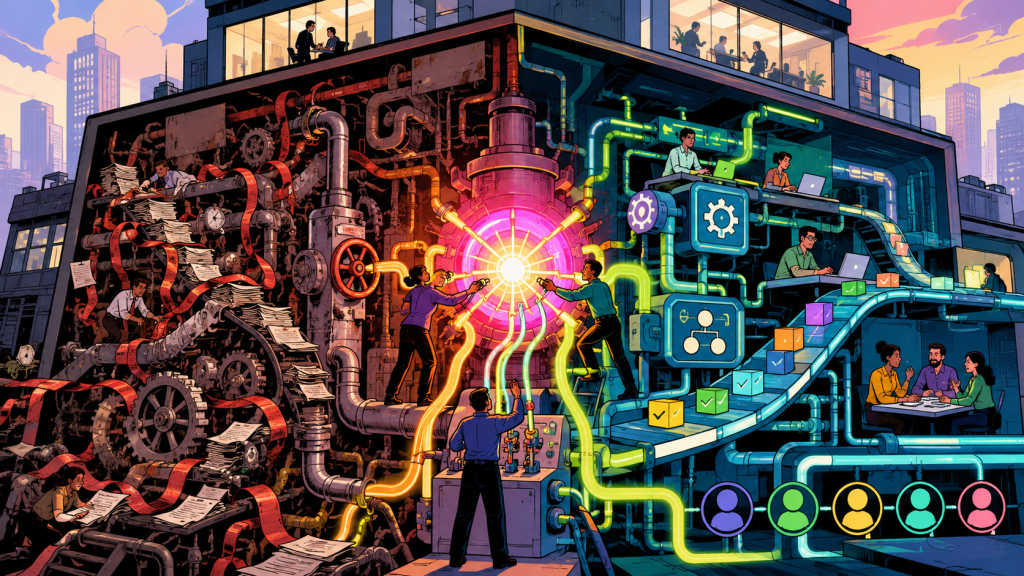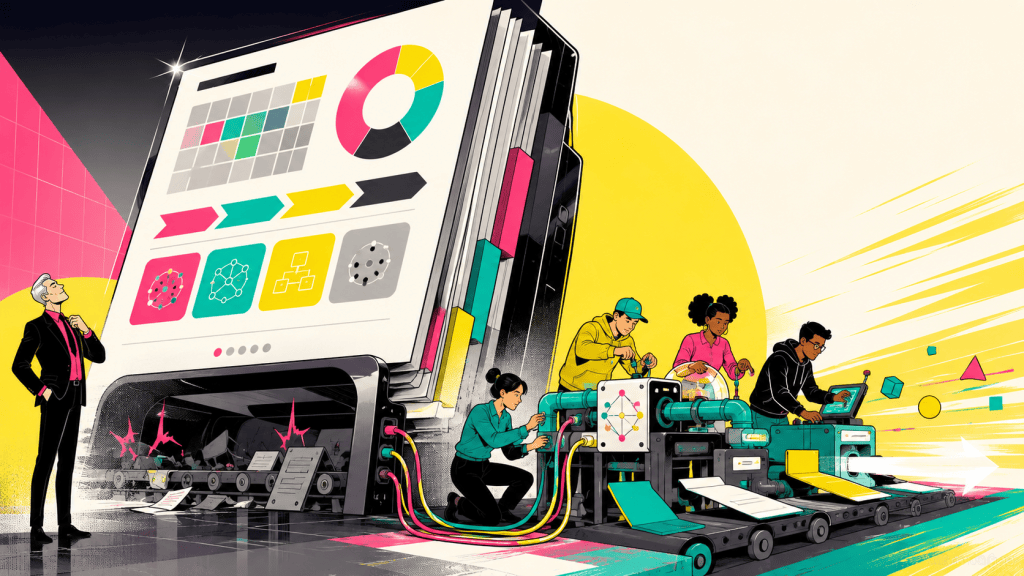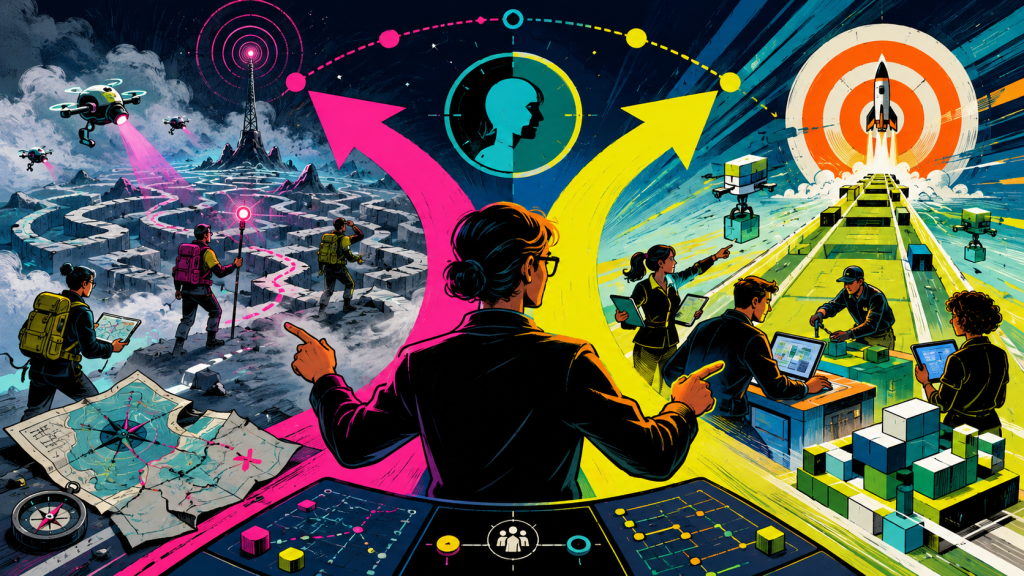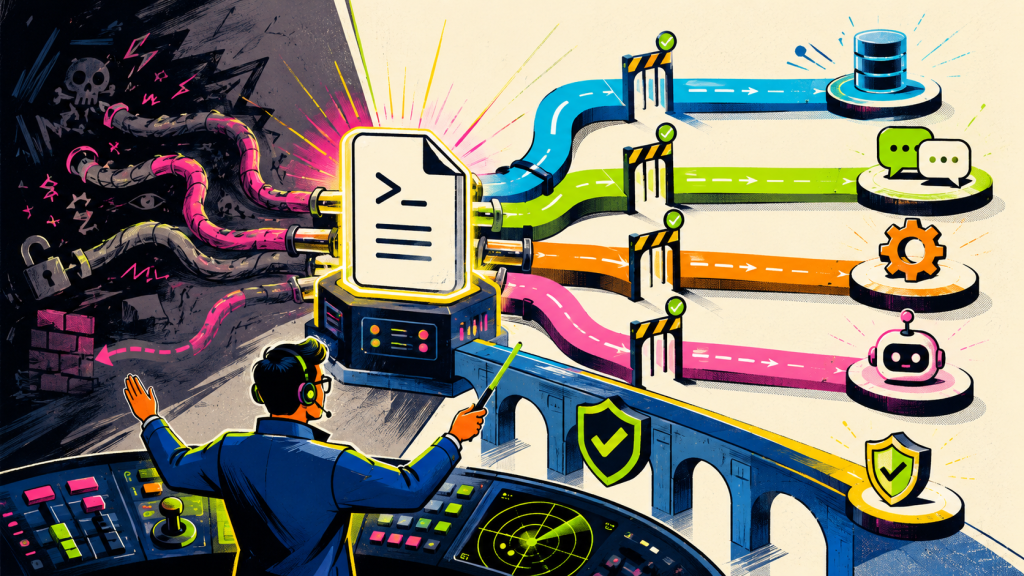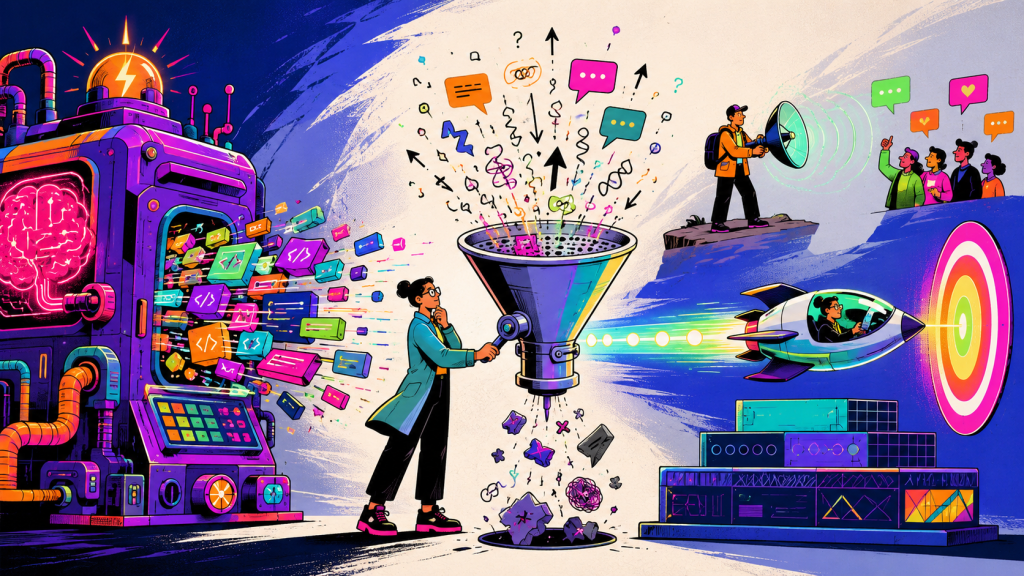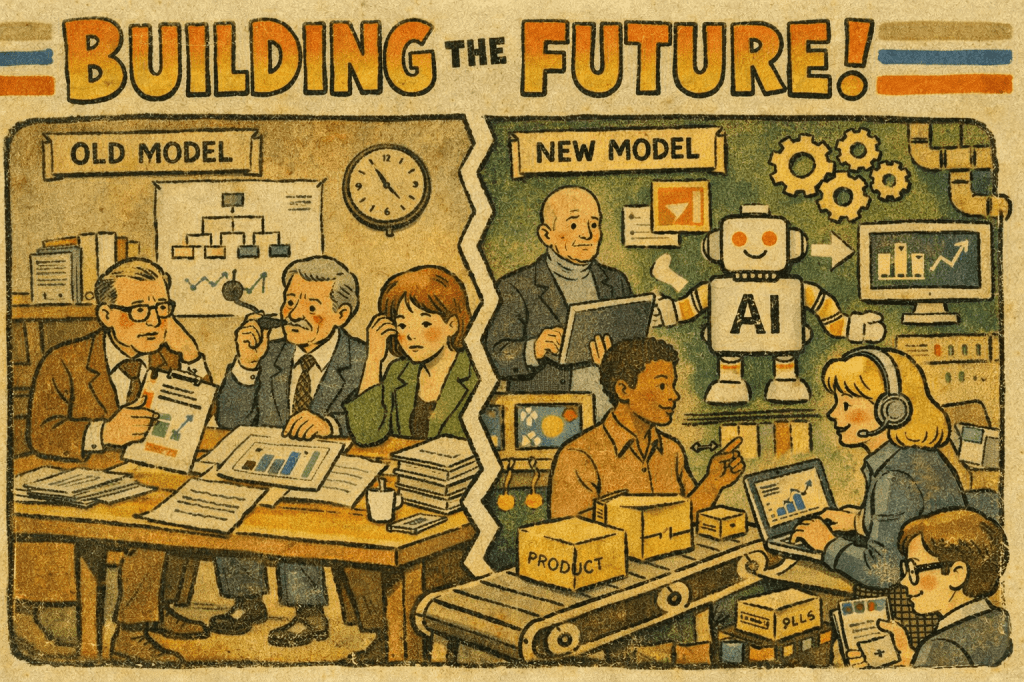
AI is not just automating tasks. It is compressing distance. Distance between strategy and execution. Between a customer signal and a product change. Between a decision and the data behind it. And when distance collapses, the org chart stops behaving like a pyramid and starts behaving like a network.
That is the uncomfortable truth for executives and middle managers: a huge portion of what we have historically called “management” was really information routing. Status aggregation. Risk translation. Permission seeking. Coordination theater. AI eats that layer first, because it is good at turning messy work artifacts into legible updates, options, and drafts. Gartner has been blunt about where this goes: through 2026, a meaningful share of organizations will use AI to flatten structures, eliminating more than half of current middle-management positions. (Gartner)
But here is the part most leaders miss. This does not automatically mean fewer leaders. It means fewer leaders whose primary value is supervising the flow of information. The surviving leaders look different. They run a system, not a spreadsheet.
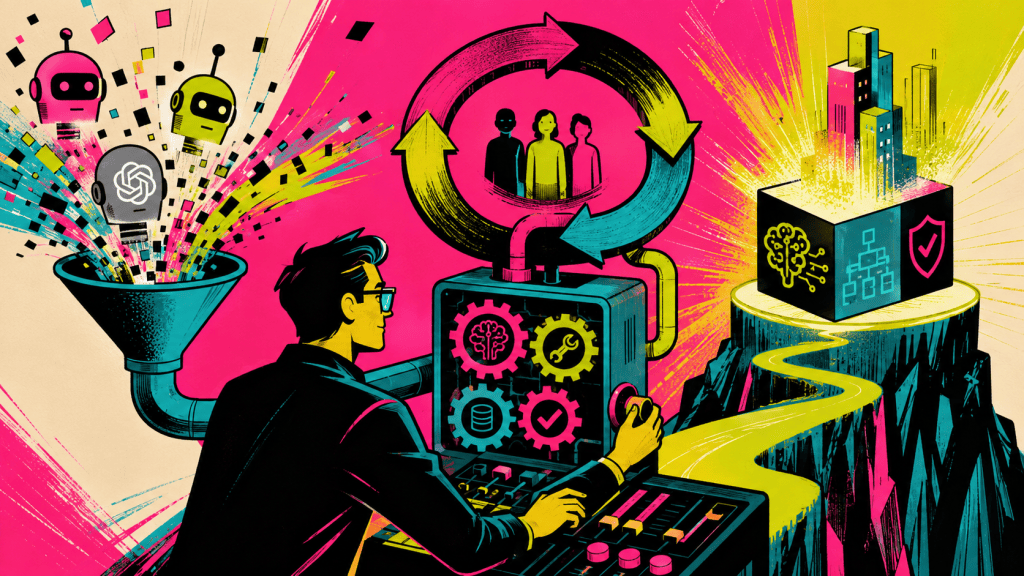
The executive job is shifting from “decide” to “design”
In the old model, executive leverage came from making the call and enforcing alignment. In the AI economy, leverage comes from designing the environment where high-quality calls get made repeatedly without your involvement. That sounds subtle. It is not. It changes what you reward, what you measure, and what you personally spend time doing.
Consider what some CEOs are signaling publicly. Amazon’s CEO told employees that AI-driven efficiency would reduce corporate headcount over the next few years and explicitly framed AI and agents as changing how work gets done. (The Verge) Shopify’s CEO pushed the same idea more operationally: teams should not ask for headcount until they can explain why AI cannot do the work, and AI usage becomes part of how performance is evaluated. (The Verge) These are not just workforce comments. They are operating model declarations.
Executives in this environment are becoming “system designers” across three fronts.
First, they set the constraints that create speed without chaos: decision rights, escalation paths, and the minimal governance needed for safety. In practice, this looks less like quarterly decks and more like clearly defined guardrails for teams and agents: what can be shipped, what must be reviewed, what data is permitted, what failures are acceptable.
Second, they design the instrumentation: what the organization sees, how fast it sees it, and what it does when it sees it. If AI reduces coordination cost, the executive advantage shifts to the company that has the clearest real-time view of customer outcomes, delivery health, and financial impact. AI can generate the narrative. Leaders must ensure the narrative is grounded in reality.
Third, they design capability, not just capacity. “Do we have enough people?” becomes “Do we have enough people who can operate with AI?” That includes AI literacy, but it also includes judgment, product sense, and the ability to work in ambiguous problem spaces where the agent output is only the starting point.
This is why some companies are merging previously separate functions. Moderna’s decision to combine technology and HR under a single leader is a loud signal that “talent strategy” and “technology strategy” are converging into one thing: how work flows through humans and machines together. (The Wall Street Journal)
Middle management is splitting into two species
AI does not eliminate middle management. It forces a split.
One species is the “approval manager.” Their job is to reduce perceived risk through reviews, check-ins, and control. They are already in trouble. When AI can draft the update, generate the plan, create the test cases, and summarize the meeting, the approval manager becomes pure drag unless they are catching real defects or enabling real learning.
The other species is the “multiplier manager.” Their job is to make the team faster, better, and calmer. They create clarity. They coach. They remove friction. They shape quality. They develop people. They are about throughput and maturity, not control.
This is where the conversation about micromanagement becomes more than workplace drama. A career coach told Business Insider that micromanagement often stems from leaders who used to be hands-on technically and never learned to delegate, amplified by job insecurity after layoffs. (Business Insider) That is exactly the psychological trap AI will spring on organizations: when leaders feel threatened, they clamp down. They demand more updates. They insert themselves into execution. They treat AI as a surveillance tool instead of a capability multiplier.
And it backfires.
If you respond to AI-driven uncertainty with tighter control, you will get slower decisions, less ownership, and worse talent outcomes. You will also push the best people to roles and companies where autonomy is real.
The winning middle manager in the AI economy is an operator of a human-plus-agent system. They do not ask, “Did you do the thing?” They ask, “Is the system producing the outcome?” They can run a team where AI generates drafts and code, but humans own the intent, the integration, the risk decisions, and the customer impact.
The new career ladder is not up. It is wider.
Flattening does not just remove layers. It changes what “progress” means.
For a long time, we promoted great engineers and PMs into management because we needed more coordination and more reporting. AI reduces coordination cost, so the default promotion path becomes weaker. Some people will still move into management, but it will be because they can coach and multiply others, not because they can hold the process together.
At the same time, the individual contributor path gets more powerful. When a small team can produce what used to take a larger org, the IC who can pair with AI effectively becomes a force multiplier. Fortune described examples where smaller units oversee AI agents to replace work once done by bigger teams, and framed it as part of the “Great Flattening.” (Fortune) Whether every anecdote holds is less important than the macro trend: output is becoming less correlated with headcount and more correlated with how well you orchestrate tools, agents, and decisions.
This is also why you are seeing “AI-first” posture statements that touch hiring and reviews. Duolingo’s CEO memo talked about phasing out some contractor work in favor of AI and making AI usage part of evaluation. (The Verge) You can disagree with the tone, but the direction is clear: AI capability is moving from “nice to have” to “baseline expectation.”
A hard truth: some layoffs are “AI-washed,” and leaders need to be honest about it
There is a credibility risk here. As AI becomes the fashionable explanation for restructuring, some companies will label ordinary cost cutting as “AI transformation.” The Guardian recently highlighted concerns about “AI-washing” job cuts, with critics arguing that some public claims outpace what the tech can actually deliver today. (The Guardian)
Executives should take that warning seriously. If you oversell AI internally, you create fear and cynicism. If you undersell it, you create complacency and lost advantage. The adult move is to separate three things clearly:
- Automation of repetitive work that is already well-defined.
- Augmentation of high-judgment work where humans remain accountable.
- Genuine product and business model reinvention.
If you cannot explain which bucket you are pursuing, your “AI strategy” is probably a slogan.
What “good management” looks like when AI is everywhere
AI makes the cost of producing artifacts close to zero. You can generate ten versions of a plan, a strategy doc, a roadmap, or a weekly update in minutes. That means the scarce resource is no longer document creation. It is coherence.
So management becomes the craft of coherence.
Executives provide coherence by setting crisp priorities, clarifying decision rights, and funding the systems that make reality visible. Middle managers provide coherence by turning intent into execution: aligning teams on outcomes, maintaining quality bars, and developing people so they can operate with increasing autonomy.
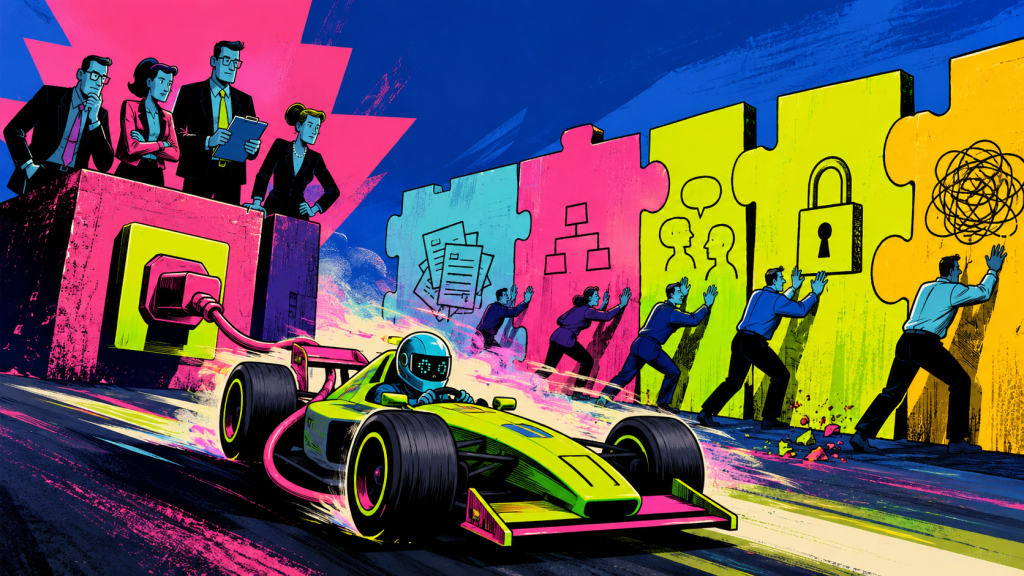
If you want a practical lens, here is the simplest test I have found: when AI increases the speed of output, does your organization’s speed of decision-making increase at the same rate? If not, you are not being transformed by AI. You are being flooded by it.
A few high-leverage moves leaders can make now
You do not need a massive reorg to start. You need new defaults.
- Replace status meetings with operational telemetry. Let AI write the update, but make humans accountable for the metrics and decisions that follow.
- Redefine the manager role around coaching and systems thinking. If the job description still centers on approvals, you are building the wrong layer.
- Make AI usage visible, not performative. Reward outcomes, quality, and learning loops, not “number of prompts.”
- Treat micromanagement as an operational risk. It is not a personality quirk. It is a throughput killer, especially when AI raises the pace of work. (Business Insider)
- Be explicit about where you are actually using AI to remove work versus reinvent work. This is how you avoid AI-washing your own narrative. (The Guardian)
The AI economy is not eliminating leadership. It is removing leadership that exists to manage distance. The leaders who win are the ones who redesign the system so that distance stays collapsed, quality stays high, and people stay motivated.
That is the new job. Design the machine that builds the product, not just the product itself.